The rejection email landed at 7:42 AM. My friend had spent three weeks on that scholarship essay. She’d written about her goals, her grades, her “passion for learning.” It was well-structured, polished, and completely forgettable.
That moment stuck with me, because I had watched her write it. And I knew exactly why it didn’t work.
Writing a winning scholarship essay in 2026 is not about being the most qualified applicant in the pile. It’s about being the most memorable one. Scholarship committees read hundreds of essays. They’re looking for a real person, not a polished brochure.
This guide walks you through what actually works: how to structure your story, what to avoid, and how to make the person reading your essay feel something. These scholarship essay tips come from studying real winners, not from a textbook.
Video Link:
📺 Watch: How to Write a Scholarship Essay Without Using AI That Still Wins (2026)
What the Scholarship Committee Is Actually Looking For
Most students think a scholarship essay is about proving you deserve money. It isn’t. It’s about helping a committee feel confident they’ve found the right person.
Here’s what that actually means in practice: committees are tired of reading essays that start with “Ever since I was young, I dreamed of…” or three paragraphs about a student’s GPA. Those essays blur together. The ones that get remembered usually open with a scene, a problem, or a moment that feels real.
Think of it this way. The reader has been sitting at a desk for four hours. Yours is the 47th essay. What’s the one sentence that makes them put down their coffee and actually pay attention?
That’s the question worth answering before you write a single word.
How to Structure a Winning Scholarship Essay
How to write a scholarship essay that wins: start with the right moment
Don’t start with your goals. Start with a moment that shows why those goals exist.
Bad opening: “I want to study medicine because I care deeply about helping people.”
Better opening: “My grandmother waited eight months for a specialist appointment. By the time she got one, she didn’t need it anymore.”
The second version does something the first one doesn’t. It makes the reader feel the problem. That emotional entry point is what gets an essay remembered. This is the core of how to write a scholarship essay that wins.
Step 1: Pick one specific moment or scene. Not a general theme, not a long backstory. One moment. Where were you? What happened? What did it cost you or teach you?
Step 2: Connect that moment to your goals. Now that the reader is invested in your story, you explain what it made you want to do and why this scholarship helps you do it.
Step 3: Show the match. Do your homework on the scholarship itself. Who funds it? What do they care about? A scholarship funded by a community development organization wants to see how your goals connect back to people, not just your personal career plan.
Step 4: Close with specifics. Not “this scholarship will change my life.” Instead: “This funding would let me complete my final year without working two jobs, which is the only thing standing between me and the research placement I’ve been offered.”
Specific is always more convincing than sincere.
Using Tools the Right Way
A lot of students in 2026 are using AI tools like ChatGPT or Claude to draft scholarship essays. Some scholarship bodies are now screening for this. Even when they aren’t, committee members notice. An AI-drafted essay tends to sound smooth but empty. It covers the right topics in the right order without leaving any fingerprints.
Use Grammarly to catch grammar and flow issues. Use Hemingway App to check your readability score. These tools sharpen what you’ve written. They aren’t a replacement for your actual story.
Your story is the thing that makes this essay worth anything. No tool can generate that.
If you want external resources, the College Essay Guy’s free scholarship essay guide is one of the most practical available, and it’s completely free. For exploring scholarship opportunities themselves, Scholarships.com has a searchable database that’s worth bookmarking.
Common Mistakes That Kill a Good Application
This is where most scholarship essay tips stop being useful, so let’s be direct.
Mistake 1: Writing about your hardship without showing what you did with it.
Committees are not scoring you on how difficult your life has been. They’re looking at what you chose to do next. If you write about a hard experience, it needs to connect to action, growth, or clarity. Pain alone isn’t a narrative.
Mistake 2: Using the same essay for every application.
A scholarship for women in STEM and a scholarship for first-generation students are looking for completely different things. Read the funding body’s mission statement. One paragraph of tailoring can completely change how an essay lands. This is one of the most overlooked scholarship application tips.
Mistake 3: Waiting until the last week.
The first draft is never the essay you submit. You need at least one round of feedback from someone who will actually tell you what’s not working. A teacher, a mentor, a family member who reads widely. Give yourself two weeks minimum.
Mistake 4: Being vague about your plan.
“I want to make a difference” is not a plan. “I want to complete my degree in environmental engineering and work on water infrastructure projects in rural communities” is a plan. The more concrete your next steps, the more credible your application looks.
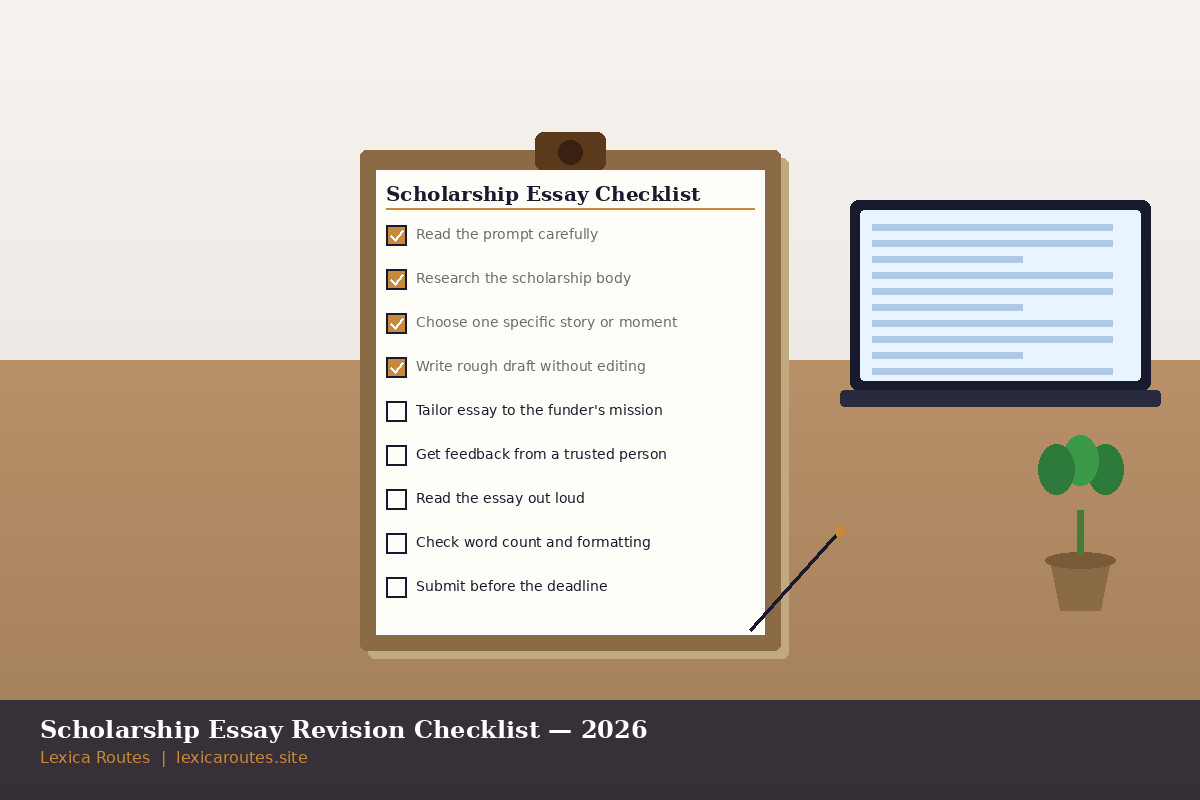
COMPARISON TABLE
Quick-Reference: Scholarship Essay Step-by-Step
| Step | What to Do | Estimated Time |
|---|---|---|
| 1. Read the prompt carefully | Understand exactly what’s being asked. Note any word limits. | 15 minutes |
| 2. Research the scholarship body | Read their mission, values, and past recipients if available. | 30 minutes |
| 3. Choose your moment or story | Pick one specific scene or event that connects to your goals. | 1 hour thinking |
| 4. Write a rough first draft | Don’t edit while you write. Just get it on the page. | 2–3 hours |
| 5. Cut to the word limit | Remove anything that doesn’t serve the story or your case. | 1 hour |
| 6. Get feedback | Ask someone who will be honest, not just encouraging. | 24–48 hours |
| 7. Revise and polish | Address the feedback, check grammar, read aloud. | 1–2 hours |
| 8. Check formatting and submit | Follow submission guidelines exactly. No late entries. | 30 minutes |
FINAL THOUGHTS
A scholarship essay is not a test you pass by being the most qualified. It’s a conversation where you help a committee see you clearly. The students who win are usually not the ones with the highest grades. They’re the ones who gave the reader something real to hold onto.
Start early, pick one specific story, match your goals to the scholarship’s mission, and get honest feedback before you submit. That’s it. There’s no secret framework beyond those four things done well.
If you want to see how winning essays actually read before you write yours, this collection of winning scholarship essay examples from Visa to Campus is worth an hour of your time. And when you’re ready to find scholarships worth applying to, check out our guide to the best fully funded scholarships for international students on Lexica Routes.
Frequently asked questions
How long should a scholarship essay be in 2026?
Most scholarship essays ask for between 250 and 650 words. Always follow the word limit given in the prompt. If no limit is given, aim for 400 to 500 words. Shorter essays that stay focused tend to perform better than long essays that drift. Reviewers notice when a student respects the guidelines.
What should I write about in a scholarship essay?
Write about one specific experience that shaped your goals, not a general overview of your life. The best scholarship essays focus on a single moment, challenge, or turning point, then connect it clearly to what you want to do next and why this particular scholarship helps you get there. Specificity always beats broad statements.
Can I use the same scholarship essay for multiple applications?
You can use the same core story across multiple applications, but you should tailor each essay to the specific scholarship. Read the funding body’s mission and adjust your conclusion and framing so the essay speaks directly to what that organization values. Sending the exact same essay to every scholarship is one of the most common reasons otherwise strong applications are passed over.
How do I make my scholarship essay stand out?
Open with a scene or moment, not a summary of your achievements. Use concrete details. Avoid phrases like “I have always been passionate about” or “this scholarship would mean the world to me.” Show the committee who you are through action and specific context, not adjectives. Read your essay out loud before you submit it. If it sounds rehearsed or stiff, it needs another pass.
Is it okay to mention financial need in a scholarship essay?
Yes, if the scholarship is need-based or if your financial situation is directly relevant to your goals. Be factual and direct rather than dramatic. Committees respond to specifics: “without this funding, I would need to defer my studies for a year” is more effective than a general statement about financial hardship. Always check the prompt first. Some scholarships are merit-based only and don’t want financial context in the essay.
RELATED POSTS
- Best Fully Funded Scholarships for International Students in 2026
- How to Apply for a Student Visa in the UK in 2026: Step-by-Step
- Study in Germany for Free: The 2026 Guide for International Students
Author: Written by the Lexica Routes editorial team, covering travel, education, and study abroad since 2025.