If you have been putting off studying abroad because of tuition costs, Germany might just change everything for you. The country has offered tuition-free education at public universities since 2014, and in 2026, that opportunity still applies to international students from virtually every country in the world. You do not need to be European. You do not need to be wealthy. You just need to know the steps.
This guide walks you through exactly how to study in Germany for free in 2026, covering what “free” actually means, which universities qualify, the costs you still need to plan for, the visa process, and how to strengthen your application before you submit it.
What does “free” actually mean at German universities?
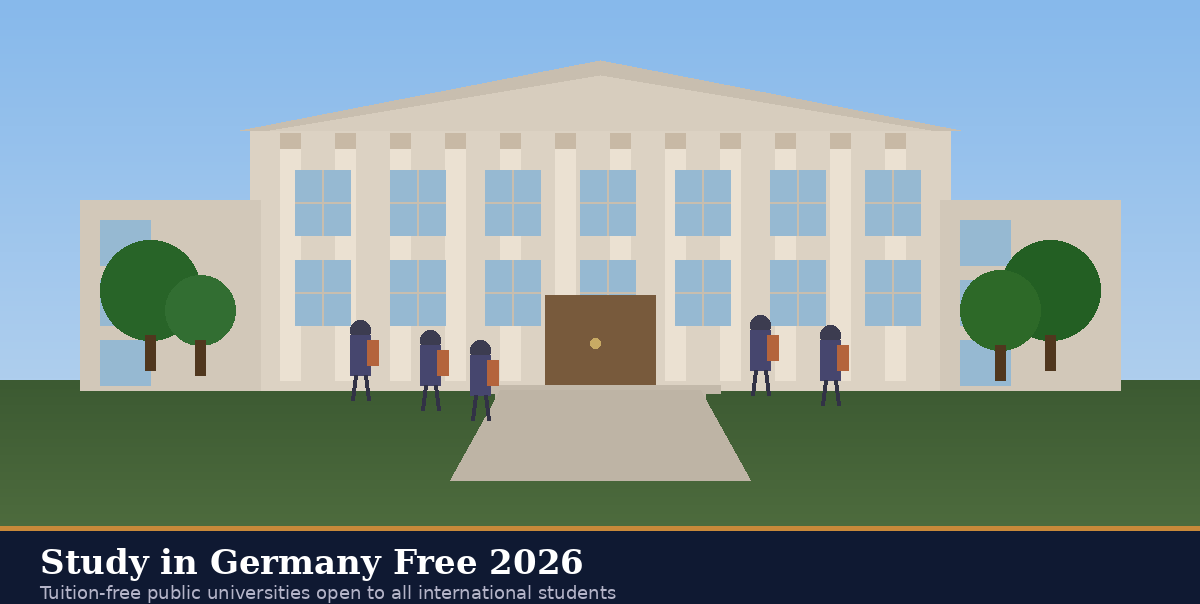
Here is where a lot of students get confused. When people say you can study in Germany for free, they mean there are no tuition fees at public universities. That has been the policy since 2014, when the last German state abolished them. The government funds higher education through taxes, so the cost is not passed on to students, whether they are German or international.
What you will pay is a semester fee, which typically ranges from €100 to €400 every six months. This fee covers administrative services, student union contributions, and in many cities, a free public transport pass for the entire semester. So your “tuition” bill at a place like Ludwig Maximilian University of Munich comes to around €85 per semester. At Humboldt University in Berlin, it is around €315.
There is one exception worth knowing. The state of Baden-Württemberg charges non-EU students a tuition fee of €1,500 per semester. This applies to universities like the Karlsruhe Institute of Technology for non-EU applicants. It is still significantly cheaper than most English-speaking countries, but it is not free.
Private universities in Germany are a different story. Fees at private institutions range from €5,000 to €20,000 per year, and some MBA programs cost considerably more. For the tuition-free route, you want a public university.
What you need before you start
Before you apply to a German university, you need to have a few things sorted. Getting these in order early will save you a significant amount of stress later.
Academic qualifications
German universities require proof that your secondary school qualification is equivalent to the German Abitur. In many cases, you will need to have your documents evaluated through a process called the VPD (Vorprüfungsdokumentation) via the uni-assist platform, which is a centralised application service used by most German universities. If you are applying from India, China, or Vietnam, you will also need an APS certificate from the Academic Evaluation Centre before your visa application can proceed.
Language skills
Many bachelor’s degree programs are taught in German, so you will need to demonstrate German proficiency, usually at the B2 or C1 level, via a recognised test like TestDaF or DSH. However, Germany has significantly expanded its English-taught options. According to DAAD, there are now over 1,300 master’s degree programs in Germany taught entirely in English. If you are applying to one of these, you will typically need an IELTS score of 6.5 or equivalent. Either way, check your specific program requirements, because they vary.
Your finances
Even though tuition is free, Germany requires proof that you can support yourself financially. As of 2026, the figure is €11,904 per year, or €992 per month. The most common way to prove this is through a blocked account (Sperrkonto), where you deposit the funds and can only withdraw a set monthly amount once you arrive. Services like Expatrio and Coracle offer blocked accounts designed specifically for students. DAAD scholarships and the Deutschlandstipendium (which provides €300 per month from private and public sponsors) are also worth checking if you need help covering living expenses.
Step-by-step: how to apply to a German university
Here is the process laid out clearly, from choosing your program to arriving in Germany.
Step 1: Find your program
Start at the DAAD database or MyGermanUniversity.com. You can filter by language of instruction, subject, city, and degree level. There are over 400 public universities in Germany, and the vast majority offer programs at zero tuition cost for all students.
Step 2: Check entry requirements and deadlines
German universities typically have two intakes: winter semester (starting in October, deadline usually July 15) and summer semester (starting in April, deadline usually January 15). Some programs only admit students once a year, so check early. Entry requirements will include your academic records, language scores, and sometimes a motivation letter or portfolio.
Step 3: Apply through uni-assist or directly
Many German universities use the uni-assist platform to process international applications. Some universities handle applications directly through their own portals. Either way, you will need certified copies of your documents, often with official translations into German or English. The uni-assist processing fee is around €75 for the first application and €30 for each additional one.
Step 4: Get your acceptance letter
Once admitted, you will receive a formal letter of acceptance (Zulassungsbescheid). This is the key document for your visa application. Keep several certified copies ready.
Step 5: Open your blocked account and buy health insurance
Open your blocked account and deposit the required funds. You also need proof of health insurance before you can enrol. In Germany, public health insurance (gesetzliche Krankenversicherung) is available to students under 30, typically costing around €110 per month.
Step 6: Apply for your student visa
Non-EU students who need a national visa (D-visa) should apply at their nearest German embassy or consulate. The application fee is €75. You will need your acceptance letter, blocked account confirmation, health insurance proof, academic certificates, passport, passport photos, and a completed application form. Apply at least three months before your intended start date. Processing typically takes around 25 days, though it can take up to three months in some locations.
Step 7: Arrive and register
Within two weeks of arriving in Germany, you must register your address at the local Resident’s Registration Office (Einwohnermeldeamt). After that, you apply for your residence permit at the Alien Registration Office (Ausländerbehörde). Your residence permit is what allows you to stay and study for the duration of your degree.
Common mistakes to avoid
Rushing the visa application is the most common one. Many students underestimate the time it takes to gather certified documents, get translations, process through uni-assist, and then wait for embassy appointments. Start at least six months before your intended arrival.
Ignoring the blocked account requirement is another frequent issue. The funds need to be in place before your visa appointment, not after. Some students also overlook the APS certificate requirement, which is mandatory for applicants from India, China, and Vietnam and can take several weeks to process.
Finally, do not assume that all public universities in Germany are tuition-free for non-EU students. The Baden-Württemberg fee is a real cost to factor in if your preferred university is in that state.
Quick reference: steps and estimated time
| Step | Action | Estimated time |
|---|---|---|
| 1 | Research and select programs | 2 to 4 weeks |
| 2 | Prepare documents and translations | 4 to 6 weeks |
| 3 | Apply via uni-assist or directly | 1 to 3 weeks |
| 4 | Wait for acceptance letter | 4 to 12 weeks |
| 5 | Open blocked account and get insurance | 1 to 2 weeks |
| 6 | Apply for student visa | 4 to 12 weeks |
| 7 | Arrive and register | First 2 weeks in Germany |

VERDICT
Studying in Germany for free in 2026 is genuinely possible, but it takes preparation and patience. The tuition-free policy at public universities is real, and it applies to you regardless of where you are from. What requires planning is everything around it: getting your documents certified, opening a blocked account, securing health insurance, navigating the visa process, and giving yourself enough runway before your semester begins.
Start early, target programs that match your language skills, and use official resources like DAAD to find English-taught options if you are not yet fluent in German. The savings compared to studying in the US, UK, or Australia are enormous, and the quality of education is genuinely world-class.
If you are also weighing up your options, read our guide to the [best study abroad destinations in Europe for 2026] to see how Germany compares to its neighbours.
FAQ SECTION
Is studying in Germany really free for international students in 2026?
At most public universities, yes. Germany abolished tuition fees in 2014, and the policy covers international students from all countries. You will pay a semester fee of €100 to €400, which often includes a public transport pass, but there are no tuition fees on top of that. The exception is the state of Baden-Württemberg, which charges non-EU students €1,500 per semester.
How much money do I need to study in Germany as an international student?
You need to prove financial resources of €11,904 per year (€992 per month) to qualify for a student visa. On top of that, budget for semester fees, health insurance of around €110 per month, and living costs of €850 to €1,200 per month, depending on the city. Berlin, Leipzig, and Dresden tend to be more affordable than Munich or Frankfurt.
Can I study in Germany in English without speaking German?
Yes. Germany has significantly expanded its English-taught programs at the master’s level, with over 1,300 available. However, many bachelor’s programs still require German proficiency at the B2 or C1 level. If you plan to study in German, you will need to pass a recognised language test like TestDaF or DSH before you can enrol.
How long does the German student visa process take?
The standard processing time is around 25 days once your application is submitted, but the full process from start to finish, including gathering documents, getting translations, and booking an embassy appointment, typically takes three to six months. Students from countries like India also need an APS certificate, which adds additional weeks to the process. Apply as early as possible.
Can I work while studying in Germany?
Yes. International students are permitted to work up to 120 full days or 240 half days per year. Part-time work is a practical way to supplement your living costs. After graduating, Germany also offers an 18-month job-search visa to help you find employment in the field you studied.
Author: Written by the Lexica Routes editorial team, covering travel, education, and study abroad since 2025.