My son came home from school one afternoon last year and told me his teacher had asked the class not to use ChatGPT for their history essay. No guidelines, no explanation of why, just a blanket “don’t use it.” He was confused. His classmates were more confused. Half of them had already used it.
That moment stuck with me, because it pointed to something real: schools across Florida were facing the same AI questions without any shared answers. That is changing now.
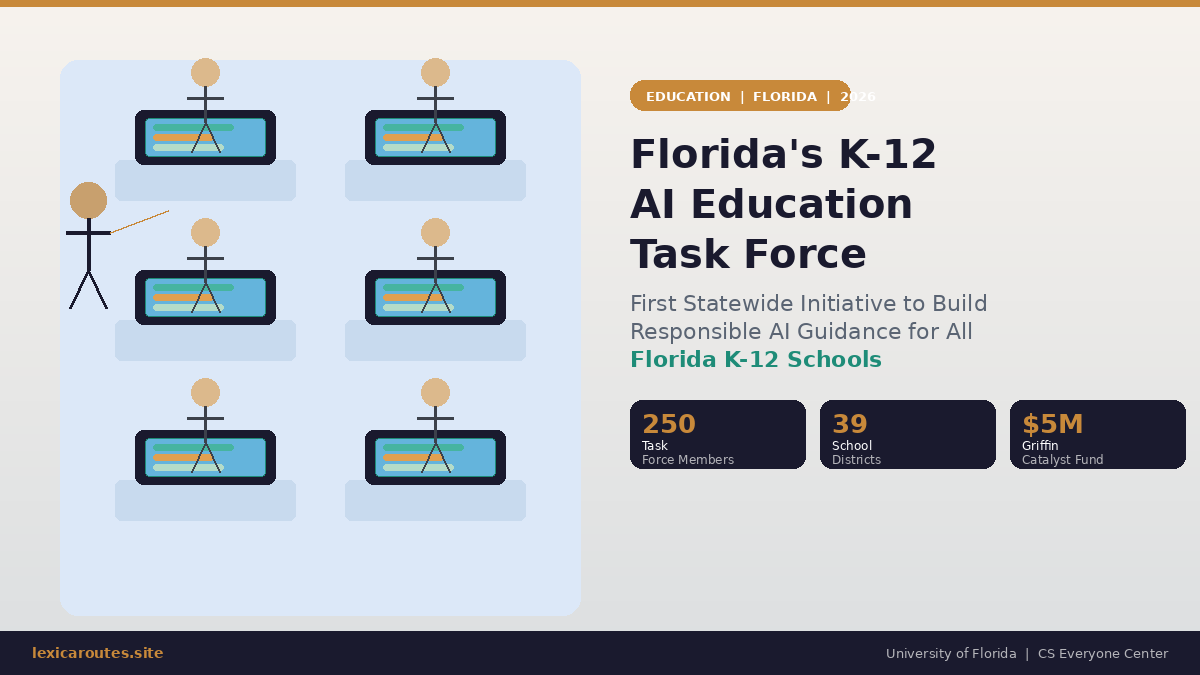
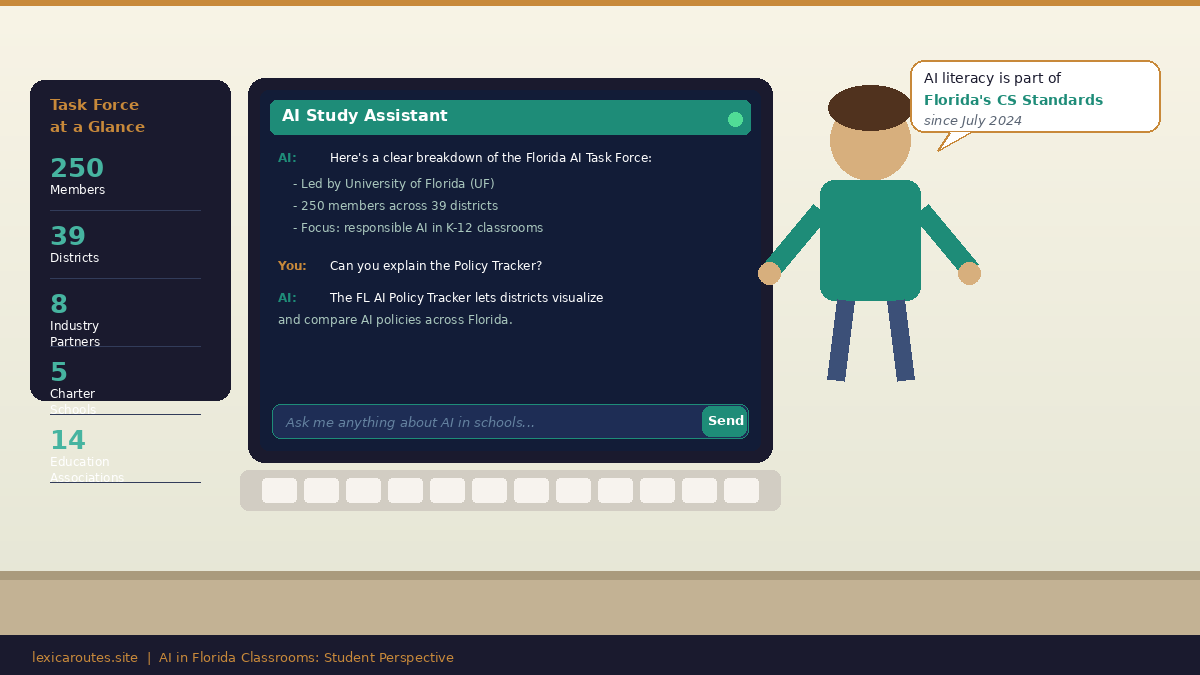
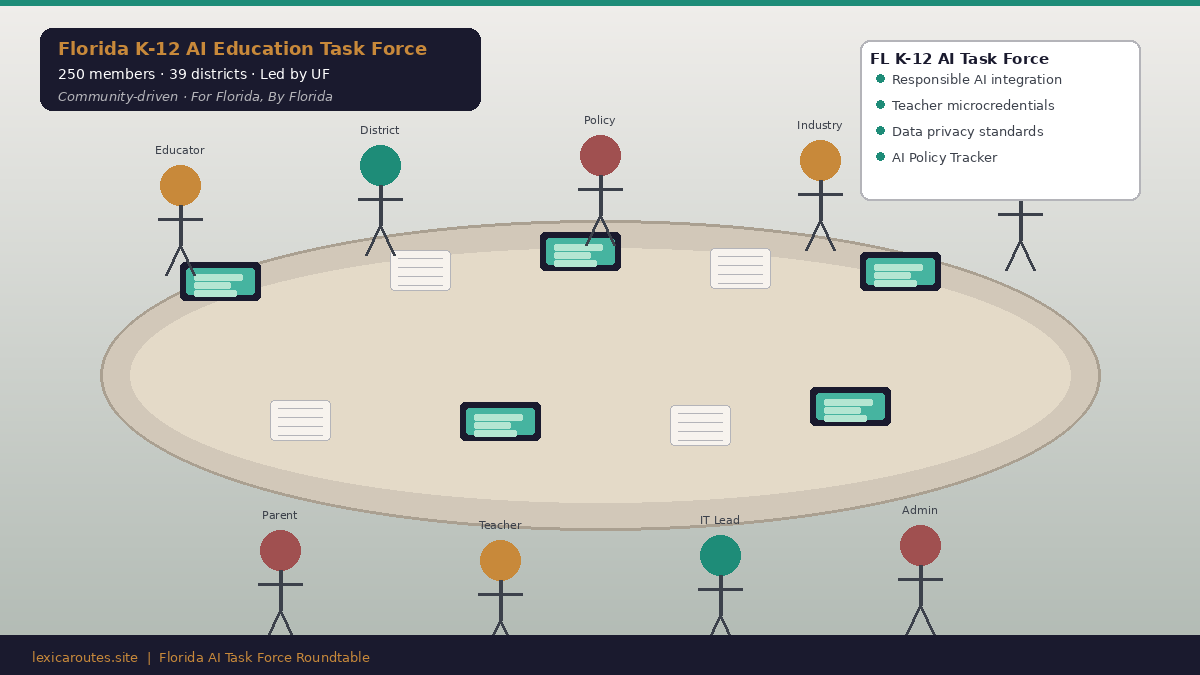
Florida’s K-12 AI Education Task Force is the state’s first coordinated effort to build real, practical guidance around AI in classrooms. Led by the University of Florida, it brings together over 250 members from 39 school districts, charter schools, tech companies, and education associations. This article breaks down what the task force is actually doing, what it means for students and teachers, and why it matters beyond Florida.
What Pushed Florida to Act on AI Education
The pressure did not come from the top down. According to the University of Florida, district leaders actually approached Florida’s commissioner of education in spring 2024 asking for help. They were watching AI tools flood into classrooms with no framework for how to handle them. Some districts were banning everything. Others were letting students use any tool freely. Neither approach was working.
Together, they made a decision that stood out: instead of issuing a state mandate, they built a coalition. The Florida K-12 AI Education Task Force was born from that conversation, and it has been built as a community-driven effort from day one. As Dr. Maya Israel, director of UF’s CS Everyone Center, put it directly: “AI integration is happening rapidly across school districts, and there is little guidance to support these efforts. Our approach of being community-driven, for Florida by Florida, I believe, is unique.”
That framing matters. This is not a top-down policy document handed down from legislators. It is built by the people actually in classrooms.
What the Task Force Is Actually Doing
The task force is developing a comprehensive guidance framework that covers everything from how AI should be taught to how it should be governed at the district level. The work sits across several focus areas.
AI literacy for all students. The guidance prioritizes building broad AI awareness for every K-12 learner, not just students in computer science classes. The goal is for students at every grade level to understand what AI is, how it affects their daily lives, and how to evaluate AI-generated content critically. This ties directly into AI in Florida classrooms more widely, not just in tech courses.
Teacher professional development. One of the most practical pieces of the task force’s work involves stackable microcredentials for teachers. The idea is to give educators, whether they are brand new or have been teaching for twenty years, flexible pathways to build real AI fluency. A college partner is even developing a post-baccalaureate certificate in AI specifically for current teachers.
School and district policy guidance. The task force launched the FL AI Policy Tracker, a live resource that allows districts to visualize and compare AI policies across the state. It is designed so that a district just starting to draft an AI policy can see what 38 other districts are doing. That kind of transparency is something you almost never see in education policy.
Data privacy and cybersecurity. This is the area most parents ask about first, and the task force takes it seriously. The guidance includes specific sections on data protection, student privacy, and responsible vendor management, because bringing AI tools into schools without thinking about data is a real risk.
Why 250 Members From 39 Districts Is a Big Deal
Most state-level education initiatives involve a small committee of administrators writing a report that gets filed somewhere. This task force operates differently.
The 250-member body spans 39 school districts, five charter schools, eight private industry partners including Microsoft, 14 education associations, and five higher education institutions. Industry partner Jennifer Womble, a Microsoft representative involved in the effort, noted that the task force brings together voices rarely heard together in the same room: classroom teachers, IT leaders, parents, school board members, and curriculum specialists.
That breadth is important because AI in education is not a single problem. A high school English teacher dealing with AI-written essays faces a different challenge than an elementary school IT director managing app permissions. The task force structure tries to address both.
What This Means for Teachers Right Now
Here is where it gets practical. If you are a teacher in Florida, the task force guidance is available now at fl-aitaskforce.org. There are AI teaching tips, family-facing resources, and professional development materials that you can use without waiting for your district to roll out a formal program.
The most important shift the task force is pushing for is moving away from blanket AI bans and toward structured, age-appropriate integration. The Computer Science standards in Florida already include AI literacy as of July 2024. The task force is essentially the implementation layer for those standards.
For parents, the task force has also published AI tips specifically for families, because students are using these tools at home whether schools address it or not. Preparing students for an AI-driven world means having those conversations outside the classroom too.
Common Mistakes Schools Are Already Making
The task force’s work highlights a few patterns worth knowing about.
Treating AI as purely a cheating problem. The academic integrity conversation is real, but schools that focus only on detection tools are missing the bigger picture. Teaching students to use AI responsibly is more durable than trying to catch every misuse.
Rolling out tools without IT involvement. Several districts have adopted AI platforms through individual teachers or departments without district-level IT review. That creates real privacy and data security gaps.
Skipping teacher training entirely. Buying an AI tutoring tool and handing it to teachers without professional development is one of the most common mistakes. The task force’s microcredential pathway is specifically designed to close that gap.
Key Facts Summary Box
| What happened | Florida launched the first statewide K-12 AI Education Task Force, organized and chaired by the University of Florida |
| Who is involved | 250 members across 39 districts, 5 charter schools, 8 industry partners, 14 education associations, 5 higher education institutions |
| When it was formed | Spring 2024; guidance published and publicly available from 2025 into 2026 |
| Key funding | $5 million from the Griffin Catalyst (Kenneth C. Griffin) established the CS Everyone Center at UF |
| National recognition | Awarded the 2026 EDSAFE AI Alliance State Policy Lab Torchbearer Award |
| Where to access | fl-aitaskforce.org |
Our take
Florida did something that more states should try: it built an AI education framework from the ground up with the people who actually work in schools, not just the people who govern them. The result is a task force with real credibility, real participation, and real resources behind it.
Is it perfect? Not yet. The guidance is still evolving, and not every district in Florida is moving at the same pace. But the structure is there, and the FL AI Policy Tracker makes it easy to see where your district stands relative to others.
If you are a parent, educator, or administrator outside Florida, this is worth watching closely. The task force has already earned national recognition through the EDSAFE AI Alliance Policy Labs, and other states are taking notes.
Frequently asked questions
What is the Florida K-12 AI Education Task Force?
The Florida K-12 AI Education Task Force is a statewide initiative organized and chaired by the University of Florida. It brings together 250 members including educators, district leaders, tech companies, parent groups, and policymakers to develop practical, research-grounded guidance for integrating AI into Florida classrooms from kindergarten through grade 12.
Which school districts are part of the Florida AI task force?
The task force includes representatives from 39 Florida school districts, along with five charter schools, eight industry partners, 14 education associations, and five higher education institutions. The full membership list is available at fl-aitaskforce.org/team.
How does the Florida K-12 AI task force affect what students learn in school?
The task force is building curriculum guidance tied to Florida’s Computer Science Academic Standards, which were updated in July 2024 to include AI literacy. The goal is for every K-12 student in Florida to develop a foundational understanding of what AI is, how it works, and how to use it responsibly, not just students in computer science electives.
What tools or resources has the Florida AI task force produced for teachers?
The task force has published AI teaching tips, family-facing resources, and a professional development pathway including stackable microcredentials for teachers at every experience level. It has also launched the FL AI Policy Tracker, which allows districts to see and compare AI policies across the state. All resources are freely available at fl-aitaskforce.org.
Is the Florida statewide K-12 AI education task force a government mandate?
No. The task force was deliberately structured as a grassroots, community-driven initiative rather than a top-down state mandate. District leaders approached the state commissioner of education for guidance in spring 2024, and together they chose a collaborative model. Participation is voluntary, and the guidance documents are designed to be flexible rather than prescriptive.
Author: Written by the Lexica Routes editorial team, covering travel, education, and study abroad since 2025.