My younger sister came home from a three-week summer program in Spain the summer before her senior year, and she was a completely different person. Not in a dramatic way, not in a “she found herself” movie montage way. She just talked differently. Asked more questions. Stopped assuming everything had to work exactly the way it did back home.
That was the moment I started paying serious attention to what summer programs abroad for high school students actually do, and whether the price tags attached to most of them are genuinely worth it.
If you’re a student, a parent, or a counselor trying to make sense of the options in 2026, this list is for you. No fluff, no sponsored rankings. Just the programs that consistently produce real results.
What Makes a Summer Program Worth the Cost
Before jumping into the list, it is worth knowing what to actually look for. A high price does not mean a high-quality experience. Some of the most life-changing programs cost a fraction of the flashy ones.
Ask these three things before applying to anything:
- Is there real academic or cultural immersion? Or is it just a tour with a worksheet attached?
- What is the student-to-staff ratio? Programs with 30 students per supervisor are closer to chaperoned tourism than genuine learning.
- Does it offer a language component, homestay, or community project? Those three factors predict whether students actually grow, or just Instagram their way through five cities.
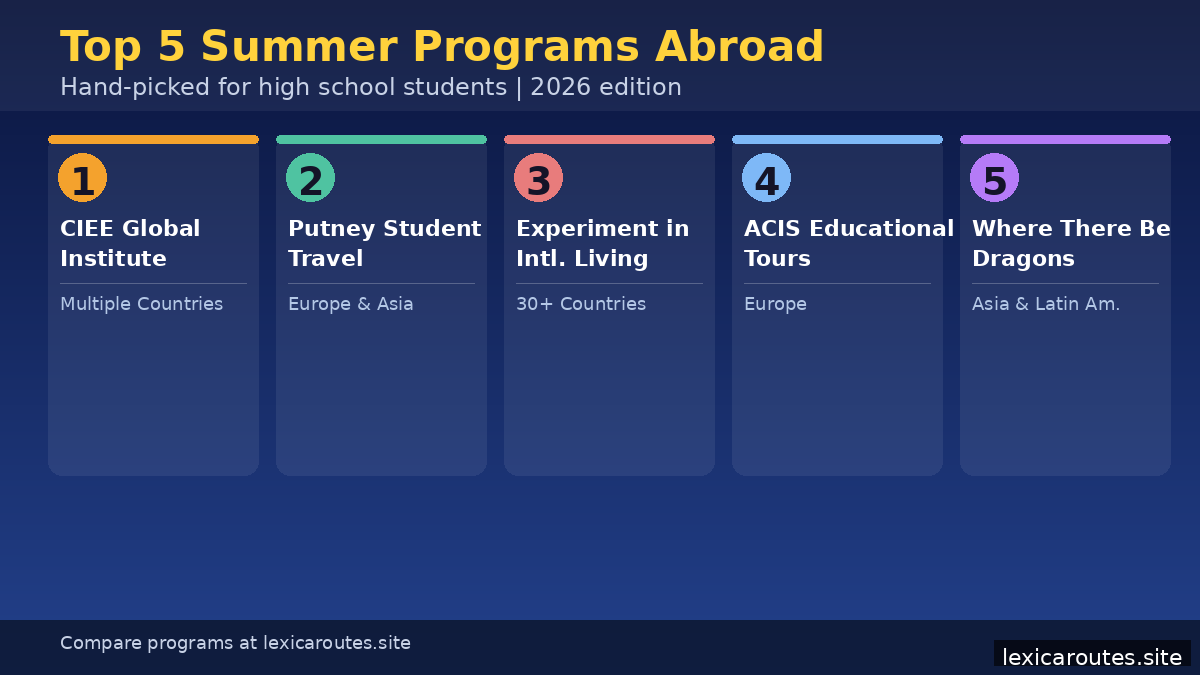
With that framing in mind, here are the seven programs worth looking at seriously in 2026.
The 7 Best Summer Programs Abroad for High School Students in 2026
1. CIEE Global Institute Teen Programs
CIEE (Council on International Educational Exchange) has been running student programs abroad for decades, and their high school offerings have gotten sharper over time. In 2026 they run teen programs across more than 20 countries, including Japan, Morocco, Costa Rica, France, and South Korea.
What separates CIEE from a lot of competitors is the homestay option. Students live with local families, which sounds uncomfortable at first but ends up being where most of the actual learning happens. Language skills spike. Comfort zones stretch. Students from their programs consistently report it as the single thing they remember most.
Costs range from roughly $4,000 to $7,500 depending on location and duration, with financial aid available. You can explore their 2026 teen programs on the CIEE official website.
2. Putney Student Travel
Putney runs small-group programs (14 students maximum) focused on community service, language learning, and adventure travel. Their model is deliberately low-tech and high-contact, meaning students are not glued to their phones navigating apps. They’re actually present.
Programs run across Europe, Asia, and Latin America. A popular 2026 track puts students in Vietnam for language immersion combined with service work at local schools. The group sizes matter a lot here. Smaller cohorts mean more accountability, more meaningful conversations, and less of the herd mentality that can water down international experiences.
3. The Experiment in International Living
This one has been around since 1932, which either sounds reassuring or ancient depending on who you ask. The model has genuinely stood the test of time though. Students are placed directly with host families in their chosen country for the full program duration, with no hotel buffer.
The Experiment runs 2026 programs in more than 30 countries. Their Ecuador program, focused on environmental study and community living in the Amazon Basin, has particularly strong reviews from students and parents. For students serious about language acquisition or social science, this is one of the most academically credible options at the high school level.
Check current availability and pricing through the Experiment in International Living program page.
4. ACIS Educational Tours
ACIS is strong for students who want structured academic content alongside travel. Think guided tours of historical sites with actual context built in, not just “and here’s a famous building, take a photo.” Their European programs are particularly well-organized, with dedicated academic themes like art history, politics, or environmental science woven through the itinerary.
Group sizes are larger than Putney or Experiment, which is a tradeoff. Less intimacy, but more peer interaction across diverse school groups. Works well for students who thrive in structured social environments.
Watch: ACIS student experience video (official overview) gives a clear picture of what a typical program week looks like.
5. Where There Be Dragons
If your student is ready for something genuinely challenging, Dragons is in a different category. Their programs run in remote areas of Asia (Bhutan, Kyrgyzstan, Nepal, Tibet) and Latin America, and they are not comfortable in a resort sense. Students carry their own gear, sleep in basic accommodation, and work through real cultural and ethical questions about travel and inequality.
It is not for everyone. The students who thrive in Dragons programs tend to be self-directed, intellectually curious, and comfortable with ambiguity. The students who struggle are usually those expecting a curated highlight reel. Dragons is honest about this distinction upfront, which is itself a sign of a trustworthy program.
6. AFS Intercultural Programs
AFS has one of the most robust scholarship systems of any international program at the high school level. Their intercultural exchange model places students in local schools abroad, not just in standalone program settings. That context matters: students navigate real bureaucratic systems, attend classes in another language, and build relationships that often last years.
For first-generation students or families on tighter budgets, AFS is one of the most accessible gateways into serious international experience. According to AFS-USA program data, partial and full scholarships are available in 2026 for qualifying applicants.
7. National Security Language Initiative for Youth (NSLI-Y)
This one is fully funded by the U.S. Department of State, which immediately makes it stand out. NSLI-Y sends American high school students abroad to study critical languages including Arabic, Chinese (Mandarin), Hindi, Indonesian, Korean, Persian, Russian, and Swahili.
The competition is real. Acceptance rates are low and the application is thorough. But for motivated students with an interest in language and international affairs, there is no better summer program in terms of depth, structure, and long-term career relevance. Fully funded means zero cost to the family.
Summer Programs Abroad Comparison Table
| Program | Best For | Duration | Approx. Cost | Homestay? |
|---|---|---|---|---|
| CIEE Global Institute | Wide choice, language focus | 3-6 weeks | $4,000-$7,500 | Yes |
| Putney Student Travel | Small groups, service learning | 3-4 weeks | $5,500-$8,000 | No (group housing) |
| Experiment in Intl. Living | Deep cultural immersion | 3-5 weeks | $4,500-$6,500 | Yes |
| ACIS Educational Tours | Structured academic travel | 2-3 weeks | $3,500-$5,500 | No (hotels) |
| Where There Be Dragons | Adventure, critical thinking | 3-6 weeks | $5,000-$9,000 | No (local lodging) |
| AFS Intercultural Programs | School integration, scholarships | 4 weeks-1 year | $2,000-$8,000+ | Yes |
| NSLI-Y (State Dept.) | Language learning, funded | 6-8 weeks | Free (fully funded) | Yes |
Common Mistakes Families Make When Choosing
Picking a program based on the country alone is the most common misstep. The destination matters less than the structure. A poorly run program in Paris will produce less growth than a well-run program in rural Costa Rica.
Also worth noting: starting the application process in September or October for the following summer is not too early. NSLI-Y and Experiment programs regularly fill or close applications before December. Leaving it to March is how students end up disappointed.
Our take
The best summer program abroad for any high school student is the one that actually pushes them. Not the one with the best brochure photos. For students ready for genuine immersion, CIEE and Experiment in International Living are consistently strong. For families navigating cost, NSLI-Y and AFS offer serious value. And for students who want a challenge that goes beyond a curriculum, Dragons deserves a serious look.
Frequently asked questions
What is the best summer program abroad for high school students in 2026?
There is no single best option because it depends on the student’s goals, budget, and readiness for independence. CIEE and the Experiment in International Living are top picks for cultural depth. For a fully funded program, NSLI-Y is the strongest option available to U.S. high school students.
How much does a summer abroad program for high school students typically cost in 2026?
Most programs run between $3,500 and $9,000 for three to six weeks, including accommodation and activities but not flights. Scholarship options exist through AFS, CIEE, and the Experiment, and NSLI-Y is completely free for accepted students.
Are summer abroad programs for teens worth the money?
Generally yes, but only if the program includes real immersion. Homestays, language study, and community projects produce the most measurable outcomes. Programs that are primarily sightseeing tours with an academic label attached tend to produce much less genuine growth.
How early should a high school student apply for summer programs abroad?
Applications for competitive programs like NSLI-Y and Experiment in International Living typically open in September or October for the following summer. Many programs fill before January. Starting research in the fall gives students the most options and time to prepare application materials.
Can high school students with no foreign language experience do a summer program abroad?
Yes. Several programs including CIEE, Putney, and ACIS accept students with no prior language experience and build language orientation into the program itself. Programs like NSLI-Y are specifically designed to teach students a new language from a beginner level.
Related posts
- Best Gap Year Programs for 2026: A Complete Guide for Students
- Scholarships and Funding for International Students in 2026
Author: Written by the Lexica Routes editorial team, covering travel, education, and study abroad since 2025.