Montessori vs Waldorf vs Traditional: Which Is Best for Your Child?
Choosing a school for your child is one of the most important decisions you will make as a parent. With so many options on the table in 2026, three approaches keep coming up in every parent forum and school fair: Montessori, Waldorf, and traditional education. Each has a loyal following, a distinct philosophy, and real results to show for it. But which one is actually right for your child? This comparison breaks down how all three work, what they do best, and the types of learners each suits most.
What Is Montessori Education?
Montessori education, created by Italian physician and educator Maria Montessori in the early 1900s, is built on the idea that children are natural learners who should be given room to learn according to their own interests and abilities. The approach prioritises hands-on, experiential learning in a carefully prepared classroom environment where children move freely and choose their own work.
In a Montessori classroom, the teacher acts more as a guide than an instructor. Montessori helps build independence, concentration, coordination, practical life skills, self-discipline, and confidence through repeated hands-on work. Academic subjects, including mathematics and language, are introduced early through physical materials rather than textbooks, which makes abstract concepts feel tangible to young learners.
One major advantage of Montessori is its flexibility. Children work at their own pace, and mixed-age groupings mean older children often reinforce their learning by helping younger peers. If your child is self-motivated, curious, and thrives when given some freedom, Montessori can be a powerful fit.
Best for: Independent, self-directed learners who enjoy exploring at their own pace.
What Is Waldorf Education?
Rudolf Steiner founded Waldorf education in the early 20th century with the belief that education should nurture the mind, body, and spirit together, giving a central place to rhythm, creativity, storytelling, and artistic expression rather than pushing early academics too soon.
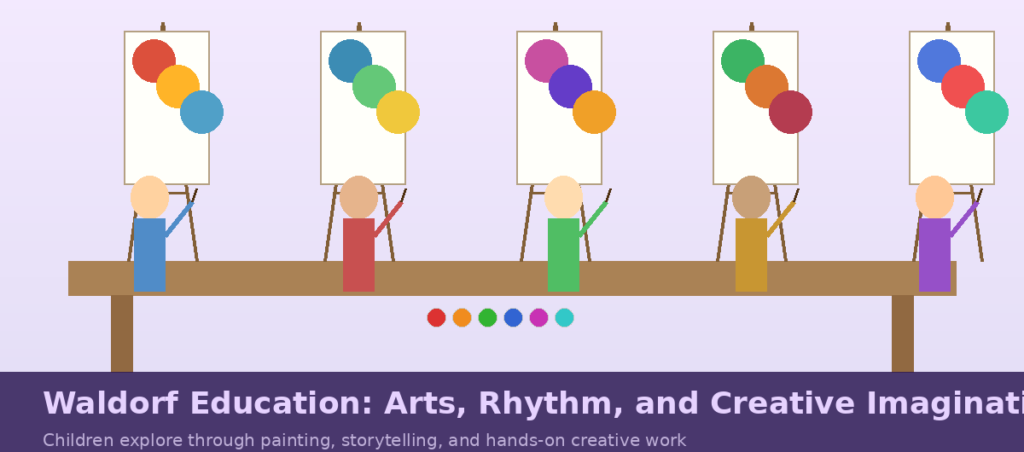
In a Waldorf classroom, age-appropriate activities such as painting, drawing, music, and storytelling are used to engage children in learning, with an emphasis on creative play and fostering imagination. Classrooms are usually kept simple and natural, with minimal toys or gadgets.
One of the most distinctive features of Waldorf schooling is its approach to formal academics. Reading instruction typically does not begin until around age 7, with the early years focused on oral storytelling and cultivating listening and imaginative skills. This slower academic start can be a genuine concern for parents who want early literacy benchmarks, but Waldorf advocates argue the long-term creative and emotional benefits more than compensate.
Another standout feature is continuity: Waldorf classrooms typically involve homerooms where children stay with the same teacher for several years, which builds deep relationships and emotional stability.
Best for: Creative, imaginative children who benefit from a slower academic pace and a strong arts-integrated environment.
What Is Traditional Education?
Traditional schooling is the model most parents grew up with: structured classrooms, standardised curriculum, teacher-led instruction, textbooks, grades, and regular assessments. In 2026, it remains the most widely available option globally and the default choice for most families simply due to accessibility.
The strengths of traditional education are real. Standardised testing and structured curricula allow schools to track student progress and make informed decisions for improvement, helping identify whether performance is trending up or down and guiding the allocation of resources and support. For families who value clear academic benchmarks and a predictable structure, traditional schools deliver both.
The weaknesses, though, are hard to ignore. Fixed class times, standardised syllabi, and limited personalisation leave many students behind, especially those who learn differently. The one-size-fits-all model rarely accounts for varied learning styles, and in high-stakes testing environments, teachers often end up teaching to the test, which can come at the cost of inquiry, engagement, creativity, and risk-taking in student learning.
That said, traditional education prepares children well for mainstream academic pathways. University applications, professional certifications, and standardised admissions processes are all designed around the traditional model, which is a practical advantage that cannot be dismissed.
Best for: Children who thrive with clear structure, routine, and defined academic expectations.
Key Differences at a Glance
| Factor | Montessori | Waldorf | Traditional |
|---|---|---|---|
| Learning style | Self-directed | Teacher-guided, arts-led | Teacher-led, standardised |
| Early academics | Introduced early via materials | Delayed until around age 7 | Begins from the start |
| Classroom feel | Open, child-led | Artistic, rhythmic, homeroom | Structured, desk-based |
| Technology | Generally accepted | Often limited or discouraged | Varies by school |
| Teacher-child continuity | Changes by age group | Same teacher for multiple years | Annual teacher change |
| Academic benchmarks | Informal, progress-based | Non-standardised until later | Standardised and graded |
| Best age range focus | Birth to 18 (all stages) | Birth to 18 (all stages) | Primarily 5 to 18 |
Which Is Better for Academic Outcomes?
This is the question every parent wants a clean answer to, and the honest truth is: it depends on the child and the school. Some children may thrive in a Waldorf environment, particularly those who value creativity and a non-formal approach to learning, while others find structured education and standardised testing more effective.
Research on Montessori consistently shows strong outcomes in literacy, numeracy, and social development, particularly when students attend genuine, accredited Montessori programmes. Waldorf graduates often go on to university and professional careers, with many noting their strong creative thinking and emotional intelligence as lasting advantages.
Traditional schooling, for all its criticisms, produces millions of capable, successful adults every year. The structure and accountability it provides work very well for children who need clear expectations.
Our Verdict
There is no single winner in the Montessori vs Waldorf vs traditional debate, but there is likely a best fit for your child specifically. If your child is independent and self-motivated, Montessori gives them the freedom to follow their curiosity. If they are imaginative, artistic, and would benefit from a slower academic pace, Waldorf offers a nurturing and creative environment. If they need structure, thrive with clear expectations, or you need access to mainstream academic pathways and accredited credentials, traditional education does that job reliably.
The most important factor is knowing your child. Visit schools, talk to teachers, and pay attention to how your child behaves in unstructured versus structured settings. No article can make this decision for you, but understanding the core differences puts you in a much stronger position to choose well.
For families exploring alternatives to traditional schooling, see our guide on gap year programs in 2026 that combine travel and education for another angle on child-centred learning.
Frequently Asked Questions
Is Montessori better than traditional education for young children?
Montessori tends to produce strong outcomes in early independence, literacy, and social skills, particularly in accredited programmes. However, “better” depends entirely on the child. Children who are self-motivated and curious often excel in Montessori settings, while those who respond well to structure may find traditional schooling a more comfortable environment. The best approach is to visit both and observe how your child responds.
At what age do Waldorf schools start teaching reading and writing?
Waldorf schools typically delay formal reading instruction until around age 7, which is later than most Montessori and traditional schools. The reasoning is rooted in Rudolf Steiner’s developmental philosophy, which holds that imaginative and oral learning should come before formal academics. Most Waldorf students catch up quickly once formal literacy instruction begins, and many go on to read well above average.
How much does a Montessori school cost compared to traditional schooling?
Private Montessori schools can range from moderately priced to quite expensive, depending on the country and city, often comparable to or higher than private traditional schools. However, a growing number of publicly funded Montessori programmes now exist in the US, UK, and parts of Europe, making the approach more accessible. Traditional public schools remain the most affordable option in most countries.
Can children transition from Montessori or Waldorf to a traditional school?
Yes, and it happens regularly. Most children transition without major difficulty, though some adjustment time is normal. Children moving from Montessori into traditional schooling sometimes need time to adjust to teacher-directed instruction. Waldorf students transitioning later may need brief support with standardised testing formats. Most educators report that children from alternative schooling backgrounds adapt well within a semester.
Which education method is best for children with learning differences?
Montessori has a particularly strong track record with children who have learning differences, partly because of its individualised pace and multi-sensory materials. Waldorf’s arts-rich, lower-pressure early environment can also work well for children who struggle in high-expectation academic settings. Traditional schools vary enormously in their special needs support, with some offering excellent resources and others lagging significantly. Always enquire specifically about a school’s support structure before enrolling a child with learning differences.
Related Posts
- Gap Year Programs 2026: 12 Best Options for Students Worldwide
- Best Free Online Courses with Certificates in 2026
- How to Fund a Gap Year: 14 Scholarships and Grants in 2026
Author: Written by the Lexica Routes editorial team, covering travel, education, and study abroad since 2025.