I Was Refreshing the Program Page at Midnight
Honestly, I did not expect to be this glued to an academic conference schedule. But there I was, well past midnight, refreshing the AIED 2026 program page like it was a concert ticket drop.
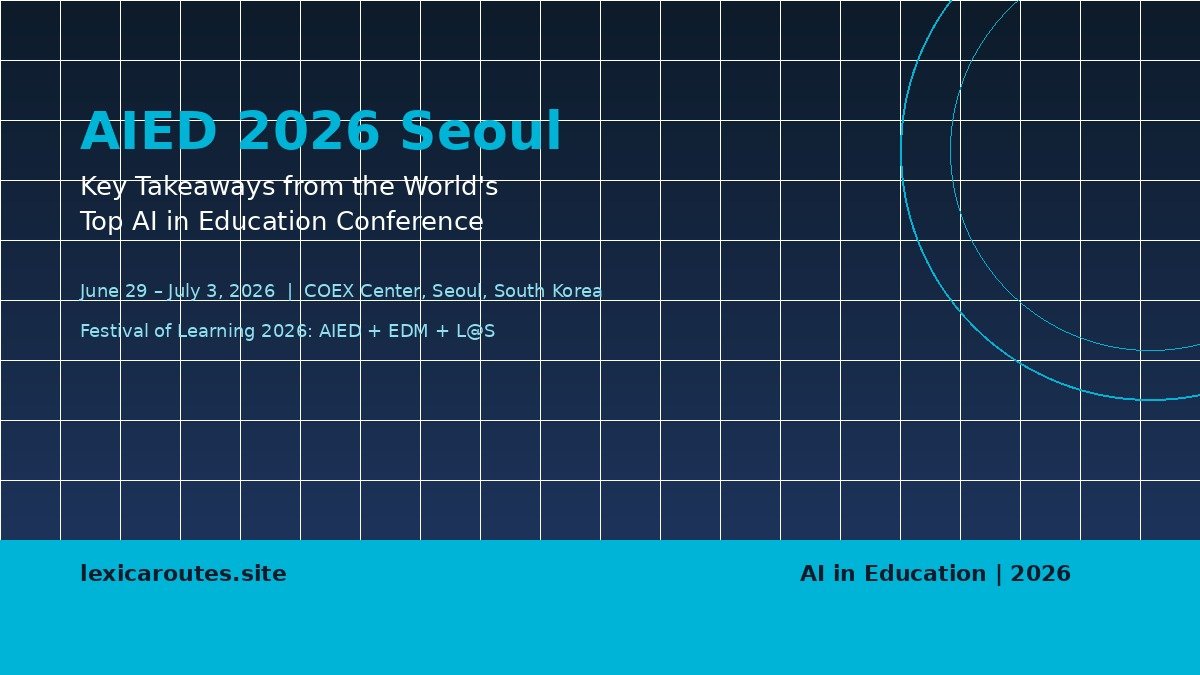
I teach English online and use AI tools daily: Khan Academy’s Khanmigo, Duolingo’s adaptive drills, and a handful of large language model tools I have stitched together for my own lesson planning. When I heard that the 27th International Conference on Artificial Intelligence in Education was heading to Seoul, South Korea for a full week from June 27 to July 3, 2026, I knew this one would be different. Seoul felt like the right city at exactly the right moment.
Why Seoul, and Why Now
The venue choice was not random. Seoul is particularly significant given South Korea’s status as a global leader in both educational technology and AI infrastructure, and that context played out in real time throughout the week. The city has been running ambitious EdTech experiments at a national scale. Starting in 2026, AI Education Support Centers are being established at regional education offices across the country, with plans to expand to all 17 nationwide by 2028, providing training for students, parents, and teachers, while connecting schools with universities and businesses. That is not a pilot program. That is policy on the ground.
And yes, South Korea also had its share of public stumbles. The country’s ambitious plan to introduce AI-powered digital textbooks at national scale collapsed after facing pushback, despite being promoted internationally as a world-first. That story came up in corridor conversations throughout the week. Researchers were using it as a live case study in what happens when you rush the rollout without teacher buy-in. More on that below.
The Headline Theme: AI as Teammate, Not Just a Tool
This year’s conference theme, “From Tools To Teammates: Human-AI Synergy For Augmented Learning,” placed emphasis on AI evolving beyond mere support for human learning, toward a collaborative model that fosters rich partnerships between human learners and AI systems.
That framing resonated deeply, and not just as a slogan. Across session after session, researchers were grappling with the same core question: at what point does an AI tutor stop being a calculator and start being a genuine co-learner? The honest answer from the research presented was that we are not quite there yet, but the direction is unmistakably clear.
The conference program featured seven thematic tracks covering technical, human, and societal aspects of AI in education. From 1,241 total submissions, 143 full papers and 165 short papers were selected, a competitive acceptance rate that signals just how active this field has become.
The Festival of Learning: Three Conferences, One Week
One thing that made AIED 2026 feel bigger than usual was its format. The conference was held as part of the Festival of Learning, co-located with Educational Data Mining (EDM) and Learning at Scale (L@S) in Seoul, bringing together the world’s leading communities in learning sciences, educational data mining, learning analytics, artificial intelligence, education, and related fields for a week of shared keynotes, panels, and collaborative events.
That co-location created real cross-pollination. You would sit through an AIED session on intelligent tutoring systems, then wander into an L@S panel on scaling personalized feedback, and realize both rooms were asking the same question from different angles. It made the whole week feel less like separate conferences and more like one sustained conversation.
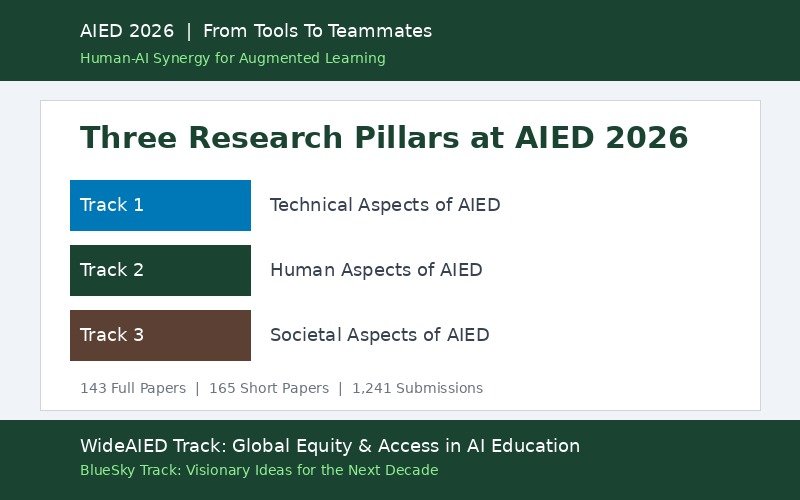
Three Research Tracks That Stood Out
1. Generative AI in Everyday Classrooms
The biggest shift from previous AIED conferences was how normalized generative AI has become as a research subject. As AI becomes deeply embedded in everyday educational practice, AIED 2026 called for systems that foster genuine human-AI partnerships, welcoming work that reimagines AIED systems not as tools, but as adaptive teammates that complement teachers and learners to achieve shared educational goals.
Practical research was the standout here. One set of findings I kept hearing about: when students cannot tell whether written feedback came from a teacher or a large language model with a few-shot prompt, it says something important about how far generation quality has come, and it raises uncomfortable questions about authorship and trust in formative assessment.
2. The WideAIED Track: Equity Is Not Optional
The WideAIED track was quietly one of the most important parts of the week. The track welcomes research addressing underrepresented contexts and global challenges, including equity and accessibility, leading to AIED approaches that adapt to diverse social and technological environments, with contributions expected to address areas of the world that are currently underrepresented in AIED regardless of the authors’ location or background.
This matters because most AI education tools are designed with well-resourced, English-speaking classrooms in mind. If your school has one tablet for every four students and an internet connection that drops every afternoon, the latest large language model tutoring tool is useless. Researchers in this track were building for that reality, and the room was packed.
3. The BlueSky Track: The Long Game
The BlueSky track called for visionary ideas that reimagine the future of learning with AI, pushing beyond the boundaries of current systems to explore innovative concepts that may shape educational experiences over the coming decades. Think of it as the conference’s permission slip to ask weird questions without needing three years of data to back them up. Some of the ideas floated here, AI systems that help learners build metacognitive skills by narrating their own reasoning out loud, felt genuinely novel.
What I Took Away as a Practitioner
Three things landed hardest for me as someone who works in online education:
AI tools need teacher training, not just student access. South Korea committed nearly $740 million between 2024 and 2026 to train teachers in advanced AI tools and methodologies. The research backed this up: the most successful classroom AI implementations were in schools where teachers had substantial professional development before the tools went live. Handing students a generative AI tutor without preparing the teacher is how you get confused kids and frustrated staff.
Student agency matters more than efficiency. Several papers raised a consistent warning: students who over-rely on AI feedback risk losing the productive struggle that drives deep learning. The best-designed systems in the research presentations were the ones that prompted students to reflect before accepting AI suggestions, not just accept them.
Equity and access are still the hardest unsolved problem. Adaptive learning systems are impressive. But if they require high bandwidth, modern devices, and English fluency to work properly, they deepen the gaps they claim to close.
Common Mistakes Educators Make with AI Tools
Watching the research presentations, a few patterns came up repeatedly:
- Using AI as a shortcut, not a scaffold. Students who use AI to generate answers rather than to interrogate their own thinking get little lasting benefit.
- Skipping the ethical conversation. Classrooms that deploy AI without discussing bias, error, and responsible use are setting students up for confusion later.
- Ignoring teacher wellbeing. Adding AI tools to an already overloaded teacher’s workflow without reducing other demands leads to burnout and abandonment of the tools.
- Treating one classroom success as a generalizable finding. What works in a well-resourced Seoul middle school may not transfer to a rural classroom with different infrastructure and cultural norms.
Final Thoughts
AIED 2026 left me more optimistic about the direction of AI in education than I expected, and more cautious about the pace. The researchers in Seoul are asking the right questions. The “Tools to Teammates” framing is not hype. It captures where the field is genuinely heading.
The most honest takeaway from a week in Seoul? Generative AI is already in classrooms whether or not research has caught up. The job now is to make sure it is there thoughtfully. If you work in education or EdTech, the proceedings published through Springer are worth an afternoon with a strong coffee.
Recommended Video:
COMPARISON TABLE
| Feature | AIED 2025 (Palermo) | AIED 2026 (Seoul) |
|---|---|---|
| Edition | 26th | 27th |
| Location | Palermo, Italy | Seoul, South Korea |
| Format | Standalone | Festival of Learning (AIED + EDM + L@S) |
| Conference Theme | AI & Inclusion | From Tools To Teammates |
| Submissions | ~900 | 1,241 |
| Accepted Papers | ~250 | 308 (143 full + 165 short) |
| Special Tracks | WideAIED | WideAIED + BlueSky (expanded) |
| Key Focus | Adaptive systems | Human-AI collaborative intelligence |
| Host Country Context | Europe education policy | South Korea national AI investment |
VERDICT
AIED 2026 in Seoul was more than a research conference. It was a live demonstration of what happens when a country takes AI in education seriously at every level: government policy, school infrastructure and academic research, all at once. The move from “AI as tool” to “AI as teammate” is not a marketing line anymore. It is a research agenda backed by hundreds of peer-reviewed papers and an uncomfortable number of honest conversations about what still is not working. If you are an educator, school leader, or EdTech builder trying to understand where AI in education is actually heading, the work coming out of Seoul is the best signal available right now.
FAQ
Q1: What is AIED 2026? AIED 2026 is the 27th International Conference on Artificial Intelligence in Education, held in Seoul, South Korea from June 29 to July 3, 2026. It is the world’s leading peer-reviewed academic conference on AI in learning and education, organized by the International AI in Education Society.
Q2: What was the theme of AIED 2026? The 2026 theme was “From Tools To Teammates: Human-AI Synergy For Augmented Learning,” focusing on how AI can move beyond being a passive support tool toward genuinely collaborative partnerships with students and teachers.
Q3: Who attends the AIED conference? AIED brings together researchers, classroom educators, EdTech practitioners, policymakers, and doctoral students from across the world. It is ranked A in CORE, placing it in the top 14% of all computer science and education research venues globally.
Q4: What is the WideAIED track? WideAIED is a dedicated track within AIED focused on equity, access, and AI in under-represented global contexts. It highlights research designed for learners in low-resource settings, non-English-speaking classrooms, and regions that are typically overlooked by mainstream AI education tools.
Q5: Where can I read the AIED 2026 research papers? The full proceedings are being published through Springer’s Lecture Notes in Artificial Intelligence (LNAI) series in a six-volume set. Many papers are also accessible through institutional library access or the authors’ academic profiles.
Q6: Why was Seoul chosen for AIED 2026? South Korea is one of the world’s most active countries in AI education investment, making it a fitting host for the conference. The country has committed billions of dollars to AI teacher training, school infrastructure, and national EdTech programs, offering a real-world laboratory for the research being discussed on stage.
Author: Written by the Lexica Routes editorial team, covering travel, education, and study abroad since 2025.