Getting a UK student visa might feel like a mountain of paperwork, but it follows a clear, predictable sequence once you know the steps. Thousands of international students face refusals every year not because their academic profiles are weak, but because their documents miss a small UKVI requirement. This guide walks you through the entire UK student visa 2026 process, from eligibility and documents to fees and what happens after you submit. Whether you are heading to London, Manchester, or Edinburgh, this is your starting point.
What You Need Before You Start
Before you open the UKVI application portal, three things need to be in place.
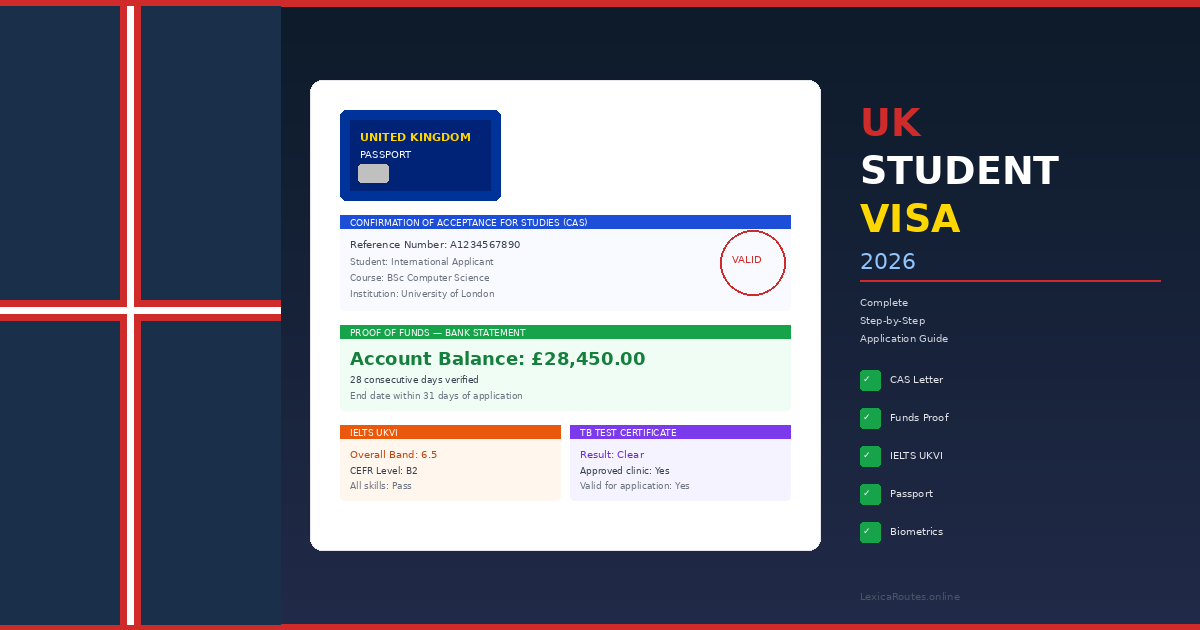
An unconditional offer from a licensed UK institution. Your university must be an approved student sponsor on the UKVI register. Once you accept your offer, your institution issues a Confirmation of Acceptance for Studies, known as a CAS. You cannot apply for a student visa without this number.
Proof of sufficient funds. You must demonstrate maintenance funds of £1,334 per month for London or £1,023 per month outside London, covering up to nine months. Your bank balance must show these funds held for 28 consecutive days, and the final balance date must fall within 31 days of your application date.
English language proficiency. From January 2026, most applicants must demonstrate CEFR Level B2 proficiency across all four skills through an approved Secure English Language Test such as IELTS Academic UKVI or PTE Academic UKVI. Some applicants may be exempt if they previously studied at an English-medium institution, so confirm this with your university early.
Documents Checklist
Getting the documents right is where most applications succeed or fail. Precision matters more than volume. Here is what UKVI requires:
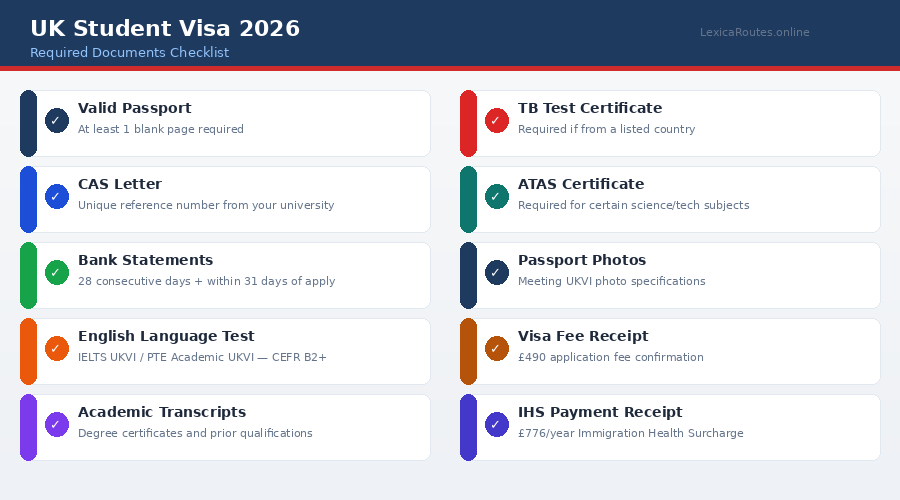
- Valid passport with at least one blank page
- CAS reference number and letter from your institution
- Bank statements covering 28 consecutive days showing the required funds
- English language test results (IELTS UKVI, PTE Academic UKVI, or equivalent)
- Tuberculosis (TB) test results if you are applying from a listed country
- Academic transcripts and qualifications
- Passport-sized photographs meeting UKVI specifications
- ATAS certificate if your subject requires academic technology approval
A missing bank statement date, an incorrect CAS detail, or an unclear financial source can undo months of preparation, so review every document against the official UKVI checklist before submitting.
Step-by-Step: The Application Process
Step 1: Accept Your Offer and Collect Your CAS
Once you receive an unconditional offer, formally accept it through your institution’s portal. Your university will then issue your CAS letter, which contains a unique reference number UKVI uses to verify your enrollment. Double-check every detail on the CAS, including your name, date of birth, and course dates, before proceeding.
Step 2: Create a UK Visas and Immigration Account
Go to the official UKVI website and create an account. This is where you will complete and manage your application. Have your passport and CAS number ready before you start filling in the form.
Step 3: Pay the Visa Fee and Immigration Health Surcharge
The visa application fee is £490, plus an Immigration Health Surcharge (IHS) of £776 per year. The IHS is paid upfront for the full duration of your visa and covers your access to the UK’s National Health Service. Both fees are paid online during the application. Keep your payment confirmation as you will need it at your biometrics appointment.
Step 4: Book and Attend Your Biometrics Appointment
After paying, you will be directed to book an appointment at a Visa Application Centre in your country. At the appointment, you provide fingerprints, a photograph, and submit your physical documents for review. Bring originals, not just photocopies.
Step 5: Submit and Wait for a Decision
UK student visa processing time from outside the UK typically runs to three weeks from the date of the biometric appointment for most straightforward applications. Priority services aim for a decision within five working days, and super priority typically delivers within 24 hours where available. Standard processing is free, while the faster services carry an additional fee.
UKVI accepts applications up to six months before your course start date. A practical minimum is 8 to 10 weeks before course commencement, and students requiring a TB test or ATAS certificate should add four to six additional weeks.
Step Summary
| Step | Action | Estimated Time |
|---|---|---|
| 1 | Accept offer and collect CAS | 1 to 4 weeks after offer |
| 2 | Create UKVI account and complete form | 1 to 3 hours |
| 3 | Pay visa fee (£490) and IHS (£776/year) | Same session |
| 4 | Book and attend biometrics appointment | 1 to 2 weeks wait |
| 5 | Wait for decision | Up to 3 weeks standard |
Common Mistakes to Avoid
Many visa refusals are entirely preventable. Here are the errors that cause the most problems.
Bank statements that do not cover 28 consecutive days. This is the most frequent financial document mistake. Your funds must be visible for a continuous 28-day window, not just on a single date.
CAS details that do not match your passport. Even a minor spelling difference between your CAS and your travel document can delay or derail your application. If you notice an error on your CAS, contact your university’s international office immediately to get it corrected before applying.
Leaving TB test bookings too late. If your country requires a TB test, some approved clinics have waiting times of several weeks. Book as soon as you have your university offer, not after your CAS arrives.
Applying too close to your course start date. The standard three-week processing window does not guarantee a visa in time if complications arise. Apply as early as your six-month window allows. According to the official UKVI guidance, the earlier you apply, the more buffer you have for any requests for additional information.
What Happens After Your Visa Is Approved
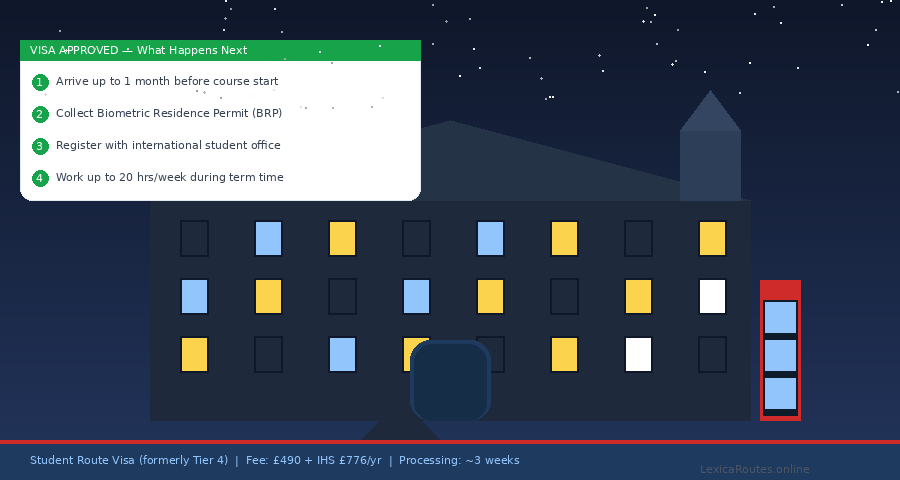
Once approved, your visa will either be stamped directly into your passport or issued as a vignette sticker. You can enter the UK up to one month before your course start date if your visa duration allows.
When you arrive, register with your university’s international student office as soon as possible. Many institutions require a check-in within the first week, and your Biometric Residence Permit (BRP) may need to be collected from a local post office. Your university will give you the collection details.
You are also allowed to work up to 20 hours per week during term time on a Student Route visa, which can help with living costs. Per the UK Home Office working rights guidelines, verify your specific conditions, as restrictions vary by course level.
Our Take
The UK student visa process is genuinely manageable once you treat it as a sequence of tasks rather than a single daunting hurdle. Start with your CAS, line up your financial evidence early, and give yourself at least ten weeks before your course begins. The most common reason for delays is documentation errors, not weak applications, so spend time getting the details right and your approval should follow without drama. For a broader look at financing your studies, check out our guide to the best scholarships for international students in 2026.
Frequently Asked Questions
How long does it take to get a UK student visa in 2026?
Standard processing runs around three weeks from the date of your biometrics appointment. Priority services can reduce this to five working days, and super priority services aim for 24 hours where available. These faster options carry an additional fee and availability varies by country.
How much money do I need to show for a UK student visa in 2026?
You need to demonstrate £1,334 per month for London or £1,023 per month outside London, covering up to nine months of living costs, in addition to your tuition fees. These funds must be present in your account for 28 consecutive days, with the final date falling within 31 days of your visa application.
Can I apply for a UK student visa without an IELTS score?
In some cases, yes. If you have previously studied in English or your university conducts its own English assessment, you may be exempt from providing a separate SELT test result. However, from January 2026, UKVI has tightened English language requirements across most routes, so confirm your exemption status with your institution before assuming you do not need a test.
What is a CAS and when do I get it?
A CAS, or Confirmation of Acceptance for Studies, is a unique reference number your UK university issues after you accept your offer. It confirms that your institution is a licensed UKVI sponsor and that you have a valid place on an approved course. You cannot start your visa application without it.
What happens if my UK student visa is refused?
A refusal is not the end of the road. UKVI provides a refusal letter explaining the specific reason. Common grounds include insufficient financial evidence, incomplete documents, or CAS discrepancies. You can reapply after addressing the issue. In some cases, you may also be able to request an administrative review. Check the UKVI appeals and review guidance for the exact options available for your situation.
Related Posts
Author: Written by the Lexica Routes editorial team, covering travel, education, and study abroad since 2025.