A few years back, a colleague of mine spent six months researching MBA programs. She had spreadsheets, sticky notes on her monitor, and a browser with roughly 40 open tabs. She ended up picking a program based mostly on the name she recognized from a TV commercial. Two years and $130,000 later, she has a degree that her employer barely noticed and student loans that are still very much alive.
I watched that happen and made a promise to myself: if I ever seriously considered an MBA, I would do it smarter. So when I started going through this process properly, I built a completely different research approach. I looked at real salary outcomes, alumni career data, accreditation details, and the actual weekly time commitment. What I found surprised me on multiple fronts.
This guide covers the best online MBA programs in 2026 ranked by value and outcomes, not just name recognition. Whether you are early in your career or a decade in and looking for leverage, this breakdown is for you.
What Actually Makes an Online MBA Worth the Money
Before jumping into any list, the question worth asking is: what does “worth it” actually mean in 2026?
A name-brand degree from a school you have heard of is not automatically a good investment. The real metric is return on investment, and that calculation starts with three numbers: total program cost, median post-graduation salary, and how long it takes to break even. A $140,000 program that gets you a $20,000 raise takes seven years to break even, assuming no interest on loans. A $60,000 program that triggers the same result gets you there in three.
According to the Graduate Management Admission Council, demand for online MBA programs has remained strong among mid-career professionals who want flexibility without sacrificing institutional credibility. The format has genuinely matured. Top programs now offer comparable career outcomes to their on-campus equivalents, and employers have largely stopped treating the online label as a red flag.
The three things I weight most heavily when evaluating programs are AACSB accreditation (fewer than 6% of business schools worldwide hold it), employer-reported career outcomes data, and the program’s actual delivery format, meaning whether live classes are involved or if it is purely asynchronous recordings. The difference matters more than most people expect.
Watch:
The 5 Best Online MBA Programs in 2026
1. Indiana University Kelley Direct Online MBA
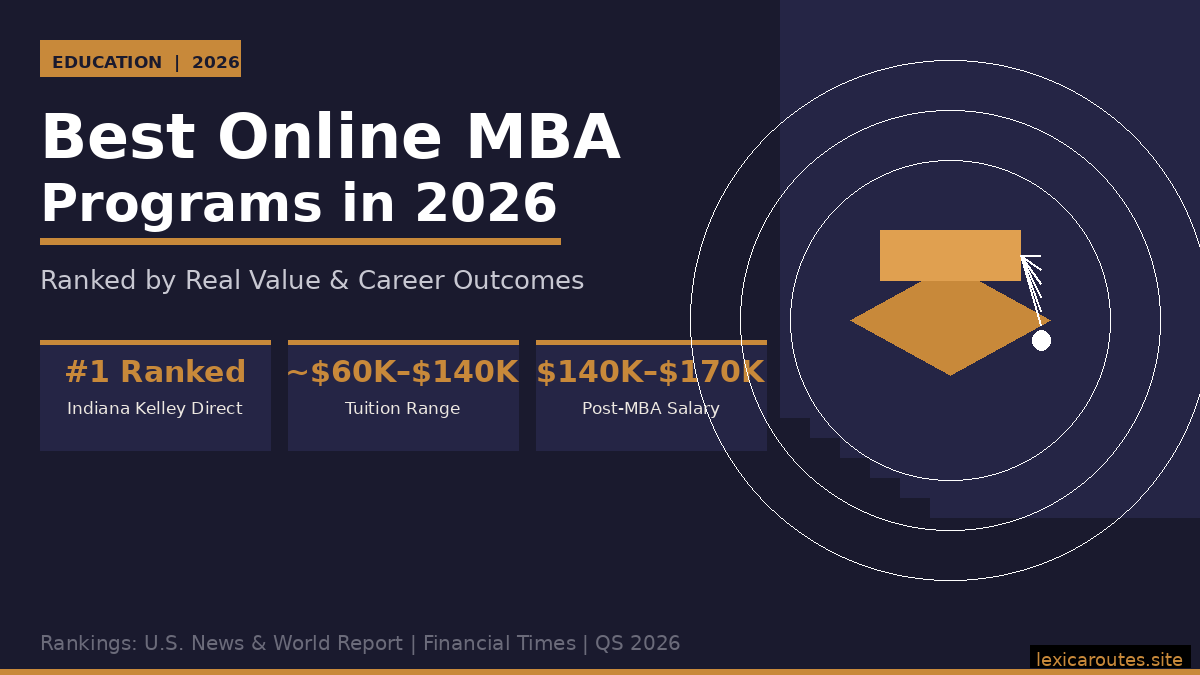
If you ask anyone who has done serious homework on US-based online MBAs, Kelley’s name comes up within the first 30 seconds. The Kelley Direct program has held the top or near-top spot in U.S. News and World Report’s online MBA rankings for multiple consecutive years, and the 2026 list is no different.
Total tuition sits around $82,000, which is genuinely middle-of-the-road for a program with this level of brand recognition. The format requires live sessions, two evenings a week roughly, plus immersion experiences in person. That live component is what separates Kelley from many competitors. You are not just watching recorded lectures; you are building real relationships with classmates spread across industries.
Career outcome data from the program consistently shows median post-graduation salaries in the $140,000 to $155,000 range across industries including technology, finance, and consulting. For a program at that price point, the ROI calculus works out well.
Best for: Working professionals seeking the strongest US brand recognition without paying Ivy League prices.
2. UNC Kenan-Flagler MBA@UNC
UNC’s online program, known as MBA@UNC, is one of the most genuinely rigorous online options in the country. It sits right around $125,000 to $130,000 in total tuition for the 2025-2026 cohort, which is meaningfully higher than Kelley, but the career outcomes support that premium.
Graduates from MBA@UNC report a 24% average salary increase at graduation, climbing to 39% within one year. The average total compensation including bonus reaches approximately $159,000 at that one-year mark. The alumni network stands at over 42,000 and is notably active in connecting graduates with hiring opportunities.
Classes are live and scheduled, which some people love and others find challenging to manage with full-time work. The program can be completed in as few as 18 months or stretched to 36, giving genuine flexibility without forcing a pace that burns people out.
Best for: Professionals targeting senior leadership roles at Fortune 500 companies who can manage the higher price tag.
3. University of Florida Warrington Online MBA
This one genuinely surprised me when I dug into the numbers. Warrington’s online MBA carries a total program cost of around $59,807, which is roughly 32% lower than most high-ranking comparable programs, according to the Warrington College of Business.
Despite the lower price, U.S. News ranked it number 5 nationally in 2026, with particular strength among US public universities. The program requires a GMAT or GRE score for admission, which signals that they are genuinely selective. Career services includes customized coaching, recruiter access, and career fairs. Graduates report strong placement in tech, consulting, and consumer goods roles.
If pure ROI is your primary filter, Warrington consistently ranks at or near the top. Indiana Kelley also sits high on that metric, but Warrington’s lower sticker price gives it an edge for anyone who is not getting employer tuition assistance.
Best for: Value-focused professionals who want a nationally ranked public university degree without the six-figure price tag.
4. Carnegie Mellon Tepper Online Hybrid MBA
Tepper is the program for quantitatively-minded professionals. The curriculum is built around data, analytics, and decision science, and that emphasis runs through every course rather than being limited to a single elective track. It is also, it should be said, expensive. Total cost runs above $140,000, making it the priciest option on this list.
The hybrid format involves live evening classes twice a week and mandatory “Access Weekends” in Pittsburgh and other major cities. These in-person components are genuinely valuable for networking, though they do require travel planning a few times a year.
For professionals in tech, quantitative finance, or data-driven strategy roles, Tepper’s brand carries real weight with specific employers. The ROI depends heavily on your industry. In roles where analytical credentials matter, the premium can be worth it.
Best for: Data and tech professionals targeting roles where analytical brand equity pays off.
5. USC Marshall Online MBA
USC Marshall’s online program has been climbing the rankings steadily, jumping into the top eight globally in the 2026 QS rankings. The total program cost sits above $120,000, and the format is described as high-touch: smaller cohorts, strong faculty engagement, and a Los Angeles-adjacent alumni network that stretches deep into entertainment, tech, and finance.
What sets Marshall apart is the geographic density of its alumni. If you are building a career on the West Coast, the Marshall network has real practical value in a way that programs based in the Midwest do not replicate as naturally. Career outcomes are strong, with graduates landing at recognizable firms across multiple sectors.
Best for: West Coast-focused professionals who want a strong alumni network in tech, media, and finance.
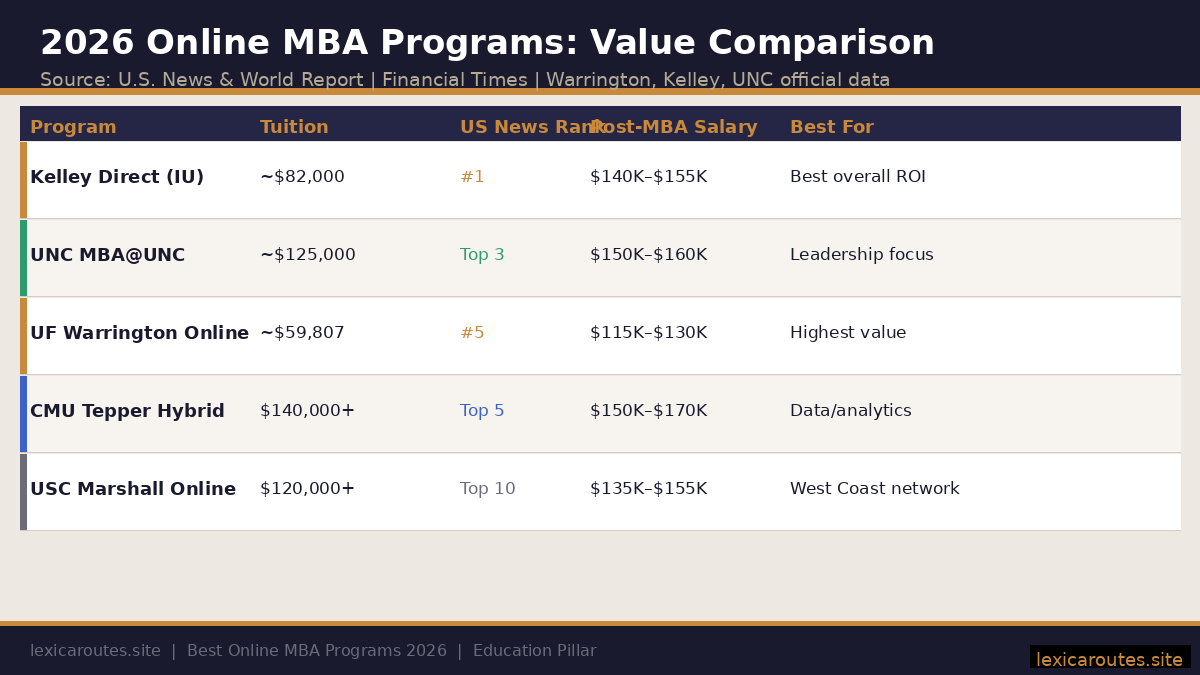
Summary Comparison Table
| Program | Total Tuition | US News 2026 Rank | Best For | Post-MBA Salary Range |
|---|---|---|---|---|
| Indiana Kelley Direct | ~$82,000 | #1 | Best overall ROI + brand | $140K-$155K |
| UNC MBA@UNC | ~$125,000-$130,000 | Top 3 | Leadership and analytics focus | $150K-$160K |
| UF Warrington Online | ~$59,807 | #5 | Highest value for cost | $115K-$130K |
| CMU Tepper Hybrid | $140,000+ | Top 5 | Quantitative and data roles | $150K-$170K |
| USC Marshall Online | $120,000+ | Top 10 | West Coast network | $135K-$155K |
Mistakes I See People Make When Choosing an Online MBA
Chasing the name over the format. A school’s offline reputation does not automatically translate to a great online program. Some universities treat their online MBA as a secondary offering with limited full-time faculty involvement and outdated course material. Always look specifically at who teaches the online sections, not just the school’s general prestige.
Ignoring AACSB accreditation. This one genuinely matters. AACSB accreditation is held by fewer than 6% of business programs worldwide, according to research.com’s 2026 program database. Without it, your degree may not be recognized by certain employers or graduate programs if you pursue further study. Every program on this list holds AACSB accreditation.
Underestimating the weekly time commitment. Most top online MBA programs require 15 to 20 hours per week outside of scheduled class time. That is real time, and if you have a demanding job, a family, or both, doing that math before you enroll will save you from dropping out six months in, which is more common than programs like to advertise.
Picking purely on price. A $12,000 AACSB-accredited program is not the same career accelerator as a $60,000 to $80,000 nationally ranked program. The lower-cost options serve a real purpose for some goals, but if your objective is a significant salary jump or a pivot into a senior role, the caliber of the program and its network matter.
Our Take
For most working professionals in 2026, Indiana Kelley Direct hits the best combination of brand recognition, career outcomes, and tuition cost. If you can stretch the budget and want a leadership-focused curriculum with strong live instruction, MBA@UNC is worth the premium. And if ROI is your single biggest criterion, Warrington at just under $60,000 total is hard to argue with.
The key thing I would tell anyone at the start of this process: build your own spreadsheet, not a list of schools you have heard of. Run the numbers, confirm the accreditation, and talk to actual alumni via LinkedIn before you commit to a single application.
Frequently Asked Questions
Are online MBA programs respected by employers in 2026?
Yes, provided the program is AACSB-accredited and comes from a well-ranked institution. Employers have broadly shifted their focus to program quality and outcomes rather than format. Graduates from programs like Indiana Kelley and UNC Kenan-Flagler consistently land senior roles at major companies.
Which online MBA program has the best return on investment?
University of Florida Warrington consistently ranks near the top for ROI due to its lower total cost relative to strong career outcomes. Indiana Kelley also ranks high because of its reputation-to-cost ratio. The right answer depends on your industry and career trajectory.
Do online MBA students get access to the same career services as on-campus students?
At the programs on this list, yes. Schools like UNC Kenan-Flagler and USC Marshall extend full career services, including recruiter access and coaching, to online students. Verify this directly with each school before applying, as policies vary.
How long does a top online MBA program take to complete?
Most programs on this list can be completed in 18 to 36 months depending on pace. Carnegie Mellon Tepper and Indiana Kelley require more structured scheduling due to live class components, while others offer more flexibility in pacing.
Is a GMAT required for top online MBA programs in 2026?
Most top-ranked programs still require GMAT or GRE scores. University of Florida Warrington requires standardized test scores, as do Kelley Direct, UNC MBA@UNC, and Tepper. Some programs offer waivers based on work experience or undergraduate GPA, so check directly with each school’s admissions office.
Author: Written by the Lexica Routes editorial team, covering travel, education, and study abroad since 2025.