Thinking about homeschooling worldwide in 2026 but not sure where to start? Whether you are a parent weighing your options or a family preparing to move abroad, the rules and realities of home education vary dramatically from one country to the next. In some places, pulling your child out of school is straightforward. In others, it can land you in serious legal trouble. And even where it is legal, figuring out which curriculum actually works takes real research.
This guide cuts through the noise. We cover which countries allow homeschooling, which do not, and what the legal requirements look like in key destinations. We also break down the most popular curriculum approaches so you can find the best fit for your child’s learning style and your family’s lifestyle.
Where Homeschooling Is Legal (and Where It Is Not)
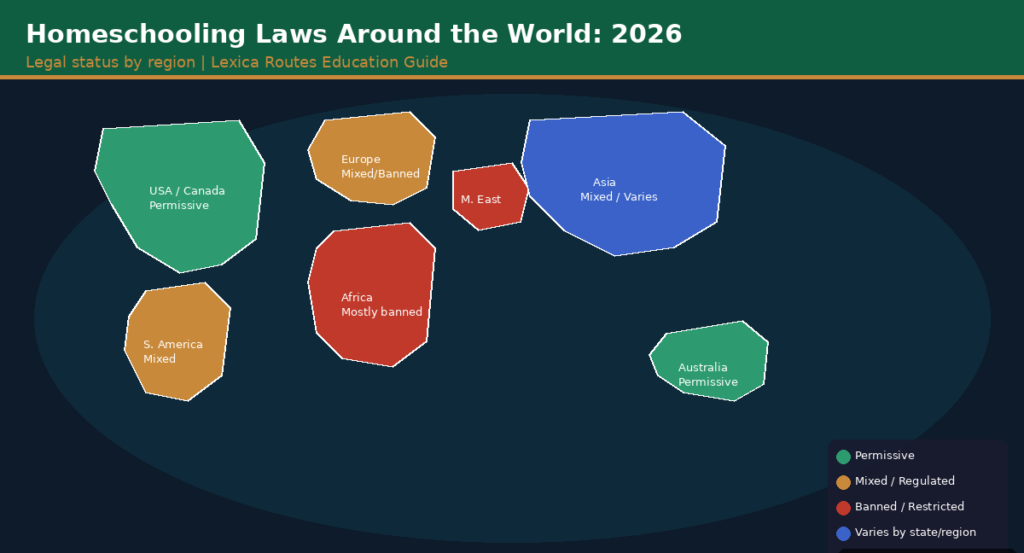
The legal landscape for home education in 2026 is anything but uniform. Roughly half of the world’s countries permit homeschooling in some form, but the regulations inside that broad permission vary enormously.
The Most Permissive Countries
The United States remains the most flexible destination for homeschooling families. Each state sets its own rules, ranging from simply filing a notice of intent to requiring standardised testing or curriculum approval. The United Kingdom, where home education is called elective home education, does not require parents to follow the national curriculum at all. Australia, Canada, New Zealand, Ireland, Portugal, and Estonia round out the group of countries with strong legal frameworks and practical support for home educators.
Eastern Europe is quietly becoming a popular destination for relocating homeschool families. Countries like Hungary, the Czech Republic, and Slovakia allow home education, often through a registered private school model where the family teaches daily but submits to periodic assessments from an approved institution.
Where Homeschooling Is Banned or Heavily Restricted
Germany is the most well-known holdout. Compulsory school attendance is enforced strictly, and homeschooling is effectively illegal except in extremely rare medical circumstances. Sweden tightened its rules significantly after 2010, making it one of the most restrictive countries in Europe. Greece and Croatia also prohibit home education outright. Much of the Middle East and parts of Asia maintain similar bans, rooted in national curriculum mandates and social integration goals.
For families committed to homeschooling in a restrictive country, the practical options are limited: relocate to a permissive jurisdiction, enroll in a registered private school that allows flexible attendance, or use an accredited international distance school as the official institution of record. (ICHER World Homeschooling Regulations Map)
Key Legal Requirements to Know Before You Start
Even in countries where home education is permitted, there are hoops to jump through. Knowing them before you start saves a lot of stress. (Home School Headquarters country-by-country legal overview)
- United States: Requirements range from a simple declaration (Alaska, Texas, Oklahoma) to structured oversight with standardised testing and teacher qualification checks (New York, Pennsylvania, Massachusetts).
- United Kingdom: Parents must notify the local authority and provide evidence of a suitable education on request. No national curriculum requirement.
- Canada: Provincial rules apply. Ontario requires written notification to the school board and a log of learning activities. British Columbia requires registration and a written educational plan.
- Australia: Parents register with the state education authority and submit a curriculum plan for approval, typically reviewed annually.
- Netherlands: Homeschooling is allowed under specific conditions, with an annual education plan submitted to the municipality and periodic reviews by the Education Inspectorate.
- Portugal: One of the most straightforward systems in Europe. Families register and children sit exams at a local school at the end of each year, but daily teaching is entirely parent-led.
The takeaway: legal permission is just the first step. Registration, curriculum documentation, and annual assessments are common requirements even in the most permissive countries. Check the official education authority website for your specific country or state before making any decisions.
Curriculum Approaches: Which One Actually Works?
The curriculum question is where most new homeschool families spend the most time and, honestly, the most money. In 2026, the options range from structured classical programs to fully child-led unschooling. There is no universal best, but there is usually a best fit.
Classical Education
Classical education follows the Trivium: grammar (knowledge acquisition), logic (analytical thinking), and rhetoric (application and expression). It is structured, content-rich, and builds on the tradition used by thinkers like Aristotle and Thomas Jefferson. Programs like Memoria Press and Veritas Press are widely used. Classical education suits children who thrive on structure and families who want a rigorous, sequenced academic experience.
Charlotte Mason Method
Developed by British educator Charlotte Mason in the late 1800s, this approach centres on living books (narrative, author-driven texts rather than dry textbooks), nature study, narration, and short, focused lessons. AmblesideOnline offers a free Charlotte Mason curriculum, and Simply Charlotte Mason provides open-and-go lesson plans for families who want more structure. This method works particularly well for children who are avid readers and families who want learning to feel connected to real life rather than confined to a desk.
Montessori
Montessori is hands-on, child-directed, and built around prepared environments and concrete materials. It suits younger children especially well and works for families who believe learning happens best through doing. Adapting Montessori for home requires more parent preparation than Charlotte Mason or Classical, but the principles translate well to a small household setting.
Unschooling
Unschooling, a term coined by educator John Holt in the 1970s, removes structured curriculum entirely. Children follow their interests, and parents provide resources and opportunities rather than lessons. It is not the same as doing nothing. Committed unschooling families curate rich environments with books, experiences, mentors, and materials. This approach suits families who prioritise autonomy and intrinsic motivation above academic benchmarks.
Online and Eclectic Programs
In 2026, online homeschooling has matured significantly. Platforms like Time4Learning offer comprehensive, self-paced programs covering core subjects with automated grading, making them practical for working parents. Khan Academy remains a free supplement for maths, science, and humanities. Many families take an eclectic approach, mixing one curriculum for maths, another for history, and online resources for science. This flexibility is one of homeschooling’s strongest advantages over traditional schooling.
Top Picks by Approach: Quick Comparison
| Approach | Best For | Key Feature | Cost Range |
|---|---|---|---|
| Classical | Structured learners | Trivium-based, content-rich progression | $300–$1,500/year |
| Charlotte Mason | Book-loving families | Living books, nature study, narration | Free to $500/year |
| Montessori | Young children, hands-on learners | Prepared environment, self-directed | $200–$800/year |
| Unschooling | Autonomous, interest-driven kids | Child-led, no fixed curriculum | Variable |
| Online (e.g. Time4Learning) | Busy/working parents | Self-paced, automated grading | $30–$60/month |
| Eclectic | Families wanting flexibility | Mix-and-match by subject | Varies by mix |
Pros and Cons of Homeschooling Worldwide
| Pros | Cons |
|---|---|
| Full control over curriculum and pace | Legal in only about half the world |
| Flexible schedule, including travel-friendly | Requires significant parent time and commitment |
| Can be tailored to each child’s learning style | Socialisation requires deliberate effort |
| No commute, more family time | Costs vary widely and can add up quickly |
| Strong outcomes when done consistently | Accreditation can be a hurdle for university entry |
Our take
Homeschooling in 2026 is more viable than ever, but it demands honest preparation. The legal picture varies so much by country that checking the specific rules for your location is non-negotiable before you start. Once you know you are on solid legal ground, the curriculum question is really a question about your child’s learning style and your family’s rhythm. Classical education rewards structure-lovers. Charlotte Mason suits families who want learning to feel rich and living. Unschooling works when autonomy is the goal. Online programs are the pragmatic choice for working parents. Most successful homeschool families do not stick rigidly to one approach forever, they adapt as their children grow.
Frequently asked questions
Is homeschooling legal worldwide?
No. Roughly half the world’s countries permit home education in some form, but a significant number, including Germany, Sweden, Greece, and much of the Middle East and parts of Asia, either ban it outright or impose restrictions that make it effectively impossible for most families. Always verify the specific law in your country or state before you start.
Which homeschool curriculum is best for beginners?
There is no single best curriculum, but families new to homeschooling often find Charlotte Mason or an eclectic online program the easiest entry point. Charlotte Mason is flexible and literature-rich without requiring heavy parent preparation. Platforms like Time4Learning offer structured, self-paced courses that remove a lot of the planning burden in the early months.
Can homeschooled children get into university?
Yes, in most countries, though the path varies. Many universities in the United States, United Kingdom, and Australia actively accept homeschooled applicants and have clear admissions processes for them. The key is documentation: portfolios, standardised test scores (SAT, ACT, A-Levels), and transcripts from an accredited distance school if needed. Starting to document work early makes university applications much smoother.
How much does homeschooling cost per year?
Costs range from near-zero (using free resources like AmblesideOnline and Khan Academy) to over $2,000 a year for boxed classical programs with physical materials. The biggest variable is curriculum choice. Online platforms typically cost between $30 and $60 per month. Families who mix and match resources tend to spend around $500 to $1,000 annually for a well-rounded program.
What is the biggest challenge of homeschooling internationally?
Legal compliance is the most immediate challenge when moving between countries, since what is perfectly legal in one jurisdiction may be a criminal offence in another. Beyond the legal side, maintaining consistency across international moves, different time zones, and varied access to resources tests even experienced homeschool families. Building a local or online community of other homeschoolers early makes a substantial difference.