Our child has a tablet in their hands. The question is not whether they will use it but what they will do with it. The best EdTech apps for kids in 2026 have moved well beyond letter tiles and chirpy sound effects. Today’s top picks use adaptive AI, curriculum-aligned content, and genuine pedagogical research to turn screen time into something that actually sticks.
This guide covers the best learning apps by age group, from toddlers just building phonics awareness to tweens tackling coding and critical thinking. Every app here has been selected based on curriculum quality, child safety, data privacy, and whether kids actually come back to it voluntarily. No filler, no sponsor picks. Just what works.
What makes an EdTech app worth downloading in 2026
Not every app with a cartoon mascot belongs on your child’s home screen. The best EdTech apps for kids in 2026 share a few key traits. They adapt to each child’s pace instead of forcing everyone through the same content. They align with real curriculum standards, so what your child learns in the app supports what they are doing in school. And they handle data responsibly, complying with COPPA for under-13 users and keeping advertising to an absolute minimum.
The biggest trend this year is the shift toward “active screen time.” Parents and educators are no longer just asking whether an app is educational. They are asking whether it builds critical thinking, emotional intelligence, and problem-solving alongside core academics. The apps that survive this test are the ones worth your child’s time.
Best EdTech apps for ages 2-5 (toddlers and preschoolers)
Khan Academy Kids (Ages 2-8) – Best overall free pick
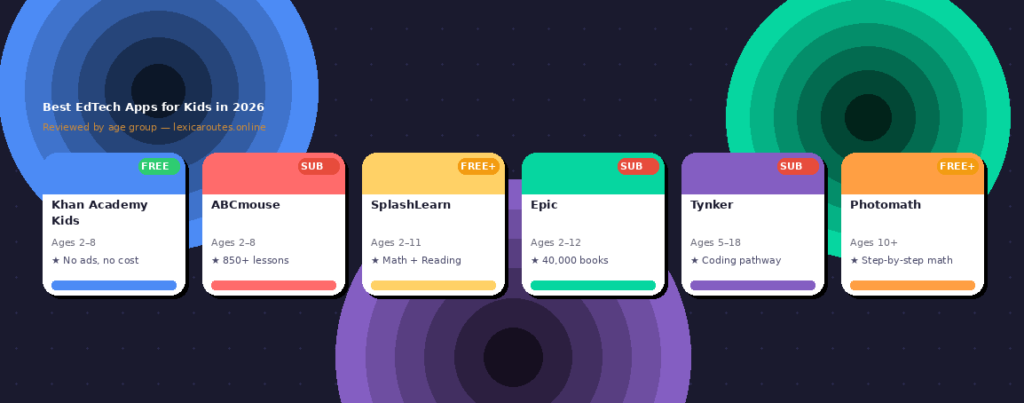
Khan Academy Kids consistently tops every independent review for this age group, and for good reason. The app covers phonics, counting, early literacy, and problem-solving through more than 5,000 standards-aligned activities. It was developed with input from learning experts at Stanford and aligns with Head Start and Common Core standards. Crucially, it is completely free with no ads and no in-app purchases, making it the most accessible tool for any family. In 2026, its age-adaptive curriculum has expanded to include a stronger bridge into second and third grade content.
Cost: Free | Platforms: iOS, Android
ABCmouse (Ages 2-8) – Best for comprehensive early curriculum
ABCmouse takes a more structured approach, offering 850 lessons across 10 progressive levels that span reading, math, science, social studies, art, and music. Research published by the app’s developer shows it doubles early learning gains in reading and math when used at least twice a week. It is trusted by over 70,000 classrooms and nearly half of US public libraries. The subscription cost is worth it for families who want a complete early curriculum in one place rather than juggling multiple apps.
Cost: Subscription required | Platforms: iOS, Android, Web
Best EdTech apps for ages 5-10 (early elementary)
SplashLearn (Ages 2-11) – Best for math and reading together
SplashLearn is one of the few apps that covers both math and reading at a serious curriculum level for the same age range. It offers more than 4,400 games, worksheets, decodable books, and videos aligned to Common Core, with personalized learning paths that adjust to each child’s level. Parents receive detailed weekly progress reports that break down mastery by subject, topic, and individual skill. For families who want one app to handle the core academic subjects through Grade 5, SplashLearn is hard to beat.
Cost: Free tier available; premium subscription for full access | Platforms: iOS, Android, Web
Epic (Ages 2-12) – Best digital reading library
Epic gives children access to more than 40,000 books, audiobooks, graphic novels, and learning videos. It works particularly well for kids who resist reading because the volume and variety of titles means there is always something on their interest radar. The Read-To-Me format, with professional narration and sound effects, is excellent for reluctant readers. Recommendations are personalized based on reading level and interests, and parents can track progress through a dedicated dashboard. Note that full home access requires a paid subscription outside of school hours.
Cost: Free in school; subscription for home use | Platforms: iOS, Android, Web
Tynker (Ages 5-18) – Best intro to coding
For families thinking about coding, Tynker is the most polished option for this age range. It takes children from simple icon-based drag-and-drop logic through block coding and, for older kids, into real Python and JavaScript. The Minecraft Modding courses introduced in recent years have become particularly popular with kids aged 8 to 10 who want to build their own game content rather than just play. The progression of difficulty is well designed and the gamification keeps engagement high.
Cost: Subscription required | Platforms: iOS, Android, Web
Best EdTech apps for ages 10-13 (tweens and middle schoolers)
Photomath (Ages 10+) – Best for math understanding
Photomath lets students point their camera at a math problem and see a full step-by-step solution. Used correctly, as a way to check work and understand where a mistake happened rather than skip the work entirely, it is a genuinely strong learning tool. The breakdowns are clear and thorough, covering everything from basic arithmetic to algebra and geometry.
Cost: Free (basic); subscription for expanded features | Platforms: iOS, Android
Quizlet (Ages 10+) – Best for active recall across subjects
Quizlet remains the most versatile study tool for this age group. Students can create flashcard decks or pull from millions of user-generated sets covering virtually every school subject. The spaced repetition algorithm surfaces cards at optimal intervals for long-term retention, and the various game modes turn revision into something closer to play. The free version covers the essentials; Quizlet Plus adds AI-powered explanations.
Cost: Free with ads; Quizlet Plus available | Platforms: iOS, Android, Web
SUMMARY COMPARISON TABLE
| App | Best For | Age Range | Cost | Standout Feature |
|---|---|---|---|---|
| Khan Academy Kids | Best overall free app | 2-8 | Free | 5,000+ activities, no ads ever |
| ABCmouse | Full early curriculum | 2-8 | Subscription | 10 progressive levels, research-backed |
| SplashLearn | Math and reading combined | 2-11 | Free tier / Premium | Weekly parent progress reports |
| Epic | Digital reading library | 2-12 | Free in school / Subscription | 40,000+ titles, Read-To-Me feature |
| Tynker | Coding from scratch | 5-18 | Subscription | Minecraft modding, Python/JS pathway |
| Photomath | Math problem-solving | 10+ | Free / Premium | Step-by-step camera-based solutions |
| Quizlet | Study and revision | 10+ | Free / Plus | Spaced repetition, millions of decks |
VERDICT
The EdTech apps market in 2026 has never been better for parents who know what to look for. Khan Academy Kids is the strongest free starting point for any child under eight, full stop. For families willing to pay for a subscription, SplashLearn and ABCmouse round out a very solid early-learning stack. As kids move into the 8 to 12 range, Epic keeps reading habits alive while Tynker builds the computational thinking that matters more and more in secondary school and beyond.
The key is matching the app to the child’s current age, subject needs, and attention style, then reviewing their progress every few weeks to see whether it is still the right fit. Screen time is only productive when the content adapts to the child, not the other way around.
For more on choosing the right learning tools, read our guide to the best gap year programs for students in 2026 and see how structured learning continues beyond the classroom.
FAQ
What is the best free EdTech app for kids in 2026?
Khan Academy Kids is the top free option for children aged 2 to 8. It covers literacy, math, and early problem-solving through more than 5,000 activities, developed with input from Stanford educators. There are no ads, no in-app purchases, and no subscription fees, making it the most accessible high-quality EdTech app available right now.
At what age should kids start using educational apps?
Most learning apps are designed for children from around age 2 upward, starting with very simple shape, color, and sound interactions. That said, the American Academy of Pediatrics recommends limiting screen time for children under 18 to 24 months and focusing on video calls and high-quality content for children 2 to 5. Apps work best as a supplement to hands-on play and real-world interaction, not a replacement for it.
Are EdTech apps safe for children’s data and privacy?
The best EdTech apps comply with COPPA, the US federal law governing data collection from children under 13. Apps like Khan Academy Kids, ABCmouse, and SplashLearn collect minimal data and do not serve behavioral advertising to children. Before downloading any app, check whether it has a dedicated children’s privacy policy, minimal ads, and in-app purchase controls that can be locked by a parent account.
What is the best EdTech app for kids learning to code?
Tynker is the strongest coding app for ages 5 to 18, offering a progression from simple drag-and-drop logic through block coding into real Python and JavaScript. For younger children under 8, Scratch Jr is a solid free introduction. For tweens who are serious about understanding AI, Google’s Teachable Machine is a free web tool that teaches machine learning concepts in an accessible way.
Do EdTech apps actually improve academic performance?
Research suggests they can, particularly when they are used consistently and alongside parental involvement. ABCmouse’s internal research indicates it can double early learning gains in reading and math when used at least twice weekly. Khan Academy’s independent studies show measurable progress in math outcomes. The critical factor is that the app adapts to the child’s level and that parents review progress rather than simply handing over the device.
RELATED POSTS
- AI in the Classroom: How Teachers Are Using It in 2026
- Best Free Online Courses with Certificates in 2026
- How AI Is Changing How Students Write Essays (And What to Do About It)
Author: Written by the Lexica Routes editorial team, covering travel, education, and study abroad since 2025.