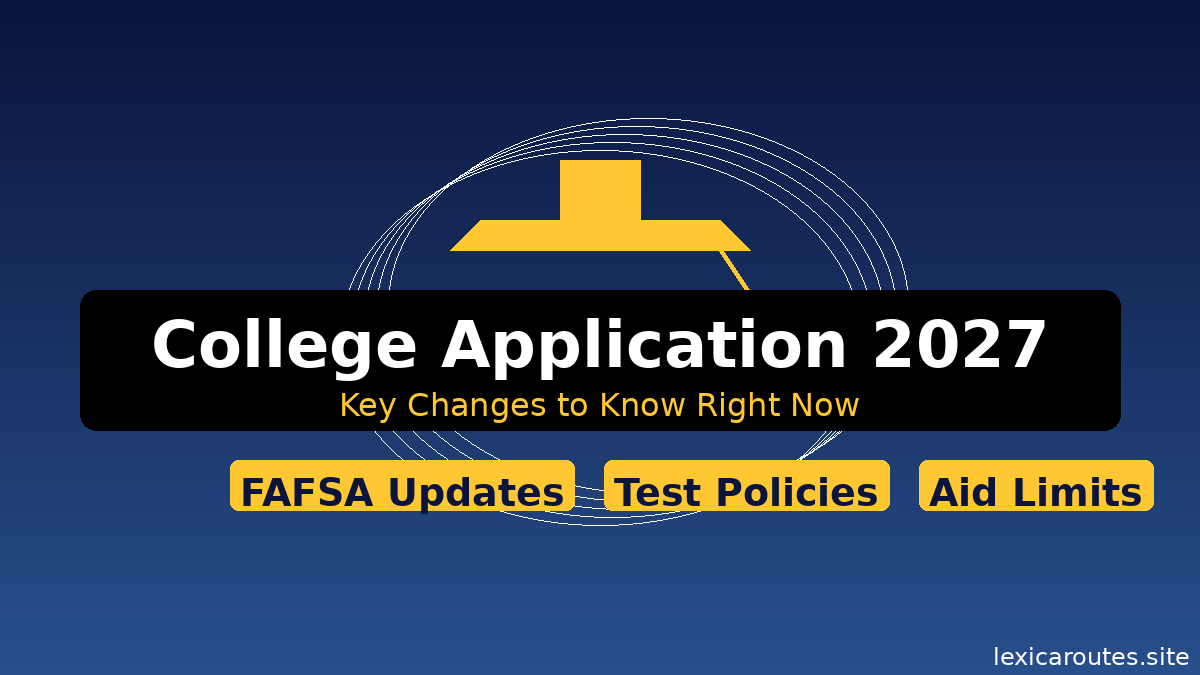
My cousin spent the better part of last October refreshing her email waiting on financial aid numbers that never came on time. The year before, the FAFSA rollout was a disaster. Families missed scholarship windows, panicked about gaps in funding, and second-guessed every school on their list. So when I tell you the college application changes 2027 cycle brings some genuinely important shifts, I mean the kind that can cost or save thousands of dollars if you miss them. Here is what is actually different this cycle and why you need to pay attention right now.
What happened with college application changes 2027
Two big forces are reshaping the 2026-2027 admissions cycle. The first is the continued rollout of FAFSA improvements. The second is a hard policy shift in standardized testing at elite universities, backed by the financial reality of the One Big Beautiful Bill Act that came into law on July 4, 2025.
Neither of these is rumour or speculation. They are already in motion, and the deadlines and requirements listed below apply to students applying right now for fall 2027 enrollment.
What actually changed on FAFSA this year
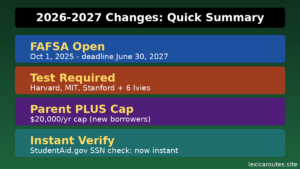
The 2026-2027 FAFSA opened on October 1, 2025, and this time around it opened on time, which is genuinely good news after the delays families dealt with in prior cycles. Financial aid counselors across the country are reporting that students and parents are finding the form faster and easier to complete than in any recent cycle.
The biggest quality-of-life improvement is instant identity verification. Previously, creating a StudentAid.gov account and having your identity confirmed could take up to three days. Now, if you sign up with a valid Social Security number, your account is verified immediately. That is one less delay standing between a student and getting their aid numbers.
The official federal deadline to submit is June 30, 2027. But here is the thing: that federal deadline is almost irrelevant for students chasing scholarships and institutional aid. Most colleges have priority deadlines in December 2025 through April 2026, and those funds run out. Submit early or risk losing money that was sitting there waiting.
You can verify the full 2026-2027 FAFSA details directly at StudentAid.gov.
The test-optional era is ending at elite schools
This is the change that blindsided the most families I have spoken to. The test-optional wave that started during the pandemic is reversing at the most competitive schools.
For the 2026-2027 admissions cycle, Harvard, Yale (test-flexible), Dartmouth, Brown, Cornell, MIT, Caltech, Stanford, and the University of Pennsylvania all require SAT or ACT scores. Princeton remains test-optional for one final cycle before making testing mandatory for students entering in fall 2028.
What does this actually mean in practice? A 1480 SAT score that sat comfortably inside Harvard’s mid-50% range before the pandemic now falls below the 25th percentile. Score expectations have climbed sharply because of self-selection during the test-optional years. If you are planning to apply to any of the schools above, testing is no longer something to debate.
Schools like Duke, Columbia, NYU, and the University of Michigan remain test-optional for 2026-2027. The full, current list of testing policies by institution is maintained at College Transitions.
Parent PLUS loans just got a hard cap
The One Big Beautiful Bill Act changed federal borrowing in a way many families have not caught yet. Starting July 1, 2026, Parent PLUS loans are capped at $20,000 per year per dependent student, with a lifetime aggregate limit of $65,000. Previously, parents could borrow up to the full cost of attendance with no annual ceiling.
If your family was counting on Parent PLUS to cover a gap above $20,000 per year, that plan needs to change. The cap applies to new borrowers. Families who had an existing Parent PLUS loan disbursed before July 1, 2026 for an active program may continue under prior limits for up to three years or until the student completes the program.
For the full breakdown of these changes, the National Association of Student Financial Aid Administrators has published detailed guidance at NASFAA.org.
KEY FACTS SUMMARY BOX
Key facts: College application changes 2027
| What | Detail |
|---|---|
| What happened | FAFSA opened on time Oct 1, 2025; test requirements reinstated at 9 elite schools; Parent PLUS loans capped |
| Who is affected | All students applying for fall 2027 enrollment, especially those targeting Ivy League or relying on Parent PLUS aid |
| When it takes effect | FAFSA now open; testing requirements active for 2026-2027 cycle; loan caps effective July 1, 2026 |
| Key deadline | Priority aid deadlines: December 2025 to April 2026. Federal FAFSA deadline: June 30, 2027 |
| Where to get more info | StudentAid.gov, your target school’s admissions page, NASFAA.org |
VERDICT
The 2026-2027 cycle is a real turning point. The FAFSA is working better, which is genuinely good. But the window to maximise aid is narrow, testing is back at the schools that matter most, and families counting on unlimited Parent PLUS borrowing just hit a wall. The students who come out ahead will be the ones who file their FAFSA before January, check their target schools’ current testing policy, and do not assume last year’s rules still apply.
If you are weighing your funding options, read our guide to the best scholarships for international and domestic students in 2026 for options that do not depend on federal loan limits at all.
FAQ SECTION
When does the 2026-2027 FAFSA close?
The federal deadline for the 2026-2027 FAFSA is June 30, 2027. However, most colleges and states have their own priority deadlines between December 2025 and April 2026. Missing the school-specific deadline often means missing out on grants and scholarships, even if you submit before the federal cutoff.
Which colleges now require SAT or ACT scores for 2026-2027 applicants?
Harvard, MIT, Stanford, Caltech, Dartmouth, Brown, Cornell, Yale (test-flexible), and the University of Pennsylvania all require standardized test scores for the 2026-2027 cycle. Princeton is still test-optional for this cycle only, and will require scores beginning with students entering in fall 2028.
How does the new Parent PLUS loan cap affect college planning?
Starting July 1, 2026, parents can borrow a maximum of $20,000 per year per dependent student, with a lifetime cap of $65,000. Families who previously relied on Parent PLUS to cover a full cost-of-attendance gap will need to find alternative funding through private loans, institutional aid, or additional scholarships.
What changed about creating a FAFSA account in 2026?
Students who create a StudentAid.gov account with a Social Security number are now verified instantly, rather than waiting up to three days for identity confirmation. This makes it faster to start and submit the FAFSA, especially important when competing for early priority aid windows.
Is the 2026-2027 FAFSA form different from last year?
The form itself is very similar to the streamlined version introduced in 2024-2025. The number of questions remains around 36, significantly fewer than the 108 on older versions. The contributor invitation process is also simpler: students can now invite a parent by email address alone, without needing the parent’s Social Security number upfront.
RELATED POSTS
Author: Written by the Lexica Routes editorial team, covering travel, education, and study abroad since 2025.