When my cousin’s family started looking into relocating to Portugal for her husband’s job, their first question wasn’t about housing or cost of living. It was: “What happens to our son’s IEP?”
Their kid, Mateo, is 11 years old and has ADHD and dyslexia. Back home in Canada, they’d spent years building a support system that worked. The thought of dismantling it felt overwhelming. But here’s what they discovered: special needs education abroad in 2026 is far more developed than most families expect.
If you’re a parent, a student, or an expat family navigating inclusive education across borders, this guide is for you. I’ll walk through real schools, resources, and the things you actually need to know before making the move.
What to Know Before You Go
The biggest mistake families make is assuming their child’s current support just transfers. It doesn’t. Every country handles special needs schools abroad differently. Some countries have strong legal frameworks for inclusive classrooms. Others still rely heavily on segregated models or have waiting lists that stretch for years.
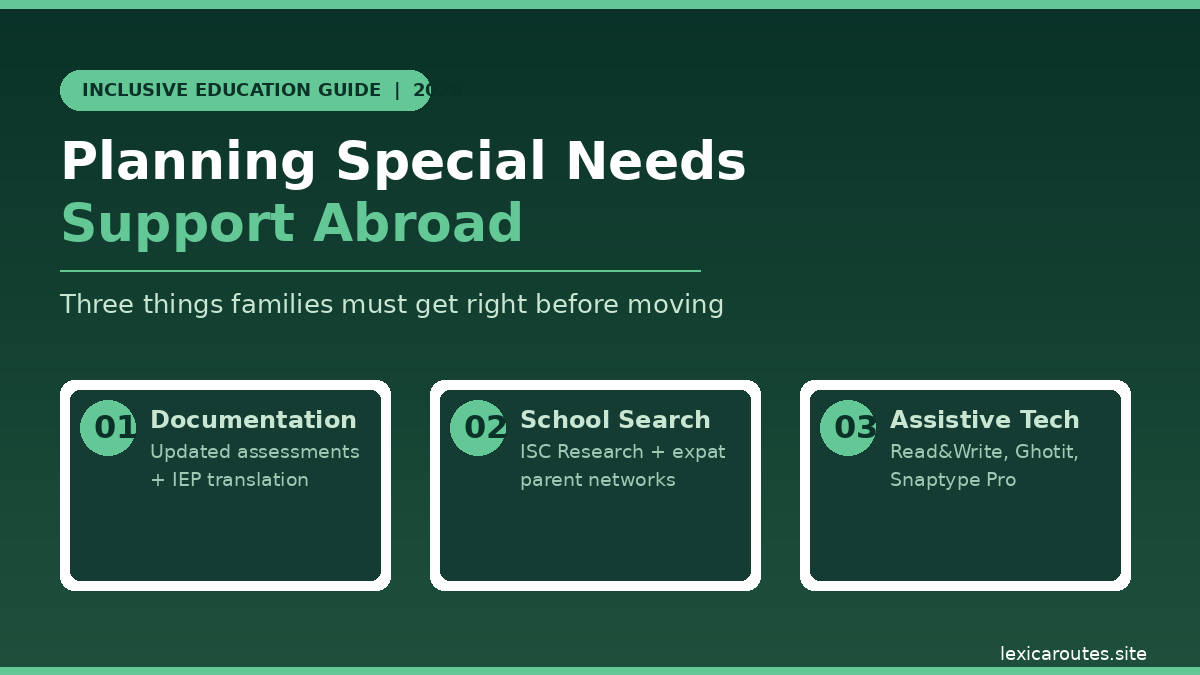
The first thing to sort out is your child’s documentation. Get an updated psychological assessment translated by a certified professional. Many international schools and public systems abroad won’t accept documents older than two years. If your child has an IEP (Individualized Education Plan), bring a full copy, but also be prepared to start the assessment process again from scratch.
Mateo’s family found that their Canadian IEP gave the new school context, but the Portuguese school still required their own evaluation before allocating support hours. It added two months to the process, but it was worth it.
Inclusive Education Abroad: Which Countries Are Leading in 2026
Not all destinations are equal when it comes to disability support services for students. Here’s where inclusive education abroad actually stands up.
Portugal has made serious strides since expanding its Decree-Law 54/2018 framework, which mandates inclusive education as the default for all public schools. For families studying overseas with a learning difference, Lisbon and Porto have multiple public schools with designated resource teachers.
The Netherlands has long been a benchmark. Dutch schools operate a “suitable education” (Passend Onderwijs) policy, meaning every child must receive a placement that fits their learning needs. International schools like the Amsterdam International Community School (AICS) actively support neurodivergent students with trained learning support coordinators.
Germany has expanded its inclusive programs, though availability varies significantly by state (Bundesland). Bavaria and Berlin have the most developed networks for students with learning disabilities at international schools.
Canada and Australia remain top destinations for expat families prioritizing inclusive education. Both countries have robust public school systems with legally protected access to support. For international students, private or independent schools often carry those same standards.
According to UNESCO’s 2024 Global Education Monitoring Report, countries that invest in inclusive frameworks see measurably better long-term outcomes for students with disabilities, including higher secondary completion rates.
Best Schools for Special Needs Students Studying Abroad in 2026
Schools with Dedicated Learning Support Programs
Finding the right school is the core of navigating education abroad with disabilities. These are schools consistently recommended by expat disability networks in 2026.
The International School of Amsterdam (ISA) has a full-time Student Support team and follows IB (International Baccalaureate) frameworks adapted for students with diverse learning needs. They use assistive technology tools like Read&Write and Claro software as standard in their learning support classrooms.
Zurich International School (ZIS) in Switzerland is another strong option. They have one of the most comprehensive learning support departments among European international schools, offering everything from speech-language therapy to executive function coaching.
Australian International School (AIS) Singapore actively integrates students with ADHD, dyslexia, and autism spectrum profiles into mainstream classrooms with co-teaching models.
The International Schools Consultancy (ISC Research) database is a practical tool for filtering schools by country and support services. It’s worth bookmarking if you’re still narrowing down your destination.
For families using the best schools for special needs students studying abroad in 2026 as a search starting point, the ISB (International Schools Bangkok) and Canadian International School (CIS) in Hong Kong also have well-documented support programs.
Resources That Actually Help
Beyond school selection, there are tools families use day-to-day that make a real difference. Understood.org has a dedicated section on raising children with learning differences internationally, including country-by-country guidance and a helpline staffed by education specialists.
The Dyslexia International network also maintains a directory of certified tutors and therapists across 40+ countries, updated in 2026. For families managing autism support, the Global Autism Project maintains a list of international partner schools and therapy centers by region.
Apps like Ghotit Real Writer (designed specifically for students with dyslexia and dysgraphia) and the Snaptype Pro app for occupational therapy support have proven genuinely useful for students in international classrooms where English is not the primary language of instruction.
One thing Mateo’s family did that I’d recommend to everyone: they joined a Facebook group called “Special Needs Expats” before they moved. The real parent-to-school intel in those communities is worth more than any official directory.
COMPARISON TABLE
Schools and support: a quick comparison
| School | Country | Key Support Features | Best For |
|---|---|---|---|
| Intl. School of Amsterdam | Netherlands | Full learning support team, IB adapted, assistive tech | Dyslexia, ADHD, executive function |
| Zurich International School | Switzerland | Speech therapy, EF coaching, inclusive IB | Broad learning needs |
| AIS Singapore | Singapore | Co-teaching, autism integration, mainstream inclusion | ASD, ADHD, mild cognitive needs |
| Canadian Intl. School Hong Kong | Hong Kong | IEP support, ESL integration, disability services | First-gen expat families |
| Intl. Schools Bangkok (ISB) | Thailand | Dedicated Learning Support Centre, psychologists on staff | ADHD, learning disabilities |
VERDICT
Our take
Special needs education abroad is no longer the logistical nightmare it was even five years ago. The infrastructure exists, the schools are stepping up, and the parent networks are stronger than ever. But none of it happens automatically.
The families who make it work are the ones who do the paperwork early, connect with other expat parents in their destination country, and don’t assume their child’s current support plan will survive the border crossing intact. It won’t, but something equally good, sometimes better, can be built on the other side.
FAQ SECTION
Frequently asked questions
What are the best countries for special needs education abroad in 2026?
The Netherlands, Portugal, Switzerland, Canada, and Australia consistently rank highest for inclusive education infrastructure in 2026. Each has legal frameworks requiring schools to accommodate students with learning disabilities and neurodivergent profiles. The Netherlands’ “Passend Onderwijs” policy and Portugal’s Decree-Law 54/2018 are particularly well regarded among expat families.
Can my child keep their IEP when studying abroad at an international school?
Your child’s IEP from home won’t be legally enforceable in another country’s school system, but it serves as a critical reference document. Most international schools will use it as a starting point before conducting their own assessment. Families should bring a full, translated, and recent copy, as schools typically require evaluations from within the last two years.
How do I find international schools with strong learning disability support?
The ISC Research database is a reliable starting point for filtering international schools by country and disability support services. Parent expat networks on platforms like Facebook also provide honest, up-to-date school reviews that official directories don’t capture. Contacting schools directly and asking for their Student Support or Learning Support team documentation is the most reliable check.
Is studying overseas with a learning difference more expensive than regular study abroad?
It can be, especially at private international schools with dedicated learning support teams. Some schools charge additional fees for one-on-one support hours or specialized therapists. In countries with strong public inclusive education systems like Portugal or the Netherlands, families may access services through public schools without the premium costs.
What assistive technology tools are useful for neurodivergent students studying abroad?
Tools widely used by neurodivergent students in international classroom settings include Read&Write (text-to-speech and literacy support), Ghotit Real Writer (dyslexia and dysgraphia focused writing tool), Snaptype Pro (for occupational therapy tasks), and Google Workspace accessibility features. Many international schools using the IB curriculum already have these integrated into their learning support workflow.
RELATED POSTS
You might also like:
Author: Written by the Lexica Routes editorial team, covering travel, education, and study abroad since 2025.