If you’ve been wondering whether a certificate, badge, or short-term training program can actually replace a four-year degree, you’re not alone. Non-degree credentials are everywhere in 2026, and employers are paying attention. But with over 1.5 million credentials now available in the U.S. market, the honest question isn’t whether they exist. It’s whether they actually pay off. This review covers what the latest research says, which credentials are worth your time and money, who they work best for, and what the landmark Workforce Pell Grant changes mean for you starting July 2026.
What Are Non-Degree Credentials, and Why Are They Booming?
Non-degree credentials include certificates, certifications, licences, badges, and microcredentials. They sit outside the traditional degree pathway, usually require weeks or months instead of years, and cost a fraction of a university degree. The pitch is simple: faster, cheaper, and more job-focused.
The numbers back up the boom. According to recent data from Credential Engine, over 1.5 million non-degree credentials now exist in the United States, and more than one quarter of American adults already hold at least one. The credential marketplace has exploded at a pace that outstrips any attempt to regulate or rank it.
Part of the surge is structural. Tuition costs have climbed for decades, Gen Z unemployment for college graduates has crept toward 7% for men according to recent labour market analysis, and employers are increasingly vocal about the fact that a degree doesn’t guarantee job-readiness. Skills-based hiring is no longer a niche HR philosophy. It’s becoming standard practice in tech, healthcare, logistics, and the skilled trades.
The Honest Numbers: Most Credentials Don’t Deliver
Here is the part the promotional material leaves out. A major analysis published by the American Enterprise Institute and the Burning Glass Institute reviewed credential outcomes across the U.S. workforce and landed on a sobering finding: only about 12% of non-degree credentials produce significant wage gains compared to peers who don’t hold them.
That is not a misprint. Twelve percent.
The credential boom has created a marketplace that is, in the words of one analyst at the Brookings Institution, functioning like a modern gold rush where far more prospectors exist than people who strike it rich. With over 1.5 million credentials available, and no consistent national standard for measuring quality, learners are often making high-stakes financial decisions with very little reliable guidance.
A separate analysis of 37.7 million U.S. worker resumes published by CEPR researchers adds important nuance. Credentials that are directly relevant to the job a worker holds or is targeting do produce meaningful returns. The first job-relevant credential a worker earns is associated with a 3.8% wage premium, more than double the 1.8% premium for a credential that lacks that direct occupational match. The takeaway: the credential itself isn’t the variable. The match between the credential and the specific role is what drives outcomes.
What Makes a Non-Degree Credential Actually Worth It?
Based on current research, four factors separate the credentials that pay off from the ones that don’t:
Employer recognition. Is this credential widely listed in job postings for the role you want? If it barely shows up, it won’t move the needle on your hiring prospects.
Occupational specificity. A JavaScript certification that appears more than ten times more often among software developers than in the general workforce signals real value. Generic “professional development” credentials rarely do.
Stackability. Credentials that build toward a qualification, a degree, or a recognised pathway tend to hold more value than standalone badges.
Industry sector. Healthcare, IT, skilled trades, and transportation are the sectors where credentials most reliably translate to employment and wage gains. Vague business or leadership credentials rarely deliver the same return.
The Workforce Pell Grant: A Game-Changer Starting July 2026
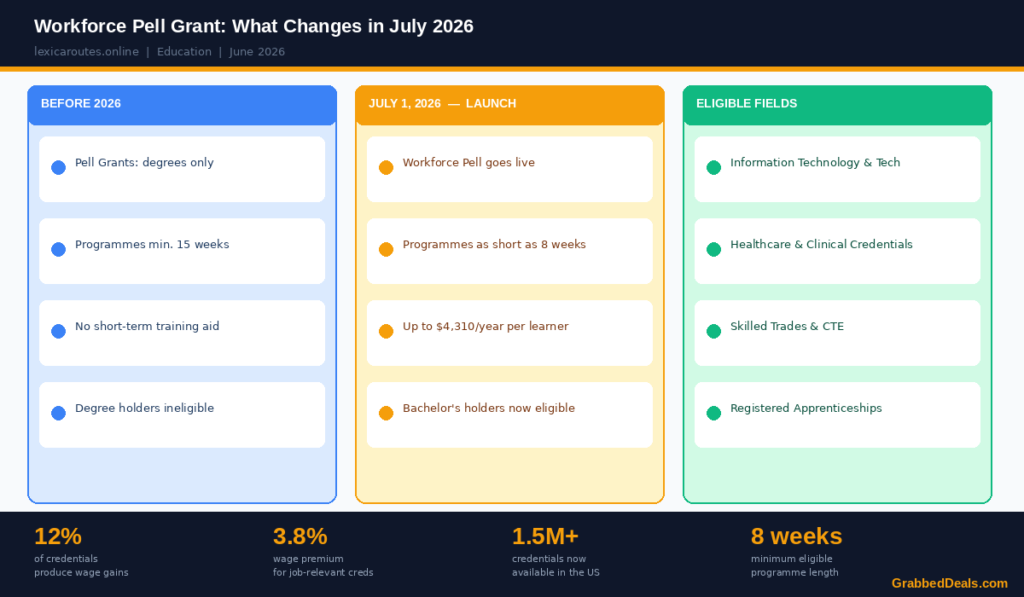
One development that reshapes this entire conversation is the Workforce Pell Grant, which launches on July 1, 2026. The U.S. Department of Education published the final rule on May 19, 2026, confirming that federal Pell Grant aid will now be available for short-term training programs for the first time in the programme’s history.
Previously, Pell Grants could only be used for programmes lasting at least 15 weeks as part of a degree pathway. Under the new rule, eligible learners can use Pell funding for programmes as short as eight weeks, in fields including IT, healthcare, and skilled trades. Eligible students can receive up to $4,310 per year toward these programmes. Crucially, even students who already hold a four-year degree are eligible for Workforce Pell, a significant departure from traditional Pell rules.
The implications are significant. Short-term programmes that were previously only accessible to learners who could self-fund are now within reach for low-income and working-class Americans. State governors, working with workforce boards, will identify eligible programmes in high-demand industries within their states, providing a layer of quality assurance that the broader credential marketplace currently lacks.
This federal backing doesn’t make all credentials equal overnight. But it does mean that the short-term credential pathway now has both government legitimacy and funding infrastructure behind it for the first time.
Pros and Cons: Non-Degree Credentials in 2026
| Pros | Cons |
|---|---|
| Faster to complete: 8 to 52 weeks vs. 3 to 4 years | Most (88%) produce no significant wage gains |
| Significantly lower cost than a four-year degree | Quality is wildly inconsistent across providers |
| Workforce Pell now covers eligible short-term programmes | Limited name recognition outside specific industries |
| Strong returns in IT, healthcare, and skilled trades | Poorly suited to management or strategic roles |
| Stackable credentials can lead toward further qualifications | Few have consistent national standards or accreditation |
Who Non-Degree Credentials Work Best For
Non-degree credentials are not a universal replacement for a degree. But for specific learners in specific circumstances, they are genuinely the most efficient path to employment.
Career changers who need to demonstrate new technical skills quickly, particularly in IT or healthcare, benefit most. A Google IT Support Certificate or an AWS Cloud Practitioner certification signals competency to hiring managers in a language they recognise.
Working adults who can’t afford to stop earning for two or four years but want to move into higher-paying roles. The new Workforce Pell framework is designed specifically with this group in mind.
Skilled trades entrants who want to formalise training in HVAC, electrical work, medical coding, or logistics. These fields have well-established credential standards and consistent employer recognition.
Degree-holders upskilling in a new technical area, such as a marketing professional adding a data analytics certification or a nurse adding a specialist clinical credential. The 3.8% wage premium from a job-relevant credential is a meaningful return on a modest investment.
Recent school leavers exploring alternatives before committing to a full degree. Short-term credentials offer a lower-risk way to test job readiness and sector fit.
Our Verdict on Non-Degree Credentials in 2026
The blanket claim that credentials are the new degree is still overstated. A four-year degree retains its value in graduate-level fields, management pipelines, and roles where employers use it as a baseline filter. But the equally lazy dismissal of non-degree credentials ignores a real, growing portion of the labour market where they genuinely outperform degrees on speed, cost, and relevance.
The framework that works: choose credentials that are recognised in job postings for your target role, in sectors with clear employer demand, ideally backed by a major institution (Google, AWS, CompTIA, NHS, TEFL-registered bodies) rather than a no-name platform. The Workforce Pell Grant, launching July 1, 2026, now provides financial access that didn’t exist before, and state-level quality filters will help separate reliable programmes from noise over time.
Frequently Asked Questions
Are non-degree credentials worth it in 2026?
It depends on the credential and sector. Research shows only about 12% of non-degree credentials produce significant wage gains. However, job-relevant credentials in IT, healthcare, and skilled trades consistently deliver a return. The key is choosing a credential that employers in your target role actually list in job postings, not just any certificate.
What is the Workforce Pell Grant and who qualifies?
The Workforce Pell Grant is a new federal programme launching July 1, 2026, that extends Pell Grant funding to short-term training programmes of 8 to 15 weeks. Low-income learners pursuing approved programmes in high-demand industries can receive up to $4,310 per year. Unlike regular Pell Grants, students who already hold a bachelor’s degree are eligible, but graduate degree holders are excluded.
What non-degree credentials do employers actually value?
Employers most consistently value credentials from recognised industry bodies or major tech firms. These include CompTIA (IT), AWS (cloud), Google (IT support, data analytics), Cisco (networking), and certified trade qualifications in healthcare, electrical, and HVAC fields. Credentials from niche platforms with no employer recognition rarely carry weight.
How do non-degree credentials compare to a two-year associate degree?
An associate degree provides broader academic foundation and often carries more institutional weight for management roles. But a targeted non-degree credential in a specific technical skill can be completed faster and at lower cost. For entry-level technical roles in IT and skilled trades, a relevant credential often competes directly with an associate degree in hiring outcomes.
Can I stack non-degree credentials toward a full degree?
Yes, increasingly so. Many community colleges and online universities now accept certain credentials for prior learning credit. Stackable credential frameworks, particularly those recognised under the new Workforce Pell rules, are explicitly designed to create a pathway from short-term certification toward longer-term qualifications. Ask your target institution about their credit recognition policy before enrolling.
Related Posts
- Microcredentials vs Degrees: Which Is Worth It in 2026?
- How to Fund a Gap Year: 14 Scholarships and Grants Available in 2026
Author: Written by the Lexica Routes editorial team, covering travel, education, and study abroad since 2025.