If you are an international student planning to study in the United States, the landscape in 2026 looks very different from just two years ago. US international student restrictions 2026 have moved from policy proposals to real-world impact, with foreign enrollment at American universities falling by 20% in the spring semester compared to the same period last year. From sweeping visa rule changes to SEVIS terminations and social media screenings, the rules governing who can study in the US have tightened significantly under the current administration. This article breaks down exactly what has changed, what is still coming, and what it means for prospective and current international students.
What Has Changed for International Students in 2026
The shift in US higher education policy toward international students did not happen overnight, but 2026 has brought several changes that are now directly affecting enrollments.
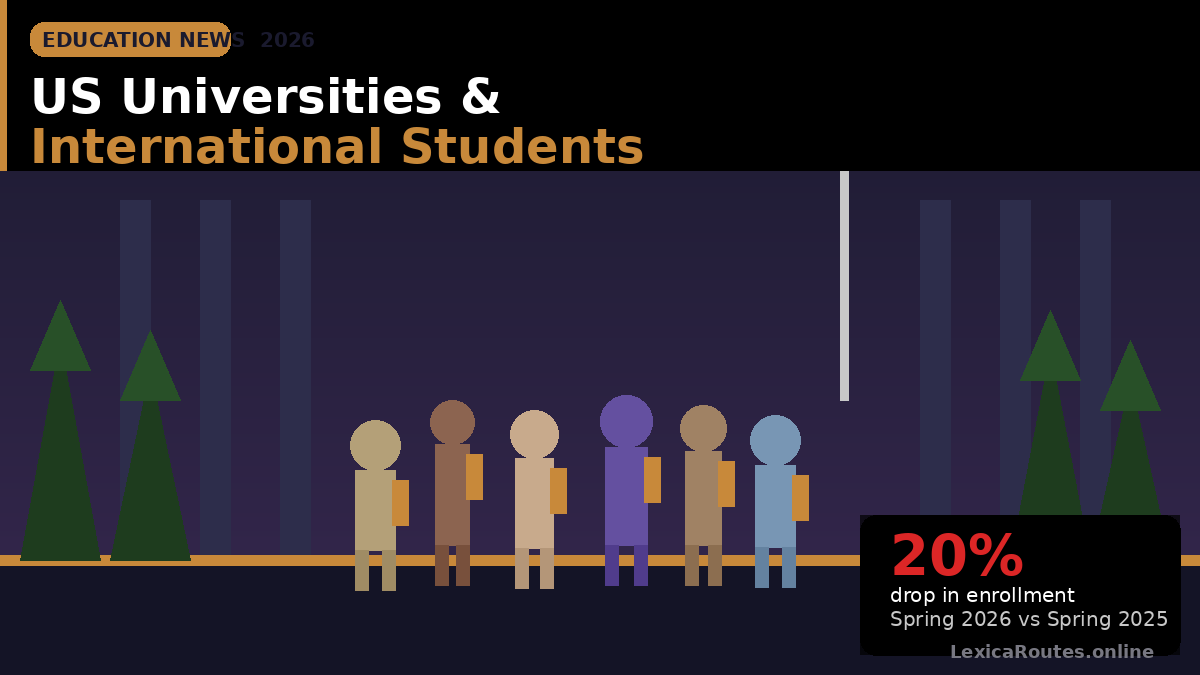
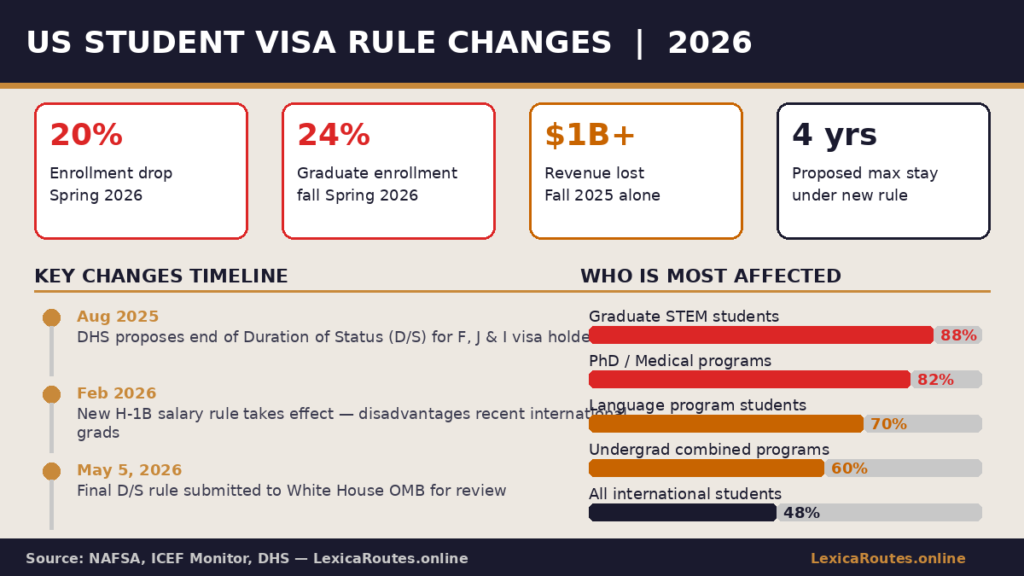
Foreign student enrollment at US universities for the 2026 spring semester fell by 20% compared to spring 2025, according to a report from NAFSA, the Association of International Educators. The survey, which covered 149 US schools, found that around 62% of those institutions reported lower international student enrollment in both undergraduate and graduate programs. At the graduate level, the average fall was even steeper, at 24%.
The financial consequences are significant. NAFSA estimates that the roughly 17% drop in new international student enrollment for fall 2025 alone translates to more than $1 billion in lost revenue for US institutions. California, Massachusetts, and New York have recorded the biggest losses so far.
Universities are already feeling the strain. The University of Southern California laid off hundreds of employees as it works to reduce its budget deficit, and Northwestern University cut 425 positions across its campus. These reductions are directly linked, at least in part, to declining international enrollment revenue.
The New F-1 Visa Rules: Duration of Status Is Ending
The most significant regulatory change on the horizon is the proposed end of the “Duration of Status” (D/S) system for holders of F, J, and I visas.
Under the current system, international students can remain in the US for as long as they are enrolled and complying with visa requirements, with no hard end date on their I-94 form. The US Department of Homeland Security (DHS) submitted a final rule in August 2025 to replace this with a fixed stay period, likely capped at four years. The rule was sent to the White House Office of Management and Budget for review on 5 May 2026, and is expected to take effect as early as September 2026 for the fall intake.
What this means in practice is significant. Students who need more than four years to complete their degree, including those in PhD programs, medical training, or combined undergraduate-graduate programs, will need to apply for an extension through US Citizenship and Immigration Services (USCIS). Crucially, universities will no longer be able to handle these extensions themselves. That authority moves entirely to federal immigration officials.
Language students face an even tighter limit, with a proposed maximum of 24 months of admission, including breaks.
According to NAFSA, the proposal would create substantial uncertainty for both students and institutions, and could discourage students from choosing American universities at all. Nearly half of all international students in the US are enrolled in graduate-level programs, and international students make up a major share of STEM fields such as engineering and computer science.
Other Enforcement Actions Already in Effect
Beyond the proposed Duration of Status rule, a series of enforcement measures have already rolled out since early 2025.
These include a temporary pause on new student visa interviews, a travel ban affecting 39 countries, mass terminations of SEVIS records, expanded social media screening of visa applicants, and threats to revoke the visas of Chinese international students specifically. A new H-1B lottery rule, which prioritizes higher-salary applicants, took effect on February 27, 2026, and disproportionately affects recent international graduates who are typically classified at lower wage levels.
Visa appointment delays have also compounded the problem. In some countries, wait times for a student visa interview have stretched to a year and a half, making it practically impossible for admitted students to arrive in time for their semester start.
Why It Matters: The Bigger Picture
The US has long relied on international students as a significant revenue stream for higher education. Public sector foreign and out-of-state students are, as one analyst puts it, no longer a supplement to funding but core funding at many institutions.
If enrollment continues to decline, the cost of that shortfall will eventually be passed on to domestic students in the form of higher tuition fees and reduced services.
Meanwhile, universities in Asia and Europe are moving quickly to fill the gap. Education agents in several countries are already advising families to consider alternatives to the US. Chinese families in particular, traditionally one of the largest sources of international students, are increasingly being steered away from Anglophone destinations altogether.
Some institutions are adapting by offering hybrid start options, allowing students to begin their coursework online before arriving on campus, and extending payment deadlines to reduce risk for students navigating last-minute visa issues.
What Comes Next
The Duration of Status final rule is currently under review at the Office of Management and Budget. Once published, it is expected to take effect in September 2026, meaning students planning to enroll in fall 2026 could be among the first affected.
Higher education groups including NAFSA, the American Council on Education, and the Presidents’ Alliance have all submitted comments opposing the rule, citing its harmful impact on graduate programs, research, and institutional finances. Legal challenges are considered likely, given that a similar rule proposed during Trump’s first term was ultimately withdrawn after being challenged in court.
For current students already in the US, it is important to track the status of your SEVIS record, confirm the end date on your I-94, and speak directly with your university’s international student office about what the new rules mean for your specific program length. For prospective students, consider applying to institutions with strong support systems for international students, and factor in realistic visa timelines when planning your start date.
KEY FACTS
| What happened | The US is ending “Duration of Status” for F, J, and I visa holders and replacing it with a fixed four-year stay limit |
|---|---|
| Who is affected | All new and current international students on F-1, J-1, and I visas in the US |
| When it takes effect | Expected September 2026 for fall intake, pending OMB review |
| What enrollment shows | Foreign student enrollment fell 20% in spring 2026; graduate enrollment fell 24% |
| Where to get more info | NAFSA.org, ICEF Monitor, your university’s international student services office |
VERDICT
The combination of a 20% enrollment drop, a billion dollars in lost revenue, and a sweeping new visa rule set to arrive in September 2026 makes this one of the most consequential moments in US international education in decades. For students, the message is clear: the rules are changing fast, and waiting to see what happens is not a safe strategy. Track your visa status, stay in close contact with your institution’s international office, and explore your options. For a broader look at where students are going instead of the US, read our guide to the top countries for international students right now.
FAQ SECTION
What does the end of Duration of Status mean for international students?
Duration of Status is the current system that lets international students stay in the US for as long as they are enrolled and compliant with their visa requirements, with no fixed end date. The proposed rule would replace this with a four-year maximum stay. Students who need longer than four years, such as PhD candidates or those in medical programs, would need to apply for an extension through USCIS rather than through their university.
When will the new US student visa rule take effect?
The Department of Homeland Security submitted the final rule to the Office of Management and Budget for review on 5 May 2026. The rule is expected to take effect as early as September 2026, potentially affecting students enrolling in the fall 2026 semester. Legal challenges could delay implementation.
Which international students are most affected by US policy changes in 2026?
Graduate students are the most immediately affected, with enrollment at the graduate level falling 24% in spring 2026. Students in STEM fields, PhD programs, and medical training also face the greatest disruption from the proposed four-year cap, since many of these programs take longer to complete. Students from countries with long visa wait times face additional barriers.
Is it still worth applying to US universities in 2026?
US universities still offer world-class programs and research opportunities, but the risk and uncertainty are higher than they have been in many years. Prospective students should factor in realistic visa timelines, look for universities that offer hybrid start options, and assess what their plan B would be if a visa is delayed or denied. Many students are now applying to the US and to universities in Canada, Germany, or the UK simultaneously.
What should current international students in the US do right now?
Check the end date on your I-94 and confirm your SEVIS record is active and in good standing. Speak with your university’s international student services office about how the proposed Duration of Status rule would affect your specific program. Avoid travel outside the US without first consulting your DSO (Designated School Official), and be aware that social media screening is now a standard part of visa processing.
RELATED POSTS
- Top 10 Countries for International Students Right Now
- Fully Funded Scholarships Open Right Now: June 2026 Roundup
Author: Written by the Lexica Routes editorial team, covering travel, education, and study abroad since 2025.