My niece is thirteen. Last month she handed in a history essay, and I asked if she needed help with research. She gave me the kind of look teenagers reserve for genuinely outdated suggestions. “I just asked ChatGPT,” she said, and went back to her phone.
That moment stuck with me, because she is not the exception. She is the norm.
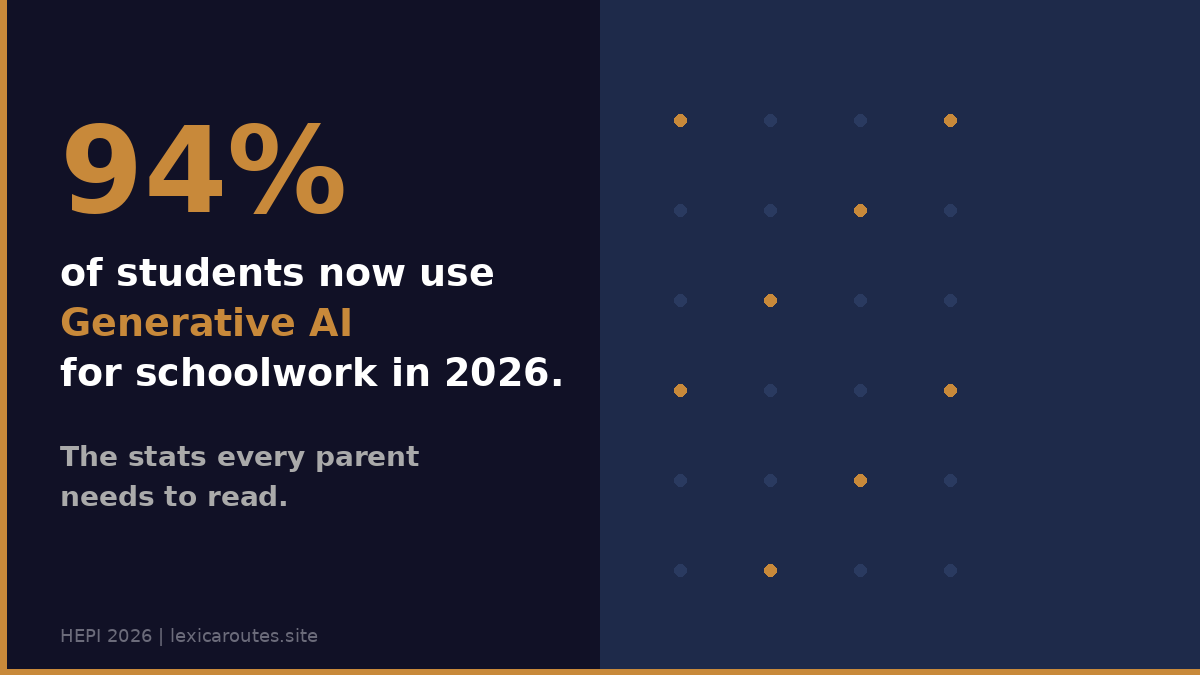
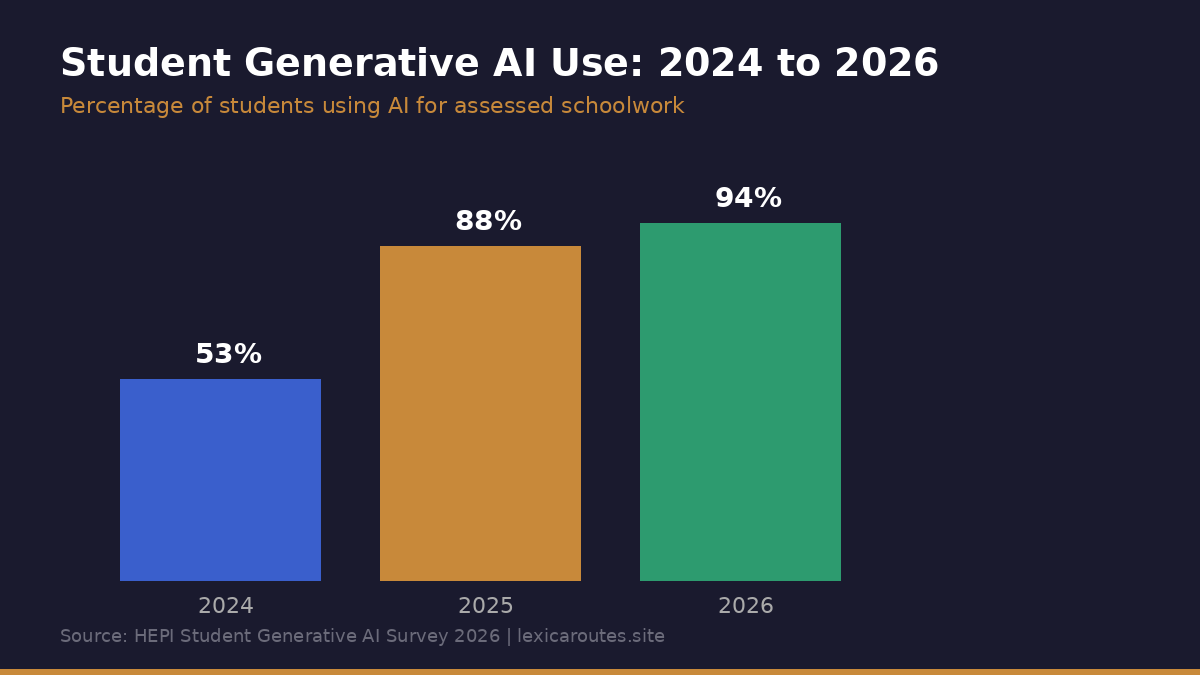
A major 2026 survey by the Higher Education Policy Institute found that 94% of students now use generative AI to help with assessed work, up from 88% the year before. If you have a child in school or university right now, there is a near-certain chance they are already using AI tools, whether you know about it or not. This article walks through what the latest data actually shows, what the real risks are, and what parents can practically do with this information.
What the 2026 Numbers Actually Say
The headline figure is striking on its own: 94% of students use generative AI to help with assessed work. But the story behind the data is even more interesting for parents.
The same HEPI 2026 survey found that 95% of students now use AI in at least one aspect of their studies. A year earlier that figure was 92%. The year before that, 66%. We are not watching a gradual adoption curve here. This is a near-complete shift in how a generation does schoolwork.
The tools students reach for most are ChatGPT, Google Gemini, Microsoft Copilot, and Grammarly. According to data compiled by DemandSage, 66% of students use ChatGPT specifically, making it by far the most common tool in classrooms and dorm rooms. Grammarly comes second at around 25%.
What are they actually doing with these tools? The most common uses, according to multiple surveys, are:
- Explaining concepts they did not understand in class
- Summarising long articles or readings
- Brainstorming essay ideas
- Getting a first draft to revise from
- Checking grammar and writing style
That list probably looks less alarming than you expected. Most students are not simply pressing a button and submitting the output. Most are using AI the way an older generation used Wikipedia: as a starting point that still requires work.
The Number That Should Actually Concern Parents
How students use generative AI for schoolwork is shifting fast
Here is the stat that tends to get buried under the bigger headline numbers.
The proportion of students who directly paste AI-generated text into assessed work and submit it as their own has risen to 12% in 2026, up from 8% in 2025 and just 3% in 2024. That is still a minority, but the trajectory is moving quickly.
This matters because there is a meaningful difference between using AI to understand a concept and using AI to complete an assignment. One builds on learning. The other bypasses it. For a student preparing for exams, job interviews, or professional work, that gap shows up later and it shows up hard.
The HEPI report also noted that 65% of students feel their assessments have changed significantly in response to AI, and some expressed genuine anxiety about being falsely accused of misconduct even when they had used AI appropriately. That is a new kind of stress that most parents are not aware their children are navigating.
The Risks Parents Are Not Talking About Enough
AI tools in education are not just an integrity question. There are a few other risks worth knowing about.
Over-reliance on AI for thinking. Multiple researchers and lecturers surveyed in 2025 flagged that students who habitually use AI for first drafts can lose confidence in their own ideas. If your child has started saying “I don’t know how to start” more often when the Wi-Fi is out, that is a signal worth paying attention to.
Misinformation from confident-sounding AI. In one engineering education survey, 73% of students identified misinformation as their top concern about AI tools. AI does not always know when it is wrong, and it rarely says so. A student who uses AI as their only source and does not cross-check can hand in essays with plausible-sounding inaccuracies.
No school policy at home. UNESCO research found that only 10% of schools have established clear guidelines for AI use. That means even if a school has rules in class, your child is likely going home to a completely unregulated environment where the line between supported learning and shortcutting is blurry.
What Parents Can Actually Do Right Now
This is not a “ban AI” conversation. These tools are already embedded in how this generation learns, and frankly, AI literacy is going to be a real professional skill within a few years. The goal is supervised, intentional use.
A few things that genuinely help:
1. Have one honest conversation, not a lecture. Ask your child which AI tools they use and what they use them for. Most teenagers will talk about this openly if you approach it with curiosity rather than suspicion. You will probably learn something.
2. Set a “show your thinking” rule. For any AI-assisted work, ask your child to explain the key ideas to you in their own words. This is not about catching them out. It is about making sure learning actually happened. If they can explain it, they have learned it.
3. Know the difference between helpful and harmful use. Using AI to understand a maths concept is different from using it to write a maths assignment. Using it to get feedback on an essay draft is different from submitting the AI’s draft as your own. Help your child see that distinction clearly.
4. Check whether their school has an AI policy. Many schools in 2026 are updating their policies in response to new state legislation. States like Idaho and Oklahoma now require schools to publish written AI policies. Ask the school directly what their current rules are, and what happens if those rules are broken.
5. Let them use it for learning, with you sometimes. Try asking ChatGPT a question together. Look at what it gets right and what it gets wrong. This builds critical thinking about AI outputs far more effectively than a warning ever will.
AI in the Classroom: What Schools Are (and Are Not) Doing
Schools are not sitting still on this. Across 2026, many institutions are redesigning assessments specifically around AI use, moving toward oral exams, in-class writing, and project-based assessments that are harder to outsource.
Some schools are now actively teaching AI use as a skill. Students are learning to prompt effectively, evaluate outputs critically, and cite AI assistance appropriately. This is arguably a better response than detection arms races.
That said, the HEPI 2026 data found that nearly half of students (49%) believe AI has improved their overall experience, particularly by saving time and improving their understanding. That is not a small number. Used well, these tools genuinely help students learn faster.
The honest truth is that AI in education is not going away. The parents who will feel most confident are the ones who understand what their children are actually doing with it.
Use Summary: What the 2026 Data Shows at a Glance
| Metric | 2024 | 2025 | 2026 |
|---|---|---|---|
| Students using AI for assessed work | 53% | 88% | 94% |
| Students using AI in any study context | 66% | 92% | 95% |
| Students submitting AI-generated text directly | 3% | 8% | 12% |
| Students saying AI improved their experience | N/A | N/A | 49% |
| Schools with clear AI guidelines (UNESCO) | N/A | 10% | ~10% |
Sources: HEPI Student Generative AI Survey 2026, UNESCO, DemandSage AI in Education Statistics 2026
Our take
The 94% figure is not a warning sign on its own. It is a description of reality. Students are using generative AI tools the same way every generation has reached for the best available tool, and most of them are using it in ways that support learning rather than replace it.
What parents should focus on is not the number but the behaviour behind it. Is your child still developing their own ideas? Can they explain what they submitted? Do they know the difference between using AI to learn and using it to avoid learning?
These are questions worth asking now, while the norms around AI in education are still being shaped. Schools are updating policies, states are passing legislation, and the tools themselves are changing fast.
Frequently asked questions
Is it cheating for students to use generative AI for schoolwork?
It depends on the school’s policy and how the AI is used. Using AI to understand a concept, brainstorm ideas, or improve a draft is generally considered acceptable at most institutions. Submitting AI-generated text as your own original work without disclosure is widely treated as academic misconduct. The key distinction is whether AI is supporting learning or replacing it.
What percentage of students use ChatGPT in 2026?
According to the HEPI 2026 survey, 94% of students now use generative AI for assessed work, and the majority rely on ChatGPT specifically. Separate data from DemandSage puts ChatGPT usage among students at around 66%, making it the dominant tool by a significant margin.
How can parents monitor their child’s AI use without invading privacy?
The most practical approach is an open conversation rather than monitoring software. Ask your child what tools they use and how. If you want to build in a check, ask them to explain their submitted work in their own words. This approach builds trust while also confirming that learning actually happened.
Are schools allowed to ban students from using AI?
Schools can set their own AI use policies, and many are doing so. As of 2026, several US states including Oklahoma and Idaho are requiring schools to publish written AI policies. Some schools ban AI for specific assessments, others require disclosure, and some have redesigned assessments entirely to reduce the scope for AI use. Parents should check their child’s school policy directly.
Does using AI actually help students learn better?
The evidence is mixed. A 2025 Harvard study found that students using AI tutoring tools learned more than twice as fast as those in traditional classroom settings. However, researchers also warn that passive reliance on AI for writing or answers can reduce critical thinking and reduce students’ confidence in their own abilities over time. The outcome depends heavily on how the tools are used.
RELATED POSTS
Author: Written by the Lexica Routes editorial team, covering travel, education, and study abroad since 2025.