A few years back, a friend of mine spent three months studying nights and weekends for a project management certificate. She passed, got a modest pay bump, then felt stuck. Going back for a full degree felt impossible: too expensive, too long, too much life already happening.
What she didn’t know then, and what more people are figuring out in 2026, is that she didn’t need to start from scratch. That certificate? It could have counted toward a diploma. That diploma toward a degree. The system that makes this possible is called Stackable Credentials 2026, and once you understand how it works, the path to building real qualifications stops looking like a cliff and starts looking like a staircase.
This guide walks through exactly how that staircase works, who it’s for, and how to climb it without wasting time or money.
What Are Stackable Credentials, Really?
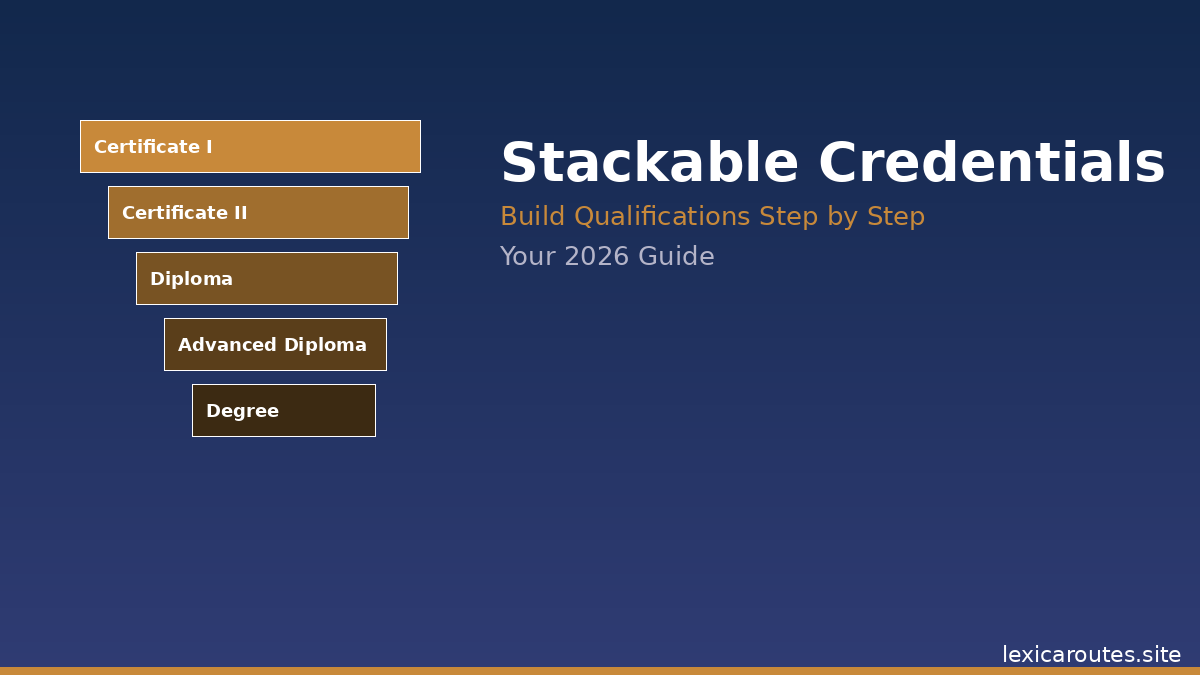
Forget the formal definition for a second. The simplest way to think about it: each qualification you earn can connect to the next one. A short course feeds into a certificate. That certificate feeds into a diploma. The diploma can count toward a degree. You’re not collecting random pieces of paper; you’re building a recognized pathway where each step has value on its own and also opens the door to the next level.
This is the core idea behind a stackable credentials guide: no single certificate is a dead end, and you don’t have to commit to a four-year program upfront to eventually get a degree-level qualification.
The system works because many educational institutions now use credit recognition (also called Recognition of Prior Learning or RPL). Credits you earned at one level transfer to the next, so you’re only covering new ground, not repeating yourself.
How the Pathway Actually Works, Step by Step
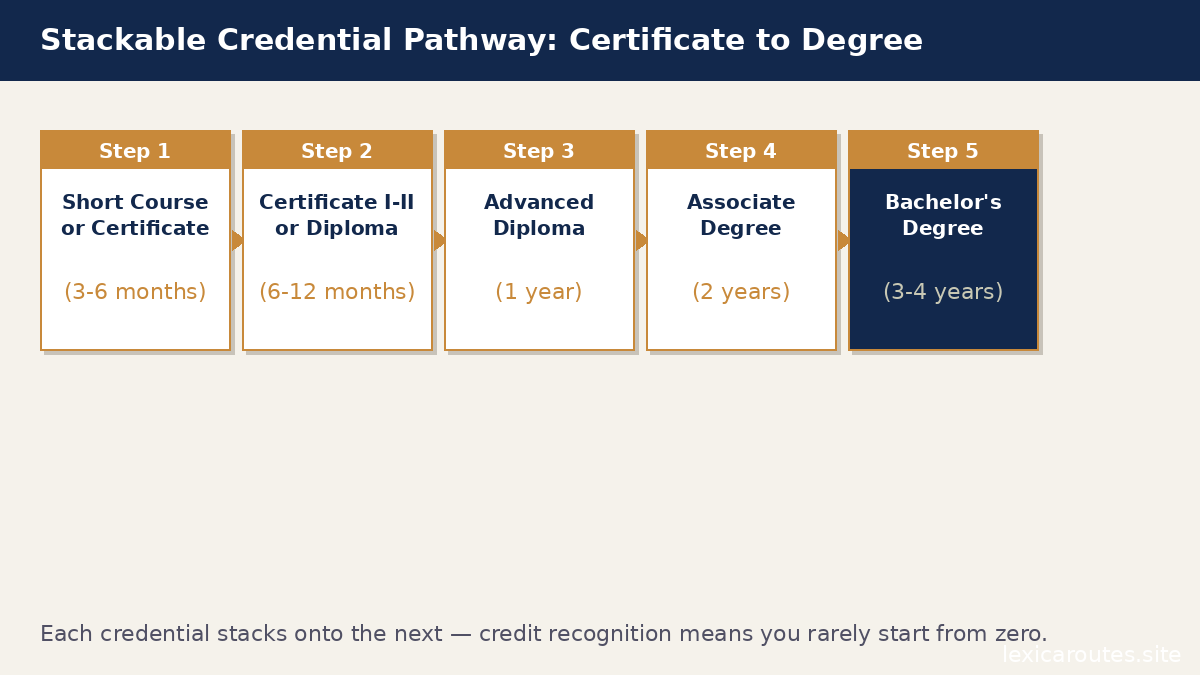
Most stackable pathways follow a structure similar to this, though exact naming varies by country:
Step 1: Short Course or Skill-Specific Certificate (3 to 6 months) Start narrow. This is where most people enter. You pick one skill area: digital marketing, data entry, project coordination, community services. You complete it, get a certificate, and it’s immediately usable on a CV. For working adults, this is often the most manageable entry point.
Step 2: Certificate I or II, or a Vocational Diploma (6 to 12 months) Your first certificate can often be credited toward a broader qualification. If you completed a short data analytics course, for example, a Certificate in IT or a vocational data diploma might accept that prior learning and let you skip modules you’ve already covered.
Step 3: Advanced Diploma or Higher Vocational Qualification (around 1 year) By this stage, you have enough foundational credit to move into specialist territory. This is where vocational training and academic pathways start to intersect. Many universities now accept advanced diplomas as entry into the second year of a bachelor’s degree, which cuts a full year off your undergraduate timeline.
Step 4: Associate Degree or University Bridging (1 to 2 years) This level is common in the US and increasingly available in Australia and the UK. It’s a standalone qualification and a recognized stepping stone toward a full bachelor’s, often with 60 to 90 credits carrying directly across.
Step 5: Bachelor’s Degree (1 to 2 additional years at this point) If you’ve built through the stack, you may only need 1 to 2 years of full-time study (or longer part-time) to complete a full undergraduate degree. You’ve effectively cut the traditional four-year timeline by half, and you had a real, employable qualification at every stage along the way.
The video below from the Australian Government’s Job Outlook channel explains how the Australian Qualifications Framework structures these pathways in practice, which is one of the clearest real-world models globally.
Watch: How the Australian Qualifications Framework Works
How to build qualifications step by step with stackable credentials: the practical checklist
Before you start, a few things worth confirming:
- Check whether your target institution accepts credit transfer or RPL for qualifications you already hold.
- Ask specifically which modules your existing certificate covers, not just whether credits “may” transfer.
- Look for pathways that are formally articulated (meaning the institutions have a written agreement, not just a general policy).
- Keep every transcript, certificate, and course outline you’ve ever received. Prior learning assessment needs documentation.
Who Gets the Most Out of This System
This isn’t for everyone in the same way. The people who benefit most from a micro-credentials pathway tend to fall into a few clear groups.
Working adults who can’t take three years off. You earn, you learn, you stack. Each credential improves your position at work while you work toward the next level.
Career changers who need to prove a new skill set quickly. A short certificate in UX design or cybersecurity, backed by prior work experience, can open a door before you’re committed to a full degree.
People in regions where universities are expensive or inaccessible. Online vocational providers and community colleges often offer the early stacking levels at a fraction of university tuition, and many now have formal articulation agreements with major universities.
According to the OECD’s Skills Outlook report, short-cycle credentials tied to employment outcomes are growing faster than traditional degree enrollment in most developed economies. The signal is clear: employers are reading them, and institutions are formalizing the pathways.
Common Mistakes That Cost People Time (and Money)
The biggest mistake is collecting certificates without a plan. You take one here, one there, all from different providers, and none of them talk to each other. Five years later you have a folder full of credentials and no clear pathway.
The second mistake is assuming credit transfer is automatic. It is not. You need to ask, confirm in writing, and sometimes submit a formal RPL application. Some institutions charge a small assessment fee. Budget for it.
The third mistake is skipping the middle steps to rush toward a degree. If you have the financial and time resources to go straight to university, that may make sense. But for most people using this system, the value is in having something usable at every stage. Skipping steps often means skipping the credentials that would have improved your income during the process.
One resource worth bookmarking is Coursera’s academic credit partnerships page, which lists university programs that accept verified online credentials toward formal degree credits. It’s a practical tool for mapping where your online learning can actually count.
COMPARISON
Stackable Credentials: Quick-Reference Step Summary
| Step | Qualification Level | Typical Duration | Standalone Value | Stacks Toward |
|---|---|---|---|---|
| 1 | Short Course / Certificate | 3–6 months | Entry-level CV boost | Certificate I/II or Diploma |
| 2 | Certificate I–II or Vocational Diploma | 6–12 months | Technical employment | Advanced Diploma |
| 3 | Advanced Diploma | ~1 year | Specialist roles, higher pay | Year 2 of a Bachelor’s |
| 4 | Associate Degree | 1–2 years | Management-level entry | Final years of Bachelor’s |
| 5 | Bachelor’s Degree | 1–2 years (via stack) | Graduate-level careers | Postgraduate programs |
VERDICT
Our take
Stackable credentials are not a consolation prize for people who couldn’t get into university. They’re a genuinely smarter route for anyone who needs qualifications to grow alongside life, not instead of it. The key is going in with a plan: know where you’re starting, confirm where each step leads, and document everything.
If you already hold a certificate or diploma and aren’t sure what to do next, the first move is a simple email or call to your target institution’s admissions office, specifically asking about RPL and articulation agreements. That one conversation often changes everything.
FREQUENTLY ASKED QUESTIONS
Frequently asked questions
Are stackable credentials recognized by employers in 2026?
Yes, increasingly so. Most major employers now recognize vocational certificates and micro-credentials issued by accredited providers, especially when they’re tied to specific job-ready skills. The key is ensuring your credential comes from an accredited institution or a provider with a recognized industry partnership. Credentials from random online platforms without accreditation carry much less weight.
How long does it take to go from a short course to a full degree using stackable credentials?
It varies by field and how much time you can commit, but most people building through a full stack reach bachelor’s degree level within four to six years of part-time study, compared to three to four years of full-time traditional university. The trade-off is that you’re employable and earning at every stage, which changes the financial picture significantly.
Can I stack online credentials toward a physical degree?
Yes, but only if the institution formally accepts the credit. An increasing number of universities have articulation agreements with online providers like Coursera, edX, and TAFE Digital, meaning verified completions can count toward academic credits. Always confirm this before enrolling, and get the agreement in writing.
What is prior learning assessment and how does it help with building qualifications step by step?
Prior learning assessment, or PLA, is the process by which an institution evaluates what you already know and have done, including work experience, informal training, and previous study, against the learning outcomes of a formal qualification. If you pass, you can skip those modules and reduce your overall study load. It saves time and often money, but requires documentation and sometimes a portfolio or challenge assessment.
Is the micro-credentials pathway the same in every country?
No, and this is worth knowing before you commit. The US, UK, Australia, Canada, and the EU each have their own qualification frameworks, and credit portability between countries is limited. If you plan to study internationally or move countries during your credential-building journey, research bilateral recognition agreements first. Your qualifications may not transfer automatically across borders.
RELATED POSTS
You might also like:
Author: Written by the Lexica Routes editorial team, covering travel, education, and study abroad since 2025.