My nephew came home last month with a reading assessment note. His teacher flagged him as “below average for his age group.” He is 10, sharp as a tack, and obsessed with building things. But put a novel in front of him and he zones out in minutes. My niece, two years younger, reads faster than most adults I know.
That small family moment mirrors what researchers have been tracking at scale for years. The 2026 data on the gender learning gap is now clearer than ever, and some of what it shows is genuinely surprising. This is a news-focused breakdown of the key findings every educator, parent, and student should know.
What the 2026 Research Actually Says
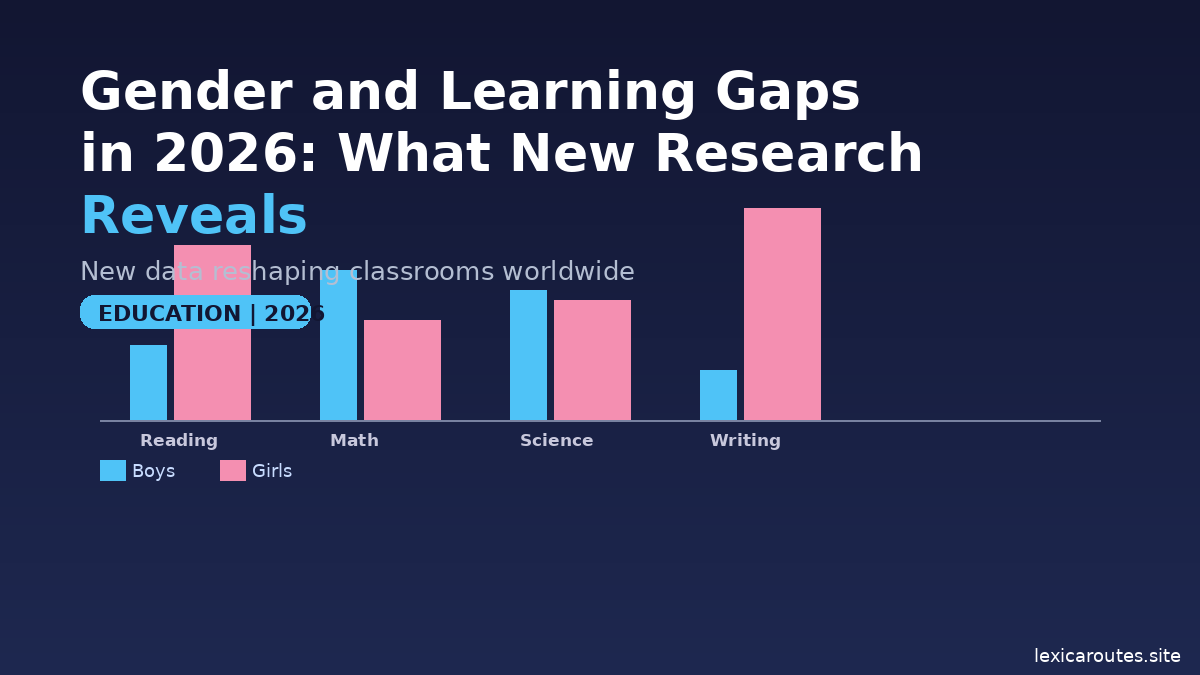
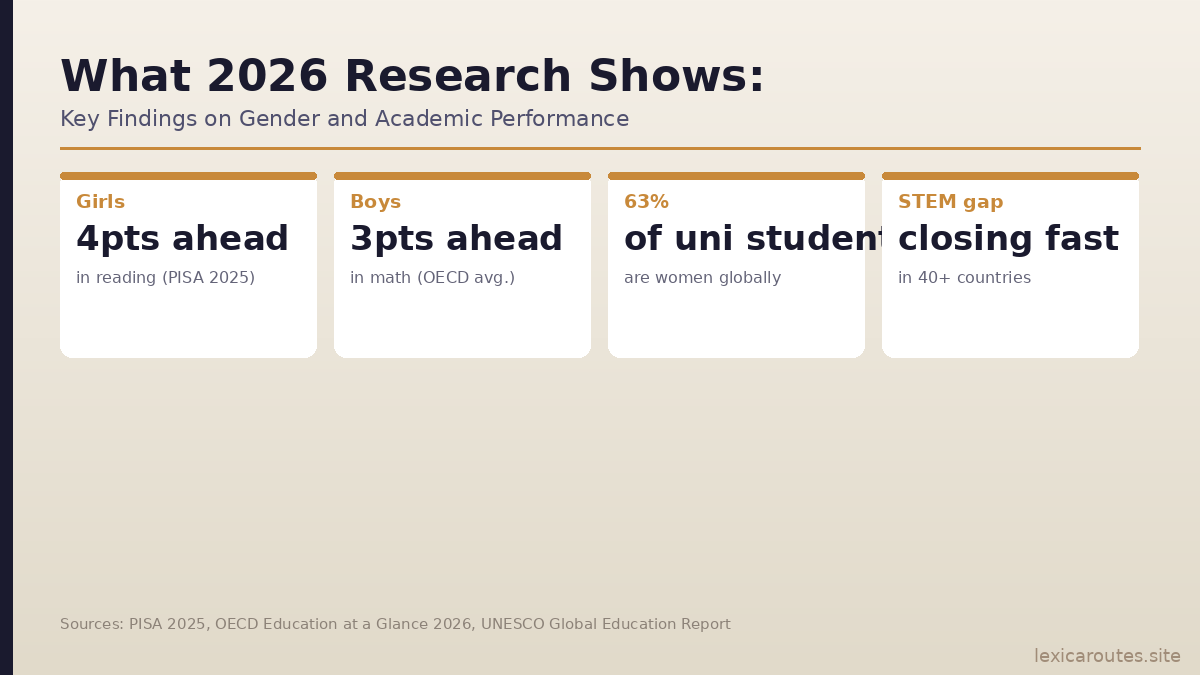
The PISA 2025 results, released in early 2026, confirmed patterns that have been building for over a decade. Girls continue to outscore boys in reading across almost every country surveyed. The gap averages around four score points globally, which sounds small until you realise it translates to roughly one full year of schooling.
Boys, on average, hold a slight edge in mathematics, though that gap is narrowing in more than 40 countries. In places like South Korea, Finland, and Canada, the math advantage for boys has nearly disappeared at the secondary level.
Writing remains the most lopsided subject. Girls outperform boys in written expression in every single OECD country tracked in the 2026 data, according to OECD Education at a Glance 2026.
The University Enrollment Shift Nobody Saw Coming
Here is the number that keeps coming up in education policy circles right now: women now make up 63% of university enrollment globally. That is according to UNESCO’s 2026 Global Education Monitoring Report. Ten years ago it was closer to 55%.
That is not a problem in itself. But it raises real questions about what is happening with boys in the years between primary school and higher education. Dropout rates among boys aged 15 to 17 are rising in several high-income countries, including the UK, Australia, and parts of the US.
Researchers at the Brookings Institution point to a few likely causes: the mismatch between how boys learn and how classrooms are currently structured, reduced physical movement during the school day, and a growing lack of male role models in primary teaching.
STEM: The Picture Is More Complicated
The STEM gender gap story in 2026 is actually two stories running at the same time.
On one hand, girls are entering biology and chemistry at record rates. Medical school enrollment is now majority female in more than 30 countries. That is genuinely good news, and it reflects decades of targeted outreach programs.
On the other hand, computing and engineering remain stubbornly male-dominated. Girls make up about 22% of computer science graduates globally, a figure that has barely moved in five years. Programs like Google’s Made With Code and Girls Who Code are making local impact, but systemic change is slow.
Why This Matters Beyond the Classroom
The learning gap is not just an education issue. It maps directly onto earnings, career outcomes, and mental health trajectories later in life. Boys who fall significantly behind in literacy by age 12 face measurably higher risks of unemployment and social isolation in their 20s.
For girls, the barriers are different but just as real. Excelling academically does not automatically translate to workplace equity. The gender pay gap and underrepresentation in leadership roles persist even as educational attainment flips.
The 2026 research is pushing policymakers toward more gender-responsive teaching methods, which means designing lessons that account for how different students process and engage with information, rather than treating gender-based patterns as fixed.
KEY FACTS SUMMARY BOX
| What | Detail |
|---|---|
| What happened | PISA 2025 and OECD 2026 data confirm persistent gender learning gaps in reading, writing, and math |
| Who is affected | Students, teachers, and education policymakers globally |
| Key figure | Girls: 4pts ahead in reading. Boys: slight math lead. Women: 63% of global university enrollment |
| STEM gap | Closing in biology and medicine; stagnant in computing and engineering |
| What comes next | Gender-responsive curriculum reforms gaining traction in UK, Australia, Canada, and OECD nations |
VERDICT
Our take
The 2026 data does not point to a simple story of one gender winning and another losing. Both boys and girls face specific, documented disadvantages depending on the subject and the country.
What is different this year is the urgency. Policymakers are moving from awareness to action, with gender-responsive teaching now on the reform agenda in over 20 countries. For parents and teachers, the practical takeaway is straightforward: knowing the pattern helps you address it.
FREQUENTLY ASKED QUESTIONS
Frequently asked questions
Are boys or girls performing better academically in 2026?
It depends on the subject. Girls outperform boys in reading and writing in nearly every country tracked by PISA 2025. Boys hold a small advantage in mathematics on average, though this gap is closing in many high-income countries. Neither gender dominates across all subjects.
Why are boys falling behind in reading and writing?
Current research points to a mix of factors: differences in early language development, classroom environments that may suit more sedentary learning styles, fewer male teachers in primary schools, and a cultural shift away from reading for pleasure among adolescent boys. These are patterns, not fixed rules, and they respond well to targeted intervention.
Is the gender gap in STEM improving in 2026?
Partially. Girls are entering biology, chemistry, and medicine at record rates globally. However, computer science and engineering remain male-dominated, with women representing about 22% of CS graduates. Progress is uneven across countries and depends heavily on school-level culture and mentorship availability.
What percentage of university students are women globally in 2026?
According to UNESCO’s 2026 Global Education Monitoring Report, women now make up approximately 63% of university enrollment worldwide. This marks a significant shift from a decade ago and is prompting discussions about support structures for male students who are disengaging from higher education.
What can teachers and parents do about the gender learning gap right now?
Start by identifying the specific gap, not the general one. A boy struggling with reading benefits from high-interest non-fiction material and structured phonics support. A girl avoiding STEM needs visible role models and low-stakes hands-on exposure. Gender-responsive teaching is about removing barriers, not lowering standards.
Author: Written by the Lexica Routes editorial team, covering travel, education, and study abroad since 2025.