A friend of mine spent three years studying graphic design, graduated with solid grades, and then spent six months sending out applications with almost no replies. Meanwhile, her classmate who had picked up UX design and basic data visualization on the side was fielding two job offers in the same month.
That contrast really stuck with me. Same degree. Same city. Completely different outcomes because of a handful of extra skills.
If you are thinking about upskilling, switching careers, or just want to know where the real salary growth is happening in 2026, this guide covers the top employer skills that companies are actively paying a premium for — and how you can start building them.
Why Career Skills Matter More Than Degrees Right Now
The job market in 2026 looks noticeably different from even three years ago. Employers in sectors from finance to healthcare are now openly hiring for specific skills over formal qualifications in many roles. LinkedIn’s 2026 Workforce Report notes that skills-based hiring has grown significantly across tech, marketing, and operations roles over the last two years.
That shift matters because it lowers the barrier to entry for people who are willing to learn, and it raises the bar for people coasting on credentials alone.
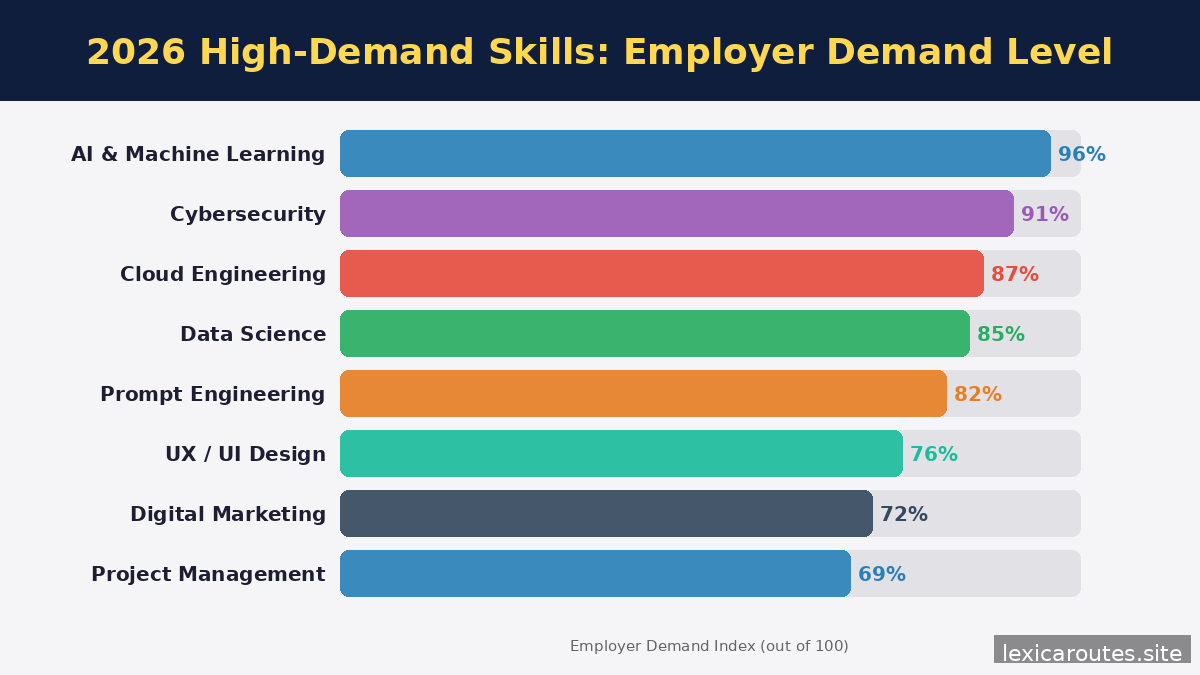
The skills that attract the biggest salary premiums right now fall into three broad areas: technical and AI-adjacent roles, data and analytics, and a cluster of high-demand human skills that automation cannot easily replicate.
Watch: The Top Skills for Jobs in 2026 — World Economic Forum
The High-Paying Technical Skills in 2026
What skills in AI and machine learning pay the most for in 2026?
AI skills are at the top of almost every employer wish list right now. But here is the thing that surprised me when I started researching this — you do not have to be a data scientist or software engineer to cash in.
Prompt engineering (knowing how to get reliable, useful output from large language models) is being listed in roles across marketing, legal, HR, and operations. Entry-level prompt engineering roles in the US are starting around $70,000 to $85,000, and senior positions at major firms are well above $120,000 according to data from the Bureau of Labor Statistics.
Machine learning engineering and AI model fine-tuning still command the highest salaries in the space, but the accessible entry point has moved significantly closer to the surface.
Cybersecurity skills that employers are paying for
Cybersecurity demand has been building for years, but the 2026 job market has a specific character to it: employers are particularly hungry for people who understand cloud security, not just traditional network defense.
If you have a background in IT, adding a cloud security certification like AWS Security Specialty or Google Professional Cloud Security Engineer can noticeably shift your salary band. The SANS Institute reports that cybersecurity professionals with cloud-specific credentials earn a meaningful premium over peers with general certifications.
This is one area where a relatively short upskilling window — three to six months of focused study — can translate into a significant pay bump.
Cloud computing and data skills
Cloud engineering, data engineering, and data analysis remain stubbornly high on the demand list. What has changed in 2026 is that companies are less willing to pay for people who know just one platform. Employers want demonstrated experience across at least two cloud environments (AWS and Azure being the most common pairing), or a strong data analysis foundation combined with a business intelligence tool like Power BI or Tableau.
High-Paying Human Skills That Complement Technical Expertise
Technical ability opens the door. Communication and project management skills determine how far you go once you are inside.
The candidates who are pulling the highest offers in 2026 are not always the most technically advanced. They are the ones who can explain a machine learning pipeline to a non-technical stakeholder, run a project that involves multiple teams, or write a clear brief that cuts weeks off a development cycle.
UX writing and UX research are two specific human-adjacent skills worth mentioning here. Both are in genuine demand, both are learnable without a design degree, and both attract salaries that surprise people who assume creative roles are underpaid.
Common Mistakes People Make When Upskilling
A mistake I see often is that people chase certifications without building projects. A certificate from Coursera or Google Career Certificates is genuinely useful, but only when it sits alongside real work you can point to.
Three other patterns worth avoiding:
Spreading too thin. Trying to learn AI, cybersecurity, cloud, and digital marketing simultaneously means you end up with a shallow grasp of everything and expertise in nothing. Pick one cluster and go deep for six months before widening.
Ignoring salary data. Not all in-demand skills translate to high pay equally. Digital marketing skills are genuinely wanted by employers, but the salary ceiling in many markets is lower than cybersecurity or cloud roles. Know what you are aiming for before you start.
Skipping soft skill development. According to the World Economic Forum’s Future of Jobs Report 2025, communication, analytical thinking, and leadership remain among the top skills employers cite as critical, and they pair with technical skills to multiply earning potential.
Top Skills Summary: What Pays Most in 2026
| Skill Area | Demand Level | Avg. Salary Range (US) | Best For |
|---|---|---|---|
| AI / Machine Learning | Very High | $85k – $160k+ | Engineers, analysts, product |
| Cybersecurity (Cloud) | Very High | $90k – $145k | IT professionals, network admins |
| Cloud Engineering | High | $100k – $150k | Developers, architects |
| Data Analysis / BI | High | $65k – $120k | Analysts, operations |
| Prompt Engineering | Growing Fast | $70k – $125k | Any professional |
| UX Research / Writing | Medium-High | $60k – $110k | Writers, designers |
| Project Management | Evergreen | $65k – $115k | All sectors |
| Digital Marketing | Medium | $45k – $90k | Marketers, content creators |
Our take
The skills employers are paying most for in 2026 are concentrated in AI-adjacent work, cloud and cybersecurity, and data analysis. But the real earning advantage comes from combining a deep technical skill with strong communication or project skills.
You do not need to retrain from scratch. If you already have a professional background, the fastest path to a higher salary is identifying which of your existing skills has the best overlap with these high-demand areas, then adding one specific technical layer on top.
Frequently asked questions
What skills do employers pay most for in 2026?
AI and machine learning skills, cybersecurity with cloud specialization, cloud engineering, and data analysis are consistently at the top of employer demand lists and salary scales in 2026. Prompt engineering has also emerged as a highly paid, accessible skill for professionals across industries.
How long does it take to learn high-paying tech skills in 2026?
It depends on the skill and your starting point, but most entry-level certifications in cloud computing or cybersecurity can be completed in three to six months of focused part-time study. Building project experience on top of that adds another two to three months before most professionals feel confident applying.
Are soft skills still important if I have strong technical skills?
Yes, and increasingly so. Employers in 2026 consistently flag that the highest-performing candidates combine technical depth with communication, leadership, or project management ability. Technical skills get you in the room; soft skills determine what you earn and how far you advance.
Do I need a computer science degree to break into high-paying tech careers?
Not necessarily. Skills-based hiring has expanded significantly across tech, data, and AI roles. Many employers now prioritize demonstrated skills and portfolio work over formal degrees, particularly for roles in data analysis, UX, digital marketing, and prompt engineering.
What is the fastest-growing employer skill in 2026?
Prompt engineering and applied AI skills are growing the fastest in terms of new job listings and salary movement. This is partly because the roles are new and partly because the talent pool with practical experience is still relatively small, which means employers are willing to pay competitively.
Related posts
Author: Written by the Lexica Routes editorial team, covering travel, education, and study abroad since 2025.