
Southeast Asia is one of the most rewarding regions on earth for island hopping, and 2026 is shaping up to be one of the best years to do it. Ferry networks are more connected than ever, budget flight routes have expanded across Thailand, Indonesia, and the Philippines, and a growing number of islands are actively managing tourist numbers to preserve the experience. If you have three weeks and want to see turquoise water, limestone cliffs, coral reefs, and a few sunsets that will honestly ruin other sunsets for you, this route delivers all of it.
This guide walks you through a practical, tested 3-week island hopping Southeast Asia itinerary covering four countries: Thailand, Malaysia, Indonesia, and the Philippines. You will get a step-by-step week breakdown, transport logistics, the best time to go, and what to know before you book.
What You Need Before You Start
Planning a 3-week island hopping route across Southeast Asia takes a bit more preparation than a single-country beach holiday. Here is what to sort out before you book anything.
Visas: Most Western passport holders get 30 to 60-day visa-free entry into Thailand, Indonesia, Malaysia, and the Philippines. Check your specific passport on each country’s immigration website before assuming. The Philippines, in particular, requires proof of an onward ticket at arrival.
Best time to go: For this multi-country route, the sweet spot is November through April. During those months, the Andaman Sea (Thailand, Langkawi) and the Philippines are both in dry season with calm waters. June through October brings the southwest monsoon to Thailand’s west coast and can make some ferry routes unreliable. If you are travelling in June, adjust Week 1 to Thailand’s Gulf coast (Koh Samui, Koh Phangan) instead of Phuket, as the Gulf side has its own weather pattern. According to Legend Travel Group’s Southeast Asia guide, the dry season from November through April offers the best overall conditions for multi-country hopping, with calm seas and maximum ferry reliability.
Ferry booking: Book major crossings two to four days in advance during peak season. Apps like Lomprayah, Koh Chang Ferry, and 12Go Asia cover most Thai and Indonesian routes. For the Philippines, fastcraft operators like 2GO Travel and Montenegro Lines handle Palawan to Manila legs.
Health and safety: Reef-safe sunscreen is not just eco-friendly etiquette now; it is required at several marine parks in Thailand and the Philippines. Pack it from home.
Step 1: Week 1 in Thailand (Days 1 to 7)
Your first week centres on southern Thailand’s Andaman coast, which is the logical starting point for this route given direct international flight connections into Phuket.
Days 1 to 2: Phuket
Skip the resort strip at Patong on arrival and base yourself at Kata or Karon beach instead. These are cleaner, quieter, and genuinely better for your first night after a long-haul flight. Use Day 2 to rent a scooter and explore Promthep Cape and Nai Harn beach at the island’s southern tip.
Day 3: Koh Phi Phi
The ferry from Phuket to Koh Phi Phi takes about 90 minutes. Book a morning departure to get to Maya Bay before the day-tour speedboats arrive around 10 am. Maya Bay reopened with strict visitor caps after its famous rehabilitation period, and the coral is visibly recovering. Stay overnight on Phi Phi Don rather than doing it as a day trip.
Days 4 to 5: Koh Lanta
Koh Lanta is where you decompress. It has good diving off Ko Ha, long beaches with very little hassle, and a charming Old Town on the east coast worth an evening walk. The ferry from Phi Phi to Lanta runs twice daily and takes around an hour. According to the Thailand diving authority, Ko Ha and Hin Daeng, just off Lanta, are considered among the best dive sites in Southeast Asia.
Days 6 to 7: Koh Samui (via Krabi)
Take a ferry to Krabi Town, then a bus and ferry connection across to Koh Samui on the Gulf side. Samui is your transition point. Two nights here give you time to see the Big Buddha temple, eat well, and get a decent rest before the Malaysia jump.
Step 2: Week 2 in Malaysia and Indonesia (Days 8 to 14)
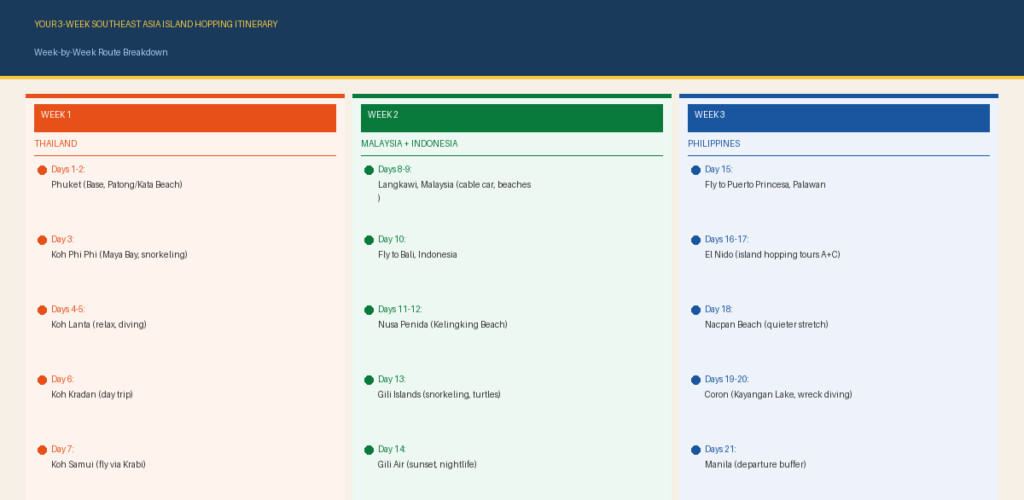
Days 8 to 9: Langkawi, Malaysia
A short flight from Koh Samui or Penang connects you to Langkawi, Malaysia’s duty-free island in the Andaman. The cable car up Gunung Mat Cincang gives you one of the region’s best views. Pantai Cenang is the main beach strip for eating and nightlife, but if you rent a car for Day 9 you can reach the quieter northern beaches with almost nobody around.
Days 10 to 12: Bali and Nusa Penida, Indonesia
Fly from Langkawi via Kuala Lumpur to Denpasar. The real discovery here is Nusa Penida, a 45-minute fast boat from Sanur Beach in Bali. Kelingking Beach is every bit as dramatic as the photographs suggest, though reaching the water requires a steep descent that takes about 40 minutes each way. Book manta ray snorkelling at Manta Point separately through a local operator rather than through your accommodation; it costs about half the price.
Days 13 to 14: The Gili Islands
Fast boats from Padangbai in Bali run directly to the Gili Islands in around two hours. Gili Trawangan has the best nightlife and the widest restaurant choice. Gili Air is quieter and better for snorkelling directly off the beach. Sea turtles are a reliable sighting at Turtle Point, a short swim from Gili Meno’s northwest coast. There are no motorised vehicles on any of the three islands, which makes them feel genuinely unhurried in a way that is increasingly rare.
Step 3: Week 3 in the Philippines (Days 15 to 21)
The Philippines leg is the most logistically complex part of this route, but it is also where the visual payoff peaks. Palawan consistently ranks among the most beautiful island groups on earth, and El Nido specifically delivers a kind of scenery that is difficult to describe without sounding hyperbolic.
Days 15 to 17: El Nido, Palawan
Fly from Bali (Denpasar) via Manila to Puerto Princesa or directly into El Nido Airport on a Cebu Pacific or AirAsia connection. El Nido’s island hopping tours, labelled A through D by local operators, are your main activity. Tour A covers the Big Lagoon and Secret Lagoon. Tour C takes you to Helicopter Island and Star Beach. Book both on separate days to avoid the crowds that arrive mid-morning. El Nido’s official tourism office now operates caps on lagoon entry numbers, so booking through a registered operator rather than a beach tout matters more than it used to.
Days 18 to 19: Coron, Palawan
A fastcraft from El Nido to Coron takes about four hours and passes through a string of limestone islands that make the journey itself worthwhile. Coron’s main attraction for many visitors is wreck diving: the Japanese fleet sunk here in 1944 now sits in shallow, warm water visible even to snorkelers. Kayangan Lake, reached by a staircase climb over a saddle ridge, has water so clear that the boats appear to be floating on air rather than water.
Days 20 to 21: Decompression and Departure
Build two nights in Manila or a quiet beach near Puerto Princesa as your buffer before flying home. This is not wasted time; regional ferries and island flights in the Philippines run on optimistic schedules, and having a buffer night before your international departure removes a significant amount of anxiety from the final days.
Common Mistakes to Avoid
Overloading the route is the most common error. Three weeks across four countries already involves eight to ten flights and ferry transitions. Adding extra stops, particularly side trips to Vietnam or Cambodia, turns what should be a restorative trip into an endurance event. Stick to the route.
Ignoring the weather on a country-by-country basis causes real problems. Thailand’s east and west coasts operate on opposite monsoon cycles. The Philippines has multiple typhoon zones. Indonesia’s conditions vary between Lombok (drier) and Flores (wetter in the same months). Check the weather by a specific island, not by the country.
Under-budgeting for transport is also extremely common. Ferry and flight connections between Bali, Langkawi, and Palawan are not cheap, and booking last-minute doubles or triples the cost. Budget at least $600 to $800 for transport alone across the three-week route if booking four to six weeks in advance.
Final Tips for a Smooth Route
Carry a small dry bag for ferry crossings. Open-air speedboats in choppy conditions will wet everything in your lap. Book accommodation for the first two nights of each week in advance, then leave the rest flexible. Charge cables and power banks earn their weight on island-to-island days. And finally, give yourself at least two full beach days per week with absolutely nothing scheduled. That is the whole point.
Comparison Table
Quick-Reference Summary: 3-Week Island Hopping Route
| Week | Countries | Key Islands | Transport | Highlight |
|---|---|---|---|---|
| Week 1 | Thailand | Phuket, Koh Phi Phi, Koh Lanta, Koh Samui | Ferries + 1 domestic flight | Maya Bay, Ko Ha diving |
| Week 2 | Malaysia + Indonesia | Langkawi, Nusa Penida, Gili Islands | Flight + fast boats | Kelingking Beach, sea turtles |
| Week 3 | Philippines | El Nido, Coron, Palawan | Flights + fastcraft | Big Lagoon, Kayangan Lake |
Estimated transport budget (booked 4-6 weeks ahead): $600 to $800. Recommended trip length: 21 days minimum. Best months: November to April for all four countries simultaneously
Verdict
Our take
A 3-week island hopping route across Southeast Asia is genuinely achievable without it feeling rushed, as long as you plan the transport transitions before you leave home. The itinerary above moves at a pace that gives you real time in each place. Thailand eases you in with good infrastructure and reliable ferries. Malaysia and Bali add variety without massive logistical complexity. And Palawan closes the trip with the kind of scenery that justifies the whole effort.
The one thing most itineraries do not tell you is that Southeast Asia rewards travellers who slow down. Three nights on Koh Lanta beats one night every time. Two full days in El Nido is the minimum to see the best lagoons without feeling rushed.
If you want to extend this route or find a scholarship to support a gap year in the region, read our guide to the best gap year programs for students in 2026 on Lexica Routes.
FAQ Section
What is the best time of year to go island hopping in Southeast Asia?
November through April is the best window for this 3-week multi-country route. During these months, both the Andaman coast of Thailand and the Philippines are in their dry seasons, meaning calm seas, reliable ferries, and clear skies for snorkelling. If you are travelling between June and October, focus your route on Thailand’s Gulf coast islands (Koh Samui, Koh Tao, Koh Phangan), where conditions are better during those months.
How much does a 3-week island hopping trip in Southeast Asia cost?
Budget travellers can cover this route for around $1,500 to $2,000, excluding international flights, by using local ferries, guesthouses, and cooking their own meals occasionally. Mid-range travellers typically spend $2,500 to $3,500, including comfortable hotels, guided tours, and most meals out. The biggest variable is accommodation in Bali and the Philippines, where good options span from $20 a night to well over $150.
Do I need to book ferries in advance for this Southeast Asia itinerary?
For Thailand’s main routes (Phuket to Phi Phi, Phi Phi to Koh Lanta), booking two to three days ahead is sufficient outside peak season. For Bali to the Gili Islands and El Nido to Coron in the Philippines, book at least a week ahead during December through March when these routes fill up fast. The 12Go Asia platform covers most connections between Thailand and Indonesia in one booking interface.
Is island hopping in Southeast Asia safe for solo travellers?
Yes, and the region has a well-established backpacker trail that makes solo travel very accessible. The main risks are standard to any travel: watch your belongings on crowded boats, keep a copy of your passport separate from the original, and always check sea conditions before booking small speedboat tours. Most islands have active Facebook travel groups where current conditions are posted in real time by other travellers.
Can I do this route in less than three weeks?
Two weeks is possible, but it means cutting one country from the route. The Thailand to Bali leg (skipping Malaysia) or a Philippines-only trip of 14 days are the two most sensible alternatives. Trying to compress all four countries into two weeks introduces too many transit days and not enough beach time to justify the journey.
Related Posts
Related posts
- How to Fund a Gap Year: 14 Scholarships and Grants Available in 2026
- Top 10 Countries for International Students Right Now
Author: Written by the Lexica Routes editorial team, covering travel, education, and study abroad since 2025.