The first time I stood in the courtyard at Auschwitz-Birkenau, I couldn’t speak. Not for a few minutes. There were a hundred other visitors around me, but it felt like the quietest place on earth. That trip changed how I see history, travel, and honestly myself.
Dark tourism destinations in 2026 are drawing more visitors than ever, and not because people are being morbid. Most of us go because we want to understand. We want to stand somewhere that textbooks can’t fully capture and let the weight of it land. If you’ve been thinking about visiting a memorial, a disaster site, or a genocide museum, this guide covers eight sites that are genuinely worth the journey, and how to approach each one with the respect it deserves.
What Makes a Dark Tourism Site Worth Visiting
Not every site with a tragic history is worth visiting as a tourist. The ones that justify travel are places where the history is preserved honestly, where local communities have had input into how the site is managed, and where your visit actually contributes through fees, attention, or both to keeping that memory alive.
The eight below meet that standard. They are managed, respected, and ready for thoughtful visitors in 2026.
1. Auschwitz-Birkenau, Poland
Nothing on a screen can prepare you for walking through the Arbeit Macht Frei gate. Auschwitz was the largest Nazi concentration and extermination camp, where over 1.1 million people, primarily Jewish, were murdered between 1940 and 1945.
The museum today preserves original barracks, the ruins of gas chambers, and rooms filled with the personal belongings of victims: shoes, suitcases, eyeglasses. You need to book a timed entry slot through the official Auschwitz Memorial website in advance, especially from spring through autumn.
Tips: Give yourself a full day. Do not take selfies in the gas chamber ruins. Go with a guided group if it’s your first visit. The guides are excellent and the context they provide is irreplaceable.
2. Hiroshima Peace Memorial Museum, Japan
At 8:15 a.m. on August 6, 1945, a single bomb destroyed Hiroshima. The Peace Memorial Museum doesn’t shy away from that reality. Personal artifacts, survivors’ accounts, and photographs document both the blast and its aftermath in remarkable, unflinching detail.
The Genbaku Dome, the skeletal remains of the building directly below the explosion, stands just outside. Hiroshima has transformed itself into a living city of peace advocacy, and visiting feels less like grief tourism and more like receiving an urgent message. The Hiroshima Peace Memorial Museum website has English-language planning resources.
Tips: Allow three to four hours for the museum. The survivors (Hibakusha) who once gave personal testimonies are now elderly and few; audio guides carry their stories forward.
3. Kigali Genocide Memorial, Rwanda
In 100 days in 1994, approximately 800,000 Tutsi people were murdered in Rwanda. The Kigali Genocide Memorial sits above mass graves holding 250,000 of those victims, and it functions both as a burial ground and as a museum that meticulously documents what happened and why.
One of the most confronting exhibits features the stories of individual children who were killed, told through photographs and descriptions of their personalities, favourite foods, and last words. It is devastating. It is also one of the most important rooms I have ever walked through.
Tips: No visitors under 12. Guided tours are often led by survivors, which changes the experience entirely. Rwanda is a remarkable country to explore beyond Kigali, so consider building a broader itinerary around it.
4. Choeung Ek, Cambodia (The Killing Fields)
Just outside Phnom Penh, Choeung Ek is one of thousands of killing fields used by the Khmer Rouge regime between 1975 and 1979, a period in which roughly two million Cambodians died. The central memorial stupa here holds over 5,000 skulls.
The audio guide, widely considered one of the best at any dark tourism site in the world, includes testimony from survivors and is narrated with genuine emotion rather than clinical detachment. It is not a comfortable visit, but it is an essential one if you’re travelling in Southeast Asia. Documentation Center of Cambodia provides further historical context for those who want to study before they go.
5. 9/11 Memorial and Museum, New York City, USA
The two reflecting pools sit precisely where the Twin Towers stood. The names of 2,977 victims are carved around their edges, and the museum below preserves artefacts, voicemails, and personal objects from September 11, 2001.
What surprises most first-time visitors is how personal it is. You expect a big, formal memorial. What you get feels intimate: the final messages people left for their families, the ordinary objects they carried to work that morning. It consistently ranks among the most emotionally powerful museum experiences in the United States.
Tips: Book tickets online well in advance. Budget two to three hours minimum for the museum portion.
6. Robben Island, South Africa
Nelson Mandela was imprisoned here for 18 of his 27 years behind bars. Robben Island, a short ferry ride from Cape Town, operated as a maximum-security prison under apartheid, and today tours are led by former political prisoners, people who actually lived in those cells.
There is nothing quite like standing in Mandela’s cell and hearing about it from someone who was imprisoned in the same complex. It is living history in the most literal sense. The experience is humbling in a way that no amount of reading quite matches.
7. Pompeii, Italy
Pompeii is dark tourism in its oldest form. When Mount Vesuvius erupted in 79 AD, it buried an entire Roman city under volcanic ash, preserving it almost perfectly. The plaster casts of victims, their final postures frozen in time, are among the most arresting images in all of archaeology.
What makes Pompeii so powerful is the ordinariness. Shops with menus still painted on their walls. Houses with frescoes intact. A city interrupted mid-life. It is a reminder that disaster doesn’t announce itself.
Tips: Avoid summer midday heat, as the site has almost no shade. The ticketing system updated in 2025 requires advance booking through the official portal.
8. War Remnants Museum, Ho Chi Minh City, Vietnam
This museum does not present a balanced view of the Vietnam War. It presents the Vietnamese perspective, and it does so through photographs, military equipment, and accounts of civilian suffering that are extraordinarily difficult to look at.
That discomfort is intentional and valuable. Many Western visitors leave feeling genuinely unsettled about narratives they grew up with. The Agent Orange exhibit in particular has changed how many travellers understand the long-term consequences of that conflict.
Tips: This is not a museum to rush. Spend at least two hours. The ground floor houses captured military hardware; the upper floors contain the photographs that will stay with you longest.
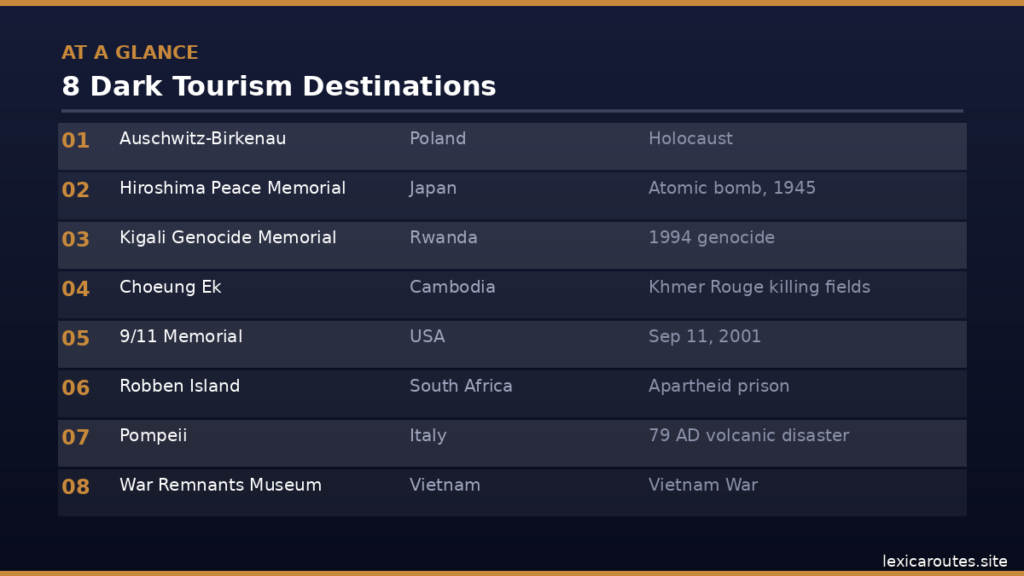
Comparison Table
| # | Site | Country | Theme | Best For | Advance Booking? |
|---|---|---|---|---|---|
| 1 | Auschwitz-Birkenau | Poland | Holocaust | WWII history study | Yes, essential |
| 2 | Hiroshima Peace Memorial | Japan | Atomic bomb, 1945 | First-time Japan visitors | Recommended |
| 3 | Kigali Genocide Memorial | Rwanda | 1994 genocide | East Africa itineraries | No, walk-in |
| 4 | Choeung Ek | Cambodia | Khmer Rouge | Southeast Asia trips | No, walk-in |
| 5 | 9/11 Memorial | USA | Sep 11, 2001 | North America travellers | Yes, essential |
| 6 | Robben Island | South Africa | Apartheid | Cape Town visitors | Yes, books fast |
| 7 | Pompeii | Italy | Volcanic disaster, 79 AD | European travellers | Yes, new system |
| 8 | War Remnants Museum | Vietnam | Vietnam War | Asia travellers | No, walk-in |
Verdict
Dark tourism, done right, is one of the most valuable kinds of travel there is. These eight sites are not about grief as entertainment. They are about memory, about bearing witness, and about making sure that what happened in these places is never reduced to a footnote.
My advice: don’t rush any of them. Don’t visit two heavy sites on the same day. Read something before you go: Philip Gourevitch on Rwanda, Elie Wiesel on the Holocaust, John Hersey on Hiroshima. Arrive prepared, stay curious, and leave quietly.
FAQ Section
What is the best dark tourism destination for a first-time visitor? Auschwitz-Birkenau in Poland is the most visited dark tourism site in the world for good reason. It is exceptionally well-managed, offers guided tours in dozens of languages, and the historical record is thoroughly documented. If you only visit one dark tourism destination in your lifetime, most experienced travellers point to this one.
Is dark tourism disrespectful? Not if you approach it properly. These sites exist because communities chose to preserve them as places of education and remembrance. Visiting with respect, reading the exhibits carefully, and avoiding frivolous photography in sensitive areas means your presence honours rather than diminishes the memory. The sites themselves want visitors, which is why they are open.
Which dark tourism sites are free to enter? The Kigali Genocide Memorial in Rwanda and the 9/11 Memorial outdoor pools are free to enter. The 9/11 Museum has an admission fee. Auschwitz is free for individual visitors without a guide, though guided tours carry a fee. Most others on this list charge a modest entrance fee that goes directly toward site maintenance and preservation.
How do I avoid feeling overwhelmed when visiting dark tourism sites? Don’t visit more than one heavy site per day. The emotional weight compounds and you end up absorbing less, not more. Build lighter activities around your visit: a walk, a good meal, time without an agenda. Many experienced dark tourists recommend reading about the history in advance so the visit feels like confirmation rather than a first encounter.
Are any of these dark tourism destinations suitable for children? Pompeii works well for older children and teenagers with an interest in history. The 9/11 Memorial outdoor area is appropriate for most ages. Auschwitz, Kigali, Choeung Ek, and the War Remnants Museum contain graphic content and are recommended for ages 14 and above as a minimum. Kigali officially prohibits visitors under 12.
Author: Written by the Lexica Routes editorial team, covering travel, education, and study abroad since 2025.