If you have a laptop, a reliable internet connection, and the freedom to work from anywhere, picking the right city for your next workation can genuinely change how productive and happy you feel. The best workation destinations in 2026 are no longer just “cool places with WiFi.” They now come with official digital nomad visas, thriving coworking communities, and a cost of living that makes your salary stretch further.
This guide covers the top cities for remote workers right now, what makes each one worth considering, and the practical details you need before booking a flight.
What Makes a Great Workation Destination?
Not every beautiful city works well for a workation. The practical side matters just as much as the scenery. Before committing to a destination, remote workers should check four things:
Internet reliability: Minimum 50 Mbps for smooth video calls. Many top workation cities now average 100 Mbps or higher at coworking spaces and cafes.
Cost of living: Your workation should cost less than your home base, or at least offer better value. Monthly budgets for most workation cities run between $1,500 and $3,000 for comfortable living, including accommodation and food.
Visa clarity: Working from a country on a tourist visa is legally grey in many places. With over 50 countries now offering dedicated digital nomad visas in 2026, there is little reason to risk it. Look for destinations with clear legal pathways.
Time zone compatibility: Staying within two to four hours of your team or clients prevents the exhaustion of middle-of-the-night calls.
Top Workation Cities in 2026
Lisbon, Portugal
Lisbon remains one of the most popular workation cities in the world, and for good reason. Portugal’s Digital Nomad Visa (D8) offers remote workers a legal residency pathway with favorable tax conditions for up to one year, renewable. Coworking spaces like Second Home and Impact Hub are easy to find, and the public transport system is both cheap and effective.
Monthly costs for a studio apartment run between $1,000 and $1,800. Add food, transport, and a coworking membership, and most remote workers report spending $2,200 to $2,800 per month while living well. The Atlantic time zone also keeps European and East Coast US teams comfortably in sync.
Medellín, Colombia
Medellín has undergone a remarkable transformation over the past two decades and is now one of the most discussed workation destinations in Latin America. WiFi speeds in coworking spaces typically run 40 to 70 Mbps, Colombian fiber internet is reliable in urban areas, and the time zone (UTC-5) matches US Eastern Time exactly, which is a genuine advantage for anyone working with North American teams.
Cost of living is significantly lower than European cities. A comfortable monthly budget, including accommodation, food, and coworking, sits between $1,200 and $2,000. The city’s Laureles and El Poblado neighborhoods have become well-established remote work hubs with strong nomad communities.
Mexico City, Mexico
Mexico City offers what one travel researcher called “first-world infrastructure at developing-world prices.” A six-month tourist visa is available to most passport holders on arrival, with a four-year Temporary Resident Visa for those who want to stay longer. The food scene is world-class, the timezone aligns with US teams, and the city’s sheer scale means coworking options are everywhere.
One important note: WiFi quality varies more than in European cities. Choosing accommodation or a coworking space with verified fast internet is worth the extra research before you arrive.
Chiang Mai, Thailand
Chiang Mai has been a digital nomad favorite for over a decade, but the infrastructure has improved considerably. Thailand introduced the Destination Thailand Visa (DTV) in 2025, allowing remote workers and freelancers to stay for six months with renewal options for up to five years. This finally gave Chiang Mai a clear legal framework to match its practical appeal.
Monthly costs are among the lowest on this list. A comfortable, well-connected lifestyle costs around $800 to $1,400 per month. The main trade-off is the time zone: UTC+7 makes real-time collaboration with US-based teams difficult.
Seoul, South Korea
South Korea launched its Workation Visa scheme in early 2026, allowing remote workers to live and work there for one year with the option to extend for a second. Family members can be included. Seoul adds a newer, more polished energy to the workation circuit: internet speeds are among the fastest in the world, the city is extremely walkable, public transport is exceptional, and the food culture is unlike anywhere else.
The income requirement is set at double South Korea’s gross national income per capita, which places it at the higher end of accessibility. For those who meet the threshold, it is one of the most exciting new workation destinations on the map.
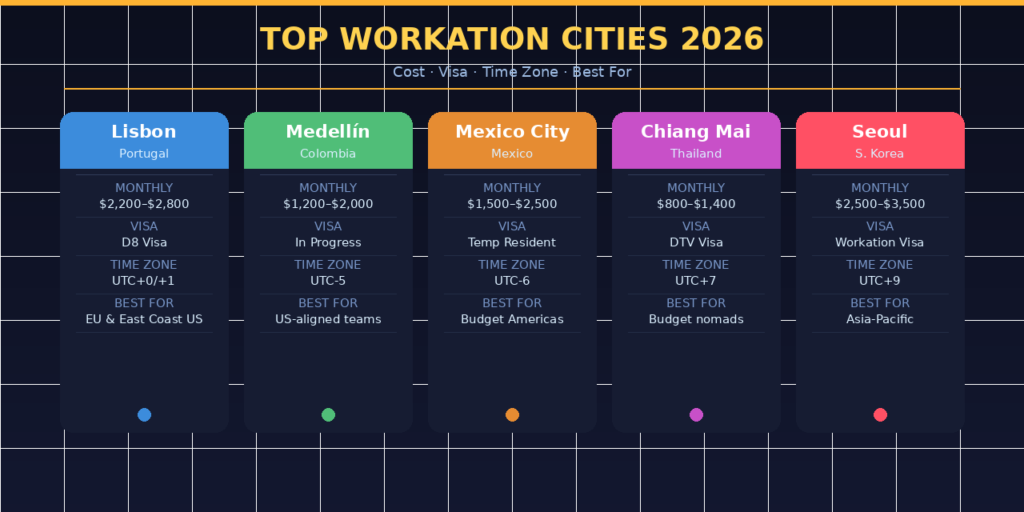
Workation City Comparison Table
| City | Monthly Budget | Digital Nomad Visa | Time Zone (UTC) | Best For |
|---|---|---|---|---|
| Lisbon, Portugal | $2,200–$2,800 | Yes (D8 Visa) | UTC+0/+1 | Europe-aligned teams |
| Medellín, Colombia | $1,200–$2,000 | Work in progress | UTC-5 | US-aligned teams |
| Mexico City, Mexico | $1,500–$2,500 | Temp Resident Visa | UTC-6 | Budget-friendly Americas |
| Chiang Mai, Thailand | $800–$1,400 | Yes (DTV) | UTC+7 | Budget, Asia-based |
| Seoul, South Korea | $2,500–$3,500 | Yes (Workation Visa) | UTC+9 | Asia-Pacific teams |
What the 2026 Workation Trend Looks Like
The workation is no longer a niche lifestyle. An estimated 40 million people now travel the world while working for foreign companies, and that number is expected to grow as more employers accept permanent remote arrangements.
One clear shift in 2026: remote workers are choosing destinations based on practical factors more than lifestyle branding. According to research from the Passportivity Digital Nomad Visa Index, affordability and infrastructure now outweigh purely recreational appeal. Countries with lower income thresholds and reliable connectivity are gaining popularity over premium lifestyle destinations with high barriers to entry.
That shift makes cities like Medellín and Chiang Mai increasingly competitive with European capitals that once dominated every best-of list.
Our recommendation
For most remote workers in 2026, Lisbon remains the most well-rounded choice: strong legal framework, reliable internet, a large nomad community, and a time zone that works for both European and East Coast US teams. Medellín is the standout pick for anyone on the Americas time zone looking to reduce costs significantly.
If you are newer to workations, start with a destination that already has a strong nomad community. The coworking infrastructure, social scenes, and practical knowledge shared by existing remote workers in these cities will make your first workation far smoother than landing somewhere off the beaten path.
Thinking about combining your workation with language learning or longer-term study?
Frequently asked questions
What is a workation and how is it different from being a digital nomad?
A workation is when you work remotely from a travel destination for a set period, usually a few weeks to a few months, without taking time off. You are still doing your regular job, just from a different location. A digital nomad typically has a more permanent or open-ended mobile lifestyle, often without a fixed home base.
Do I need a special visa to do a workation abroad in 2026?
It depends on how long you plan to stay and which country you are visiting. For short stays of under 90 days, many passport holders can enter most countries on a tourist visa. For longer workations, a digital nomad or remote work visa is strongly recommended to avoid legal grey areas. Over 50 countries now offer dedicated visas for this purpose.
How much does a workation typically cost per month?
Costs vary widely by destination. Budget-friendly cities like Chiang Mai can work out to $800 to $1,400 per month all-in. Mid-range destinations like Medellín and Mexico City typically run $1,500 to $2,500. European cities like Lisbon sit closer to $2,200 to $2,800. Your accommodation choice is the biggest cost lever.
What internet speed do I need for a workation?
For general remote work including video calls, 25 to 50 Mbps is sufficient. If your work involves large file transfers, video editing, or frequent screen sharing, aim for 100 Mbps or higher. Always confirm the internet speed at your accommodation before booking, and identify a nearby coworking space as a backup.
Which workation city is best for remote workers on US time zones?
Medellín, Colombia is the strongest match for US Eastern time. Mexico City aligns well with Central and Mountain time. Lisbon works if you are willing to adjust your schedule slightly, as it sits five to six hours ahead of US Eastern time. Seoul and Chiang Mai are better suited to Asia-Pacific teams or workers with fully async roles.