My Italian trip almost ended in a full-blown ordering disaster. I’d spent three months using a free language app, felt genuinely confident, walked into a Florence trattoria, and proceeded to ask for “the bathroom bill” instead of the check. The waiter laughed. I laughed louder, eventually. But that moment made me take a hard look at which language learning apps actually work and which ones just make you feel like you’re learning.
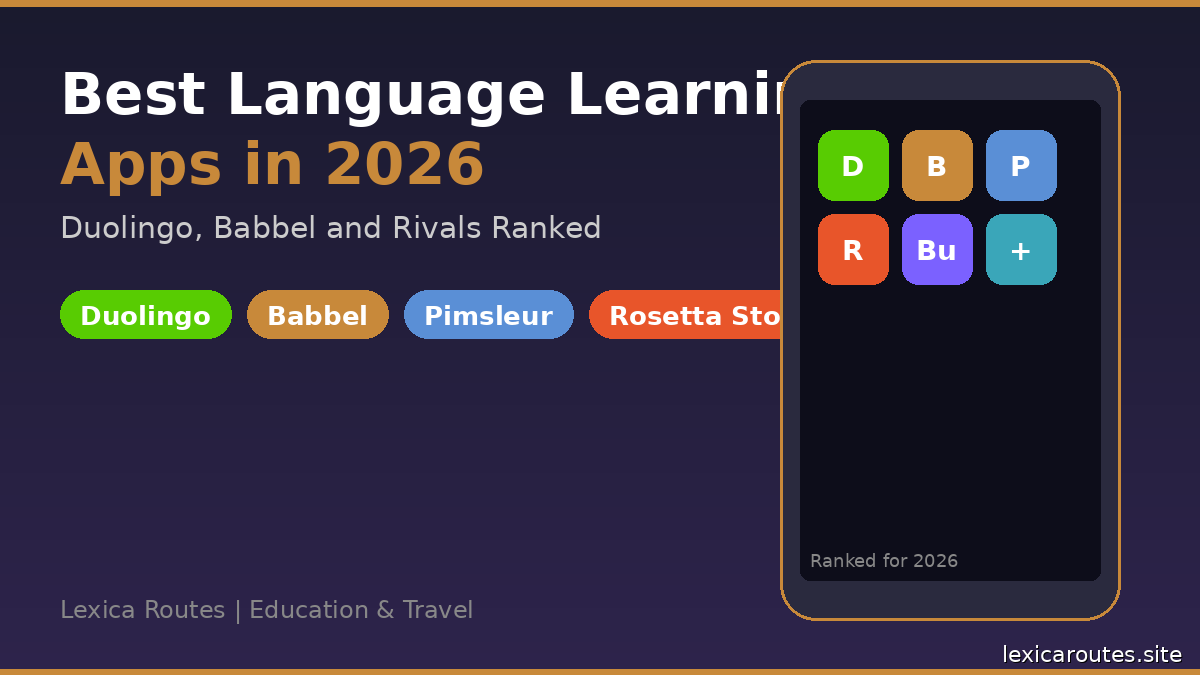
That experience pushed me to properly test the top apps before a bigger trip in 2026. I spent time with Duolingo, Babbel, Pimsleur, Rosetta Stone, and a few newer rivals. Here is what I found, ranked honestly.
What Makes a Language App Worth Using in 2026
Before we get into rankings, here is what I looked at. Not just review scores, but real daily use. I checked how each app handles speaking practice, how quickly you pick up conversational phrases versus just vocabulary, and whether it keeps you coming back after week one.
The apps that failed me shared one pattern: they were great at vocabulary builder drills but skipped the messy, real-world speaking practice you need for actual travel or work conversations. That is the gap that separates the good ones from the rest.
Watch: Which Language Learning App Is Actually Best in 2026?
Duolingo: Still Fun, Still Free, Still Limited
If you have ever picked up a language app, you have probably used Duolingo. There is a reason it has over 500 million downloads. The gamification is genuinely clever, the streak system works, and the free tier is generous.
Where it falls short is depth. Duolingo is phenomenal for beginners building daily habits. It is the best free option for someone who wants 10 to 15 minutes of practice a day and is not in a rush. However, if you are trying to reach conversational fluency before a trip, the lessons start to feel thin around the intermediate stage. You know individual words but struggle to string sentences together under pressure.
Duolingo Max, their AI-powered tier, has improved a lot. The “Roleplay” feature lets you practice real conversations with an AI character, which is genuinely useful. According to Duolingo’s official research page, their courses align with CEFR levels, though independent testing suggests it takes longer to reach those benchmarks than the app implies.
Best for: Absolute beginners, habit builders, budget learners.
Babbel: The One That Actually Teaches You to Speak
Babbel is the app that turned things around for me. After the Florence fiasco, I switched to Babbel for Spanish, and the difference in how it handles conversation was immediately noticeable.
Every lesson connects vocabulary to real dialogue. You do not just learn “table” and “chair” in isolation. You learn how to ask where to sit, how to order, how to apologise when you get it wrong. The speech recognition is also more forgiving and useful than Duolingo’s, which matters when you are a self-conscious beginner speaking out loud into your phone.
Duolingo vs Babbel comes down to this: Duolingo is a game that teaches language; Babbel is a language course with game elements. For practical travel preparation, Babbel wins.
According to a study published by City University of New York and the University of South Carolina, just 15 hours of Babbel can get you to a level equivalent to a full university semester. That is a bold claim, but my personal experience actually backed it up.
Best for: Travellers, adult learners, people who want practical conversational skills fast.
Pimsleur: Underrated for Speaking Practice
Pimsleur gets ignored because it looks old-fashioned. No flashy interface, no streaks, no badges. But if your goal is speaking and understanding spoken language, especially for languages with tricky pronunciation like Mandarin, Arabic, or Japanese, Pimsleur might be the best tool out there.
The method is entirely audio-based. You listen, repeat, and respond out loud. It sounds simple but it builds genuine language fluency in listening and speaking far faster than screen-based apps. The big downside is cost. A single language subscription runs around $20 a month, which stings compared to free options.
Best for: Auditory learners, long commutes, languages with complex pronunciation.
Rosetta Stone: Still Alive, Still Debated
Rosetta Stone has been around for decades and still has loyal fans. The immersion method, which teaches through images and context without translation, works beautifully for some people and drives others completely crazy.
The redesigned app is cleaner than earlier versions, and the live tutoring sessions (available on higher-tier plans) add real value. But at around $36 per month for a single language, it is hard to recommend over Babbel unless you specifically love the immersion-only approach.
Best for: Visual learners who hate translation methods.
Newer Rivals Worth Watching in 2026
A few apps have quietly gotten good. Busuu has built an impressive community feature where native speakers correct your written practice, which is excellent for improving conversational skills beyond what any AI can offer. Clozemaster is brilliant for intermediate learners wanting to improve grammar in context.
If you are learning a language for educational travel or study abroad, Busuu’s academic partnerships actually let institutions integrate language learning into curricula, which is a nice sign of credibility.
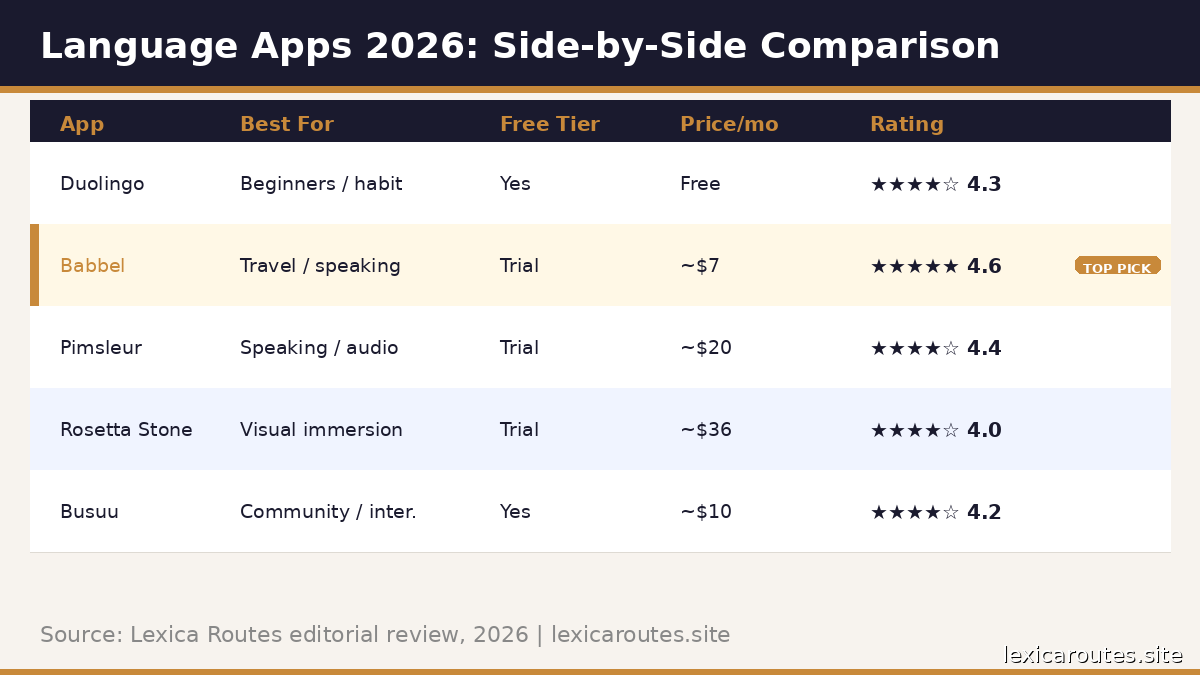
App Comparison: Which One Should You Pick?
| App | Best For | Free Tier | Starting Price | Rating |
|---|---|---|---|---|
| Duolingo | Beginners, habit building | Yes (generous) | $0 / Free | 4.3/5 |
| Babbel | Conversational skills, travel | Trial only | ~$7/month | 4.6/5 |
| Pimsleur | Speaking and listening | Limited trial | ~$20/month | 4.4/5 |
| Rosetta Stone | Visual immersion learners | Trial only | ~$36/month | 4.0/5 |
| Busuu | Community feedback, intermediate | Yes (limited) | ~$10/month | 4.2/5 |
Common Mistakes People Make With Language Apps
Most people download an app, do it enthusiastically for two weeks, and quit. The apps are not always to blame. Here are the mistakes I see over and over.
Using only one app. No single app covers everything well. Pair Duolingo for daily habit and Babbel for structured conversation practice. That combination alone beats using either alone.
Skipping speaking practice. Tapping the right answer does nothing for your accent or your confidence in real conversations. Force yourself to use the speaking features, even if it feels awkward.
Expecting the app to do all the work. The best apps for beginners in 2026 will still not replace actual exposure to native speakers. Watch a show, listen to a podcast, talk to someone. Use the app as a foundation, not a complete solution.
Bottom line
If you only download one app, make it Babbel for practical travel prep or Duolingo if you are just starting out and need to build the habit first. For best language learning apps for beginners in 2026, that pairing is hard to beat.
The honest truth is that no app will get you fluent by itself. But the right app will get you confident enough to order your meal, find your hotel, and maybe avoid a bathroom bill situation like mine.
Frequently asked questions
Which is the best language learning app overall in 2026?
Babbel edges out the competition for most adult learners focused on practical conversation. It balances structured grammar lessons with real dialogue and speech practice better than any free alternative. That said, the best app depends on your learning style and how much you can spend.
Is Duolingo actually effective for learning a language?
Duolingo is effective for building a vocabulary base and daily learning habits, especially for beginners. Its free tier is one of the most accessible tools for learning a new language at home. However, it tends to plateau at an intermediate level, and many users find they need a supplementary app to reach real conversational fluency.
What are the best language learning apps for beginners in 2026?
For absolute beginners, Duolingo is the lowest-friction starting point. Babbel is excellent if you are willing to pay from the start and want to move faster toward conversational skills. Pimsleur suits beginners with busy schedules who can learn during commutes.
How do Duolingo and Babbel compare for travel preparation?
Duolingo vs Babbel for travel prep is not a close call: Babbel wins. Its lessons are built around real-world scenarios like restaurants, transport, and accommodation. Duolingo teaches you the same vocabulary but less contextually, meaning the words do not stick as well under pressure.
Can language apps replace actual immersion or a language course?
Not quite. Apps are outstanding tools for learning a language at home and building confidence before you travel. But improving conversational skills abroad, through actual conversations with native speakers, adds something no app can replicate. Use apps to prepare, then lean into real interaction to consolidate.
Related posts
Author: Written by the Lexica Routes editorial team, covering travel, education, and study abroad since 2025.