
Literary travel is having a serious moment. In 2026, more readers than ever are trading standard holidays for “readaway” vacation trips built around the cities, streets, and cafes that shaped their favourite books. Research by EF Ultimate Break found that 62% of 18-to-35-year-olds want to visit locations connected to books they love, and the numbers keep climbing thanks to BookTok and literary communities online.
Whether you want to sit in the Paris cafe where Hemingway wrote, walk Dublin’s cobblestones with James Joyce, or browse a secondhand bookshop in Tokyo’s Jimbocho district, the world is full of places that feel different once you’ve read the right book first. This guide covers 10 of the best literary travel destinations for book lovers in 2026, with what to visit, when to go, and what to read before you pack.
How we chose these destinations
Every destination on this list earned its place through a combination of literary history, active visitor infrastructure (museums, tours, bookshops, festivals), and current reader interest in 2026. We weighted cities that offer more than a plaque on a wall, places where you can genuinely immerse yourself in a living literary culture. The list spans continents and centuries, covering classic European capitals alongside less obvious picks in East Asia and South America.
10 Literary Travel Destinations for Book Lovers in 2026
1. Paris, France
Paris has one of the deepest literary reputations of any city on earth, and it still earns it. The Left Bank of the Seine is where Hemingway, Fitzgerald, and Gertrude Stein held court in the early 20th century, and the energy there has never fully left. The green bouquiniste stalls lining the river have sold secondhand books since the 1500s, making them one of the oldest book markets in the world.
The unmissable stop is Shakespeare and Company, the legendary English-language bookstore near Notre-Dame that has served as a meeting point for writers and readers since 1951. Beyond that, follow the Hemingway walking trail through Saint-Germain-des-Prés, visit the annual Festival America, or spend an afternoon at the Musée de la Vie Romantique.
Read before you go: A Moveable Feast by Ernest Hemingway
Best time to visit: September, when the literary festival season peaks
2. Dublin, Ireland
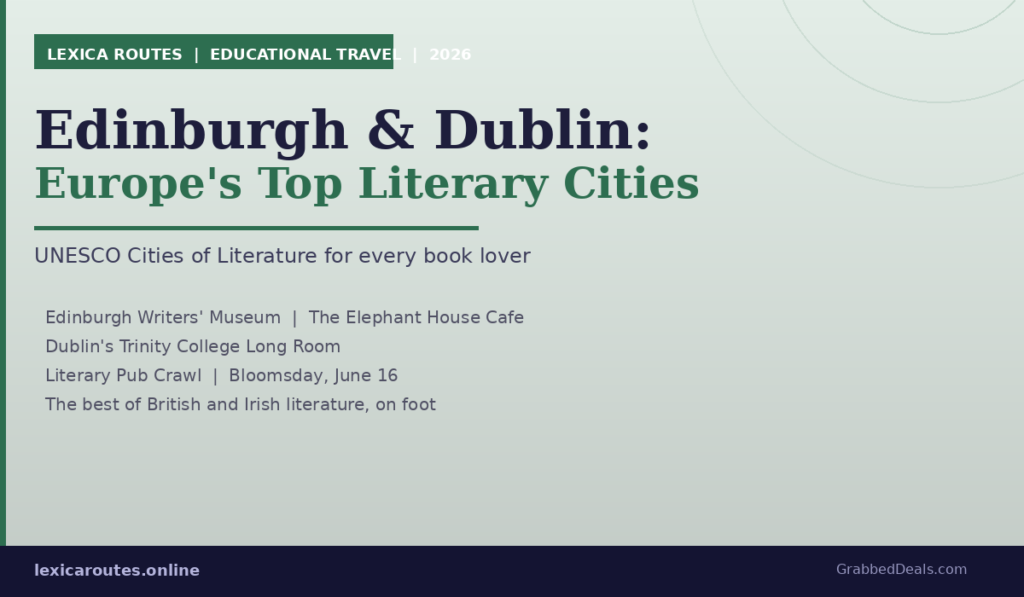
Of all the literary capitals in the world, Dublin may be the one that wears its bookish identity most proudly. Oscar Wilde, Samuel Beckett, W.B. Yeats, and James Joyce all called this city home, and the streets still feel soaked in their influence. According to UNESCO’s Creative Cities network, Dublin holds official status as a UNESCO City of Literature.
Trinity College Library’s Long Room is one of the most breathtaking spaces a book lover can stand in, housing over 200,000 of the oldest books in Ireland. The Dublin Literary Pub Crawl is worth every euro, as actors guide small groups between historic pubs while performing scenes from the city’s greatest writers. If you visit in June, time it for Bloomsday on the 16th, when the whole city celebrates James Joyce’s Ulysses with costumed walks and public readings.
Read before you go: Ulysses by James Joyce or Normal People by Sally Rooney
Best time to visit: June for Bloomsday
3. Edinburgh, Scotland
Edinburgh was the world’s first UNESCO City of Literature, and the title fits. The city gave us Robert Louis Stevenson, Sir Walter Scott, Arthur Conan Doyle, and, more recently, J.K. Rowling, who drafted early chapters of Harry Potter in The Elephant House cafe on George IV Bridge.
The Writers’ Museum on the Royal Mile is the essential stop, with exhibits on Stevenson, Scott, and Robert Burns, including personal writing desks and manuscripts. Every August, the Edinburgh International Book Festival draws writers and readers from around the world as part of the city’s famous summer festival program, making it the largest book festival of its kind globally. The Literary Pub Tour offers a lively alternative route through the city’s history, with actor-guides performing debates between Scotland’s greatest literary minds.
Read before you go: The Prime of Miss Jean Brodie by Muriel Spark
Best time to visit: August for the Book Festival
4. Prague, Czech Republic
Prague’s Gothic architecture and winding alleyways feel like they were built for a Kafka story because, in many ways, they were. Franz Kafka was born in the Old Town and spent most of his life in the city, and the Franz Kafka Museum on the banks of the Vltava River brings his world into sharp focus for visitors who know his work and those discovering it for the first time.
Beyond Kafka, the city has a rich literary culture shaped by Milan Kundera, Rainer Maria Rilke, and dozens of writers who lived under Communism and wrote in defiance of it. The Strahov Monastery Library, with its two ornate Baroque halls, is one of the most beautiful libraries on the continent. Cafe Slavia, where intellectuals and writers gathered for generations, is still open and still worth a long afternoon.
Read before you go: The Metamorphosis by Franz Kafka or The Unbearable Lightness of Being by Milan Kundera
Best time to visit: Spring or autumn, avoiding peak summer crowds
5. Tokyo, Japan
Tokyo is a book lover’s city in ways that go far beyond what most Western travellers expect. The Jimbocho district in Chiyoda is one of the world’s great secondhand book neighbourhoods, with over 170 bookshops packed into a few walkable blocks. You can spend hours there and still not cover everything. Tokyo also holds UNESCO City of Literature status, recognising its deep reading culture.
The Natsume Soseki Memorial Museum traces the life of Japan’s most celebrated novelist, while the Ghibli Museum connects studio storytelling to literary roots in a way that resonates with readers of all ages. Haruki Murakami’s novels are so tied to specific Tokyo neighbourhoods that fans now do self-guided literary walks through Shinjuku and Shibuya.
Read before you go: Norwegian Wood by Haruki Murakami or Convenience Store Woman by Sayaka Murata
Best time to visit: March to May (cherry blossom season) or October to November
6. London, England
London’s literary history is so dense it could fill several lifetimes of visits. From Shakespeare’s Globe Theatre to the Charles Dickens Museum in Fitzrovia, from the Sherlock Holmes Museum on Baker Street to the British Library’s treasure collection of original manuscripts, the city gives you centuries of material to work through. According to the British Library, its collection includes the Gutenberg Bible, Shakespeare’s First Folio, and handwritten Beatles lyrics.
Bloomsbury, the neighbourhood that gave its name to one of the most famous literary circles in history (Virginia Woolf, E.M. Forster, John Maynard Keynes), is still filled with independent bookshops and publishing houses. Daunt Books on Marylebone High Street is one of the most beautiful bookshops in the world and is worth the journey on its own.
Read before you go: Mrs Dalloway by Virginia Woolf, or any Dickens you haven’t got to yet
Best time to visit: Year-round; the London Book Fair runs in April
7. Naples, Italy
Naples is the literary travel destination that has caught up to its reputation fast. Elena Ferrante’s Neapolitan Novels put the city on the global literary map in a way that tour operators are still catching up with, and visitors now arrive specifically to walk through the neighbourhoods where the fictional Lenu and Lila grew up. The Quartieri Spagnoli and Rione Luzzatti districts feel like living chapters from the series.
Beyond Ferrante, Naples has a rich classical literary heritage tied to Virgil, who reportedly lived near the city and whose tomb is located at the Parco Virgiliano. The Biblioteca Nazionale di Napoli holds one of Italy’s most important manuscript collections.
Read before you go: My Brilliant Friend by Elena Ferrante
Best time to visit: April to June or September to October
8. Reykjavik, Iceland
Reykjavik is a UNESCO City of Literature with a population of around 130,000 people, which makes its literary output per capita genuinely remarkable. Iceland’s storytelling tradition stretches back to the medieval sagas, and the Arni Magnusson Institute for Icelandic Studies holds some of the most important manuscript collections in the world, including the Codex Regius, which is a key source for Norse mythology.
The city’s independent bookshop culture is thriving, with residents buying more books per capita than almost any other country on earth. Literary festivals, reading clubs, and an active contemporary fiction scene make Reykjavik feel like a city that genuinely lives through its books. The natural landscape surrounding it, lava fields, glaciers, and northern lights, provide a backdrop that makes any reading experience feel elevated.
Read before you go: Independent People by Halldor Laxness, or any of the Sagas
Best time to visit: June to August for the midnight sun, or January for the Northern Lights
9. Bogotá, Colombia
Bogota earns its place on this list as one of the most exciting literary cities in the southern hemisphere, shaped by Gabriel Garcia Marquez and now home to a thriving contemporary writing scene. It became a UNESCO City of Literature in 2007 and has since built one of the most impressive public library networks in Latin America.
The Biblioteca Luis Angel Arango in the city centre is a remarkable building housing over a million volumes and regularly hosts readings, talks, and literary events open to visitors. The Hay Festival Cartagena, which runs in January across Cartagena and Bogota, is one of Latin America’s biggest literary gatherings and draws writers from around the world. Garcia Marquez’s hometown of Aracataca is a few hours north and worth the trip for fans of One Hundred Years of Solitude.
Read before you go: One Hundred Years of Solitude by Gabriel Garcia Marquez
Best time to visit: January for the Hay Festival season or August for the Book Fair
10. Yorkshire Moors, England
The Yorkshire Moors is the one destination on this list that is defined not by a city but by a landscape, and for readers of Emily Bronte, that makes it essential. Wuthering Heights draws its power from the specific character of this wild, windswept terrain, and being there shifts how the novel reads for the rest of your life. Interest in the Moors surged in 2026 following Emerald Fennell’s film adaptation of the classic novel.
The village of Haworth, where the Brontë family lived, is the base for any literary visit. The Brontë Parsonage Museum holds the family’s personal effects, manuscripts, and Charlotte’s tiny handwritten juvenilia. Walking trails across the moors connect the village to the landscapes that inspired both Wuthering Heights and The Tenant of Wildfell Hall.
Read before you go: Wuthering Heights by Emily Brontë or Jane Eyre by Charlotte Brontë
Best time to visit: Late summer or early autumn when the heather is in bloom
Summary Comparison Table
| Destination | Best for | Iconic Literary Landmark | Best Visit Month |
|---|---|---|---|
| Paris, France | Classic literature and cafe culture | Shakespeare and Company | September |
| Dublin, Ireland | Joyce, Wilde, Beckett fans | Trinity College Long Room | June (Bloomsday) |
| Edinburgh, Scotland | Scottish lit and Harry Potter | Writers’ Museum | August (Book Festival) |
| Prague, Czech Republic | Kafka, Kundera, dark history | Franz Kafka Museum | April or October |
| Tokyo, Japan | Japanese lit and book culture | Jimbocho Book Town | March to May |
| London, England | Dickens, Woolf, Shakespeare | British Library | April (Book Fair) |
| Naples, Italy | Elena Ferrante fans | Quartieri Spagnoli | April to June |
| Reykjavik, Iceland | Sagas and Nordic lit | Arni Magnusson Institute | June to August |
| Bogota, Colombia | Garcia Marquez, Latin American lit | Biblioteca Luis Ángel Arango | January (Hay Festival) |
| Yorkshire Moors, England | Bronte country and wild landscapes | Brontë Parsonage Museum | August to September |
Bottom line
The best literary travel destination for you is the one tied to the books that already matter to you most. But if you are starting from scratch, Dublin and Edinburgh are the easiest entry points: both are English-speaking, walkable, and built around an active literary tourism infrastructure that welcomes first-time visitors. For something further afield, Tokyo’s Jimbocho book district and Bogota’s contemporary scene offer experiences you genuinely cannot replicate anywhere else.
Literary travel works best when you read before you go. Pick one book connected to your destination, read it in the weeks before you arrive, and notice how differently the streets, cafes, and neighbourhoods feel once you land. The stories are still there. You just have to show up.
Heading to Europe? Read our guide to the [best study abroad destinations in Europe for 2026] to combine your literary trip with an educational experience.
Frequently asked questions
What is the best overall literary travel destination for book lovers?
Dublin and Edinburgh consistently top lists for literary travellers because of their high density of author landmarks, active touring culture, and accessible visitor infrastructure. Dublin’s Bloomsday celebration in June is one of the most unique literary events in the world, while Edinburgh’s status as the first UNESCO City of Literature makes it a reliable choice for any serious book lover.
Which literary travel destinations are most affordable for budget travellers?
Prague and Naples offer the best combination of rich literary history and relatively affordable day-to-day costs compared to Paris and London. Transport, accommodation, and food in both cities cost significantly less than in Western European capitals, and many literary landmarks, like walking tours of Kafka’s Old Town or the Ferrante neighbourhoods in Naples, are completely free.
What literary travel destinations are best for first-time solo travellers?
Dublin is one of the friendliest solo travel cities in Europe, with a strong backpacker infrastructure and a welcoming pub culture that makes it easy to connect with other readers. Edinburgh is similarly solo-friendly, especially in August when the Book Festival brings an international crowd together in one place.
How do I plan a literary trip if I do not know where to start?
Start with one book. Pick a novel or memoir set in a city you are curious about, read it before you go, and let the story build your itinerary. James Joyce’s Ulysses maps to Dublin perfectly, Garcia Marquez’s One Hundred Years of Solitude makes Bogota feel entirely different, and any Haruki Murakami novel will rewire the way you see Tokyo.
Are literary travel destinations worth visiting if you have not read the associated books?
Yes, but reading first makes a real difference. Cities like Prague, Dublin, and Edinburgh have excellent museums and guided tours that provide context even for visitors unfamiliar with local authors. However, standing on the Yorkshire Moors after reading Wuthering Heights, or walking Dublin’s streets after finishing Ulysses, is a genuinely different experience from seeing those places cold.
Related Posts
You might also like:
- Top 10 Countries for International Students Right Now
- Best Off-Peak Travel Destinations in Europe for Summer 2026
- Volunteer Travel Done Right: How to Avoid Harmful Voluntourism
Author: Written by the Lexica Routes editorial team, covering travel, education, and study abroad since 2025.