Trip planning used to eat up hours. You’d open twenty browser tabs, compare flights, cross-reference hotel reviews, and still second-guess every choice before booking. AI travel planning tools in 2026 have changed that completely. The best ones now do far more than generate a basic list of things to do. They learn your preferences, track your budget, handle group coordination, and in some cases connect directly to live pricing so you can book without switching apps.
This guide covers the top AI travel planning tools available right now, what each one actually does well, and who each tool suits best. Whether you’re a solo backpacker, a family coordinating a multi-city trip, or a frequent flyer who just wants smarter booking suggestions, there’s a tool here worth trying.
What Makes an AI Travel Planning Tool Worth Using
Not every app that calls itself an AI travel planner earns the title. Most fall into one of two categories: itinerary generators that produce a suggested schedule and stop there, and full AI travel planners that build the itinerary and then give you tools to manage the trip all the way through.
The difference matters when you’re actually on the road. A genuinely useful AI travel planner should handle real trip complexity, including multi-city routes, different trip lengths, group preferences, and budget constraints. Plenty of tools score well on producing a draft itinerary. Far fewer handle the logistics that come after.
When evaluating any AI travel planning tool, look for: real-time pricing data, day-by-day itinerary structure, budget tracking, the ability to share or collaborate with others, booking links, and a free tier you can test before paying.
The Best AI Travel Planning Tools in 2026
1. Kayak AI – Best for Real-Time Pricing
Kayak AI is the only trip planning tool backed by a major travel metasearch engine with actual real-time pricing data. Every other AI planner generates itineraries with estimated costs. Kayak AI tells you what flights and hotels actually cost right now, searches across hundreds of providers, and lets you book directly.
The PriceCheck feature is a standout: upload a screenshot of any flight itinerary and Kayak scans hundreds of sites for a better deal. The AI Mode, which launched in late 2025, pairs travel inspiration with real pricing so you can go from “where should I go for New Year’s?” to actual bookable flight options in a single conversation. It is completely free, with Kayak monetising through booking commissions rather than subscriptions.
Best for: Anyone who wants inspiration and real booking data in one place without paying for a subscription.
2. Layla AI – Best All-in-One Dedicated Planner
Layla covers flights, hotels, activities, best dining, and tailored recommendations. It uses live pricing and availability to keep itineraries accurate, and most travelers find three to five days ideal for city breaks and seven to ten days for multi-city or road trips.
For group trips, a solid workflow is to start with a broader AI tool to work out logistics, then transfer the plan to Layla for collaborative editing and booking links. Layla also handles multi-city itineraries and road trips, optimising routes across destinations including flights, trains, and car rentals. The premium tier runs at $49 per year and unlocks unlimited access to all planning features.
Best for: Travellers who want one app to handle both the planning and the booking from start to finish.
3. Mindtrip – Best for Collaborative and Visual Planning
Mindtrip is the most sophisticated AI plan-and-book tool in this category. It offers chatbot-style back-and-forth but adds two important extras: it shows hotels on a map with scrollable lists you can click for details, pictures, and booking links, and it creates an itinerary that updates automatically as you choose flights, hotels, and activities.
Mindtrip earned a spot on Fast Company’s list of Most Innovative Companies of 2025. At its core, it works like a chatbot layered on top of an interactive Google map. You can type a city, upload a screenshot, or paste a blog link, and Mindtrip generates places to explore complete with opening hours, addresses, local guides, and reviews.
Best for: Travellers who want a visual, map-based planning experience and the ability to share the plan with a group.
4. Stippl – Best for Full Trip Management
Stippl takes a different approach. You describe your trip and the AI generates a full day-by-day itinerary, which then drops directly into Stippl’s trip planning suite. You can edit the itinerary with a visual drag-and-drop timeline, track your budget automatically as you spend with per-person splits for group travel, manage your packing list within the same app, and share the whole trip live with everyone going.
No other tool in this comparison covers all four of those functions together. The free tier includes itinerary planning, budget tracking, and a packing list. The Pro version adds full AI itinerary generation, advanced AI features, and offline access.
Best for: Organised travellers and groups who want one living document that covers the plan, the budget, and the packing list.
5. Wanderlog – Best for Route and Map Planning
Wanderlog offers visual planning and a straightforward day-by-day structure. Where it can struggle is with routing accuracy, realistic time estimates, and recommendations tailored to specific preferences, so it works better as a starting point that you refine manually rather than a finished plan you follow directly.
That said, for road trips and multi-stop routes where you want to see all your stops on a map before committing to an order, Wanderlog remains one of the cleaner tools available. It is free to use with optional paid upgrades for collaboration features.
Best for: Road trippers and visual planners who want to map out a route before building the day-by-day detail.
6. ChatGPT – Best Free Starting Point
ChatGPT remains the most widely used AI tool for travel brainstorming in 2026 because it is free, fast, and genuinely good at producing detailed itinerary drafts. Ask it for a ten-day Japan itinerary with a mix of cities and rural areas and it produces a well-reasoned response in seconds.
The limits are equally clear. ChatGPT cannot check live flight prices, verify that a restaurant still exists, confirm hotel availability, or build an itinerary you can share or edit collaboratively. For experienced travellers who just want a starting point, it is excellent and free. For anyone who needs a plan they can actually use on the trip, it is only the beginning.
Best for: Travellers who want a fast, free brainstorming partner before moving into a dedicated planning tool.
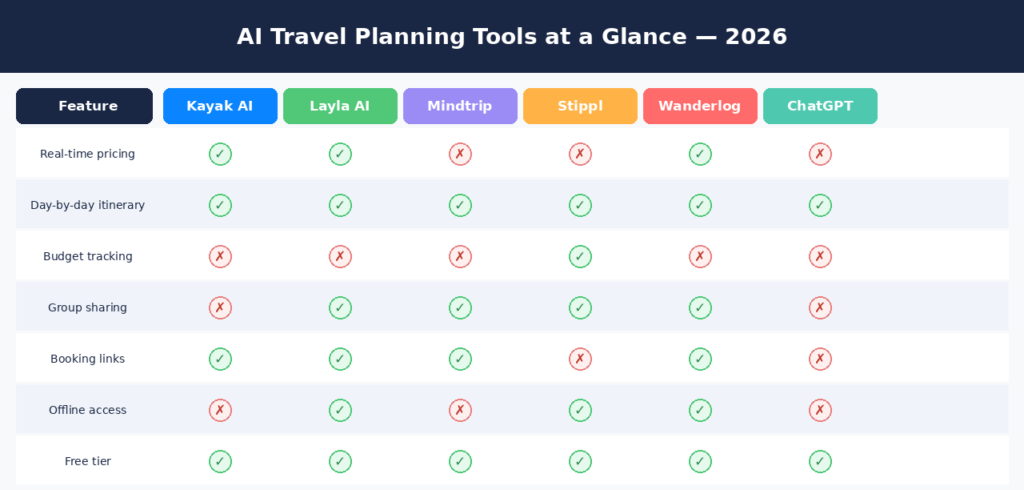
| Tool | Best For | Free Tier | Real-Time Pricing | Booking Links |
|---|---|---|---|---|
| Kayak AI | Live pricing and booking | Yes | Yes | Yes |
| Layla AI | All-in-one trip planning | Yes (limited) | Yes | Yes |
| Mindtrip | Visual and collaborative planning | Yes | No | Yes |
| Stippl | Full trip management | Yes | No | No |
| Wanderlog | Road trips and route mapping | Yes | No | Yes |
| ChatGPT | Free brainstorming | Yes | No | No |
Bottom line
The right AI travel planning tool depends entirely on what you need it to do. If live pricing matters most, Kayak AI is the only tool with real booking data built in. If you want a single app that handles the plan, the budget, and the packing list, Stippl covers all three. For visual and collaborative planning, Mindtrip’s map-based interface is hard to beat. And if you just need a free starting point to sketch out an itinerary, ChatGPT still does that job well.
The travelers who get the most out of AI in 2026 are the ones who use it as one tool among many, combining algorithmic efficiency with their own curiosity and judgment rather than following AI suggestions blindly.
Frequently asked questions
Which AI travel planning tool is best overall in 2026?
For most travellers, Kayak AI and Layla AI cover the widest range of needs. Kayak AI wins on real-time pricing and booking, while Layla AI offers the most complete dedicated planning experience including multi-city itineraries and collaborative editing. If you only want to try one free tool first, start with Kayak AI since it has no subscription and connects to live flight and hotel data.
Are AI travel planning tools free to use?
Most of the top tools offer a free tier that covers basic itinerary generation and planning. Kayak AI is fully free. Stippl, Mindtrip, and Wanderlog all have free tiers with optional paid upgrades. Layla AI has a free plan with premium features available at $49 per year. ChatGPT’s standard version is also free, though it lacks real-time travel data without a paid plan.
Can AI travel planning tools book flights and hotels for me?
Some can. Kayak AI and Layla AI both connect to live booking systems and let you complete a booking without leaving the app. Mindtrip provides booking links that take you to third-party sites. Tools like Stippl and ChatGPT focus on planning rather than booking and do not connect to live inventory, so you would book separately after using them to build your itinerary.
How accurate are AI-generated travel itineraries?
Accuracy varies by tool and destination. Tools like Wanderlog can struggle with routing accuracy and realistic time estimates, particularly for less common destinations, so itineraries often need manual adjustment. Tools connected to live data, like Kayak AI, are more reliable for pricing. For any AI-generated itinerary, it is worth cross-checking opening hours, entry requirements, and local conditions before you travel, especially for international trips.
Is it safe to let AI plan my entire trip?
AI is well-suited to handling the logistical groundwork: flights, accommodation options, activity sequencing, and budget estimates. Where it falls short is in the nuanced local knowledge that a well-travelled friend or specialist agent brings. Use AI to handle the research and structure, but apply your own judgment on decisions like neighbourhoods, safety considerations, and activities that matter most to you.