Tourism accounts for around 8 to 10% of global greenhouse gas emissions, and that number keeps climbing as travel returns to record highs. If you want to lower your sustainable travel carbon footprint in 2026, the good news is you do not need to give up your holidays or sleep in a tent. The choices that make the biggest difference are simpler than you think, and most of them cost nothing extra. This guide walks you through every stage of your trip, from booking to coming home, with practical steps you can act on right now.
What You Need Before You Start
Before you plan a single flight or hotel booking, it helps to know where your travel emissions actually come from. Transport is the biggest single factor, responsible for the majority of your trip’s carbon output. Accommodation, food choices, and the activities you do on the ground all add up too, but none come close to the impact of how you get there and back. With that in mind, the steps below are ordered by impact, starting with the biggest wins.
Step 1: Choose Lower-Carbon Transport
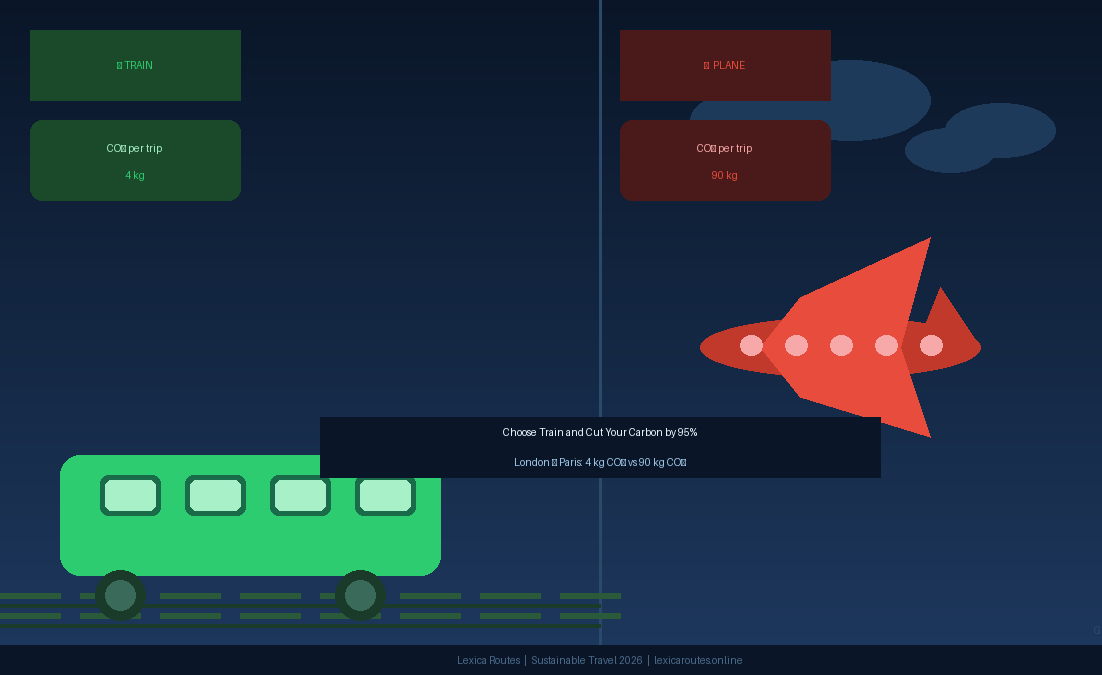
Getting from A to B is where most travellers can cut the deepest. The gap between different modes of transport is enormous. Taking a train instead of a short-haul flight can slash your journey’s carbon emissions by up to 90%. To put that in real terms, a London to Paris trip by rail produces around 4 kg of CO2 per passenger, while the same trip by plane produces roughly 90 kg. That is not a small rounding error. It is a completely different order of magnitude.
When flying is unavoidable, a few choices still matter. Direct routes are meaningfully cleaner than connections because takeoff and landing burn the most fuel. Economy class is also more efficient per passenger than business or first, since it puts more people on the same plane. In 2026, a growing number of airlines are introducing flights powered partly by Sustainable Aviation Fuel (SAF), which you can sometimes filter for when searching routes on major booking platforms.
Quick wins:
- Take the train for any journey under five hours
- Choose direct flights over connections when you must fly
- Book economy class to maximise passengers per unit of fuel
Step 2: Slow Down and Stay Longer
One of the most effective sustainable travel habits is also the most enjoyable: stay in fewer places for longer. The constant movement of a five-city whirlwind holiday racks up transport emissions at every stop. Spending a full week in one region, whether that is the Algarve coast in Portugal or a smaller city in Southeast Asia, keeps your transit footprint low while giving you a far richer experience of the place.
This approach, often called slow travel, has picked up serious momentum in 2026. Overtourism has pushed many travellers to step away from crowded hubs and spend more time in secondary destinations where their tourism money also circulates more deeply into the local economy. You get more, the planet gets less damage, and the community you are visiting actually benefits.
Step 3: Pick Genuinely Eco-Friendly Accommodation
Where you sleep makes more difference than most people realise. The hotel industry has made significant progress on transparency in 2026, with many properties now publishing their energy sources, water usage, and waste management policies openly. You do not have to take marketing claims at face value.
Look for independent certifications. LEED and EarthCheck are two of the most credible standards, covering energy efficiency, water use, and operational sustainability. A certified property has been independently assessed, not just self-declared green.
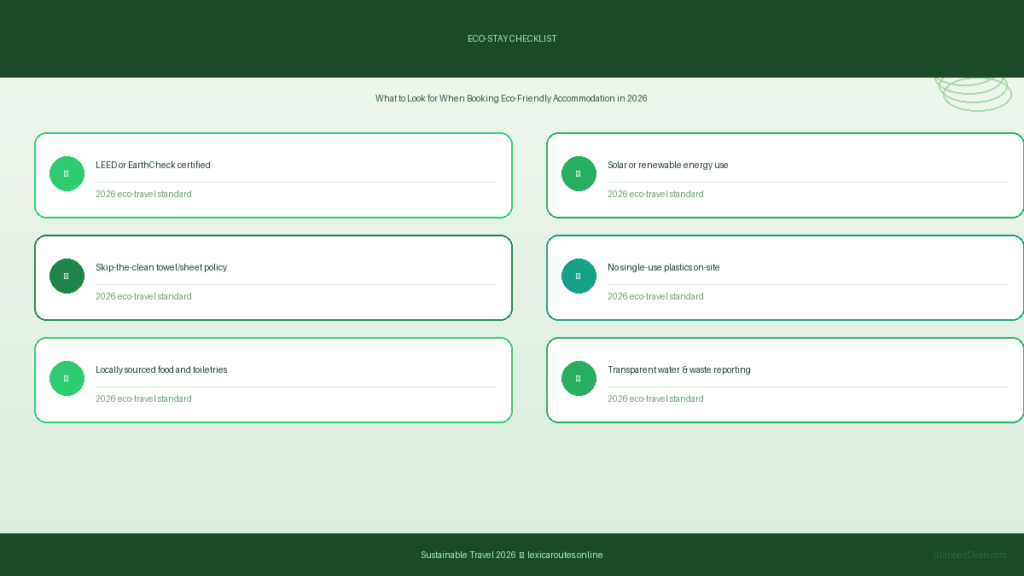
Beyond certifications, a few simple habits amplify the benefit once you check in. Declining daily housekeeping and reusing your towels is one of the easiest things you can do. Across hundreds of rooms and thousands of stays, this small choice saves enormous volumes of water and reduces the energy used in laundering. Skip single-use toiletries where your accommodation provides refillable dispensers, and turn off air conditioning when you leave the room.
What to look for when booking:
| Feature | Why it matters |
|---|---|
| LEED or EarthCheck certified | Independently verified, not self-declared |
| Renewable energy use | Cuts the accommodation’s operational emissions |
| Skip-the-clean towel policy | Saves water and laundry energy at scale |
| No single-use plastics on-site | Reduces plastic waste in sensitive destinations |
| Locally sourced food and toiletries | Lower food-mile emissions, supports local economy |
| Transparent water and waste reporting | Signals genuine accountability |
Step 4: Eat and Pack with Carbon in Mind
Food is a hidden contributor to your travel footprint that most guides skip over. Ingredients flown in from across the world, and meals heavy in meat, drive up emissions in ways that are easy to overlook. The fix is not complicated. Eating local, seasonal, and plant-forward food when you travel is better for the planet and usually produces the most memorable meals of a trip anyway. Support restaurants that source from nearby producers, and skip the chain restaurants that import ingredients regardless of what is available locally.
Packing light has a measurable impact too. Heavier bags mean more fuel burned per passenger, particularly on flights. Building a capsule wardrobe for your trip, with versatile items that work across multiple outfits, keeps your luggage manageable and cuts unnecessary weight.
Step 5: Offset What You Cannot Eliminate
Carbon offsetting is not a perfect solution and it should never be used as a guilt-free pass to ignore the steps above. But as a final layer on top of genuine footprint reduction, it has real value. When you offset, look for programmes certified to the Gold Standard or Verified Carbon Standard (VCS). These fund independently verified projects, from reforestation to community renewable energy, and the credits are measured against real, monitored outcomes. Use offsetting as the “and” at the end of your trip: reduce first, then offset what remains.
Comparison Table
Quick-Reference: 5 Steps to Lower Your Travel Carbon Footprint
| Step | Action | Estimated impact | Time to act |
|---|---|---|---|
| 1. Transport | Choose train over short-haul flight | Up to 90% reduction in journey emissions | Before booking |
| 2. Trip design | Slow travel, stay longer in fewer places | Cuts repeated transit emissions | Planning stage |
| 3. Accommodation | Book LEED or EarthCheck certified stays | Reduces energy and water impact | Before booking |
| 4. Food and packing | Eat local, pack light | Reduces food miles and fuel per passenger | Before and during trip |
| 5. Offsets | Use Gold Standard or VCS-certified programmes | Balances unavoidable emissions | After booking flights |
Verdict
Sustainable travel in 2026 does not ask you to sacrifice the quality of your trip. The steps that cut the deepest, choosing rail over short-haul flights, staying longer in one place, and picking certified accommodation, tend to produce richer, more connected travel experiences anyway. Start with transport because that is where the numbers are largest. Then work through the rest of the list at your own pace. Every choice you make compounds across the millions of journeys taken every day, and the collective impact adds up faster than most people expect. If you want to go further, read our guide to the best eco-friendly destinations in Europe for 2026, where we break down which countries are making it genuinely easy to travel with a lighter footprint.
Frequently Asked Questions
Is flying really that much worse than taking the train?
Yes, by a very significant margin. A short-haul flight can produce more than 20 times the CO2 per passenger compared to the equivalent train journey. The London to Paris route is a well-documented example: roughly 90 kg of CO2 by plane versus around 4 kg by Eurostar. For any journey where rail is a realistic option, it is the single biggest carbon-saving choice you can make.
Does carbon offsetting actually work?
It depends on the programme. Offsetting schemes that are certified to Gold Standard or Verified Carbon Standard (VCS) fund independently monitored projects and are generally considered credible. The key is to treat offsetting as a supplement to reducing your footprint, not a replacement for it. Buying offsets while making no other changes is unlikely to produce meaningful progress.
What does slow travel mean and how does it reduce emissions?
Slow travel means spending more time in fewer places rather than moving between multiple destinations on a single trip. Each additional transit leg adds emissions, so a week in one region produces far less transport carbon than a five-stop itinerary covering the same distance. It also tends to produce deeper, more satisfying travel experiences.
Are eco-certified hotels noticeably different to stay in?
In most cases, no. LEED and EarthCheck certified properties have simply been assessed against independent standards for energy efficiency, water use, and waste management. The guest experience is typically the same or better, since many eco-certified hotels invest in design features that improve comfort while reducing resource consumption. The “skip the clean” housekeeping option, for example, is now standard in most certified properties.
How much does packing light actually help?
The impact from weight alone is modest compared to transport mode choices, but it is real. Aircraft fuel consumption per passenger increases with baggage load, and heavier luggage on road trips means more fuel burned. More practically, travelling light reduces the temptation to buy single-use items on the road and makes the whole trip easier to manage, which indirectly supports more sustainable choices throughout your journey.
Author: Written by the Lexica Routes editorial team, covering travel, education, and study abroad since 2025.






1 comment