Inheritourism ancestral travel 2026 is no longer a niche idea discussed in travel magazines. It is a full-blown global movement, and the numbers behind it are striking. According to Hilton’s 2026 Trends Report, based on a survey of more than 14,000 travelers across 14 countries, 52% of families are now actively planning trips specifically to learn about their family roots. For the first time, millions of travelers are asking not “where do I want to go” but “where do I come from?” This shift is reshaping itineraries, tour operators, and even the travel industry’s relationship with DNA testing. Here is what the inheritourism trend actually means, who it affects, and why it is growing so fast in 2026.
What Happened
Hilton’s 2026 Trends Report, published in October 2025 and tracking travel behaviour through early 2026, officially named inheritourism one of the defining travel trends of the year. The report identifies two distinct sides to the trend: the literal return to ancestral homelands, and the broader pattern of travel habits being passed down through generations like an invisible inheritance.
On the ancestry side, 52% of families surveyed said they were planning trips to learn about their family roots. Nearly 70% said they were looking for experiences that connect them to local traditions. These are not casual sightseeing trips. Travelers are booking guided walks through ancestral villages, visiting old family churches and cemeteries, working with local historians, and in some cases reconnecting with long-lost relatives.
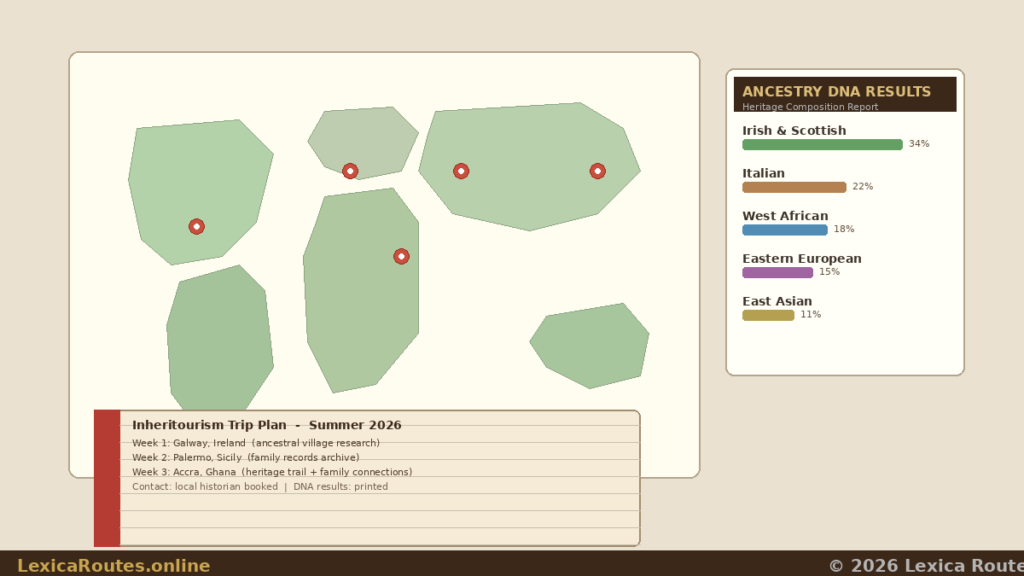
The trend has been accelerated by the global boom in at-home DNA testing. Companies like AncestryDNA and 23andMe have handed millions of people a list of countries and regions tied to their genetic heritage, and those people are now buying flights to see those places firsthand.
Why It Matters for Travelers
The inheritourism trend is not just emotionally meaningful. It is changing the practical side of how trips are planned and sold. Tour operators across Ireland, Italy, Greece, Eastern Europe, West Africa, and Japan have reported significant upticks in heritage-focused bookings. These trips tend to be longer, more expensive, and more deeply researched than standard holidays, which makes them a growing economic force in the travel sector.
For Black travelers in particular, the trend carries specific weight. As Condé Nast Traveler noted in its 2026 trend report, ancestry travel allows travelers to trace histories disrupted by slavery and forced migration, turning a DNA result or a family story into a structured itinerary. Travel Noire reported in April 2026 that the category is growing faster among Black travelers than the broader market, as the motivations are often layered with historical recovery alongside personal curiosity.
The generational dimension of inheritourism is equally significant. The Hilton data shows that 73% of travelers say their overall travel style was shaped by their family, and 66% say their parents directly influenced their hotel choices. Gen Z and Millennials are not just inheriting destinations from their parents. They are inheriting the entire emotional framework of what a trip should feel like, from the pace of travel to the type of accommodation chosen.
What Comes Next
The inheritourism wave shows no sign of slowing. Classic Vacations’ 2026 Luxury Travel Trends Report identified meaningful family time as one of the top three motivations driving luxury bookings this year, sitting alongside genuine rest and milestone celebrations. Researcher-guided heritage journeys, private genealogy tours, and culturally immersive stays in ancestral regions are all moving from niche to mainstream.
Travel experts suggest that the trend also has a sustainability benefit. Inheritourism naturally steers travelers away from the most overcrowded tourist hotspots and toward smaller towns and rural regions that rarely appear on standard itineraries. Ancestral villages in southern Italy, rural counties in Ireland, coastal towns in West Africa, and agricultural regions in Eastern Europe are seeing new visitor interest driven by genealogical research rather than glossy travel brochures.
For travellers who want to start their own inheritourism journey, the most common starting points are at-home DNA testing kits, national archive databases, and organisations like Ancestry.com’s heritage travel resources, which now offer guided trip planning alongside their genealogy tools. The National Park Service’s heritage tourism program in the United States also offers structured routes for domestic ancestral exploration, from Native American cultural trails in the Southwest to historic African American routes across the South. For broader context on the trend’s scale, Condé Nast Traveler’s 2026 Travel Trends report provides the clearest snapshot of where heritage travel fits within global tourism right now.
KEY FACTS BOX
| Key Fact | Detail |
|---|---|
| What is inheritourism? | A travel trend where people travel to ancestral homelands or pass down family travel habits across generations |
| Who identified it? | Hilton’s 2026 Trends Report, based on 14,000+ travelers across 14 countries |
| Key statistic | 52% of families are planning trips to trace their family roots in 2026 |
| Who is affected? | All travelers, with particular significance for diaspora communities and multigenerational families |
| Where to start | DNA testing kits, national archives, genealogy platforms, and heritage tour operators |
VERDICT
Inheritourism is one of the most significant travel trends of 2026 because it changes the fundamental question behind a trip. Instead of choosing a destination based on beach rankings or Instagram feeds, millions of travelers are now choosing based on family history, cultural identity, and a desire to understand where they come from. The Hilton data is clear: this is not a niche interest. It is a mainstream shift in how people assign meaning to travel. Whether you trace your roots to rural Ireland, West Africa, Eastern Europe, or rural Japan, the practical tools to plan an ancestral trip have never been more accessible.
FAQ
What exactly does inheritourism mean in 2026?
Inheritourism in 2026 refers to two connected travel behaviours: traveling to places tied to your ancestral heritage and family history, and the broader pattern of inheriting travel styles, hotel preferences, and destination choices from your parents and grandparents. Hilton’s 2026 Trends Report brought the term into mainstream conversation, with data from over 14,000 travelers confirming both patterns are accelerating.
How is inheritourism different from regular heritage tourism?
Heritage tourism is a broad category covering visits to historic sites, cultural monuments, and culturally significant destinations. Inheritourism is more personal. It specifically means traveling to places connected to your own family’s story, whether that is the village your grandparents left, a country revealed by a DNA test, or a destination your parents always returned to. The emotional stakes are higher, and the research involved is often more detailed.
Which destinations are most popular for ancestral travel in 2026?
The most commonly visited destinations for inheritourism trips in 2026 include Ireland and Scotland, Italy and Greece, Eastern Europe, West Africa, and Japan. These destinations see the highest demand from diaspora communities in North America, the UK, and Australia tracing their roots back to historical migration and, in the case of West Africa, forced displacement through the transatlantic slave trade.
Do I need a DNA test to plan an inheritourism trip?
A DNA test is a common starting point but not a requirement. Many travelers begin with family stories, birth records, immigration documents, or names passed down through generations. National archives, genealogy platforms, and local historians in destination countries can all help fill in the gaps. DNA tests simply add a data layer that can confirm or expand what family oral history suggests.
Is inheritourism only for older travelers or multigenerational families?
No. Hilton’s data shows that Gen Z and Millennials are among the most active participants in the inheritourism trend, partly driven by DNA testing and partly by a broader desire for travel that feels personally meaningful rather than generic. Solo travelers in their 20s and 30s are booking ancestral research trips in growing numbers, often independently rather than as part of a family group.
RELATED POSTS (Section 12)
Related posts
- Sustainable Travel 2026: How to Reduce Your Carbon Footprint on Holiday
- Culinary Tourism 2026: Best Food Cities in the World Right Now
- How to Plan a Multi-Gen Family Trip Everyone Will Love
Author: Written by the Lexica Routes editorial team, covering travel, education, and study abroad since 2025.
Explore our more pages: Education | EdTravel | Travel |