You sit down to write an essay. Before you type a single word, you open ChatGPT, Paperpal, or Grammarly. If that sounds familiar, you are not alone. AI essay writing has become one of the most talked-about shifts in education in 2026, and students, teachers, and universities are all scrambling to figure out where the line is. This guide breaks down what is actually happening, how schools are responding, and the step-by-step way to use AI without putting your academic future at risk.
What AI Is Actually Doing to Essay Writing Today
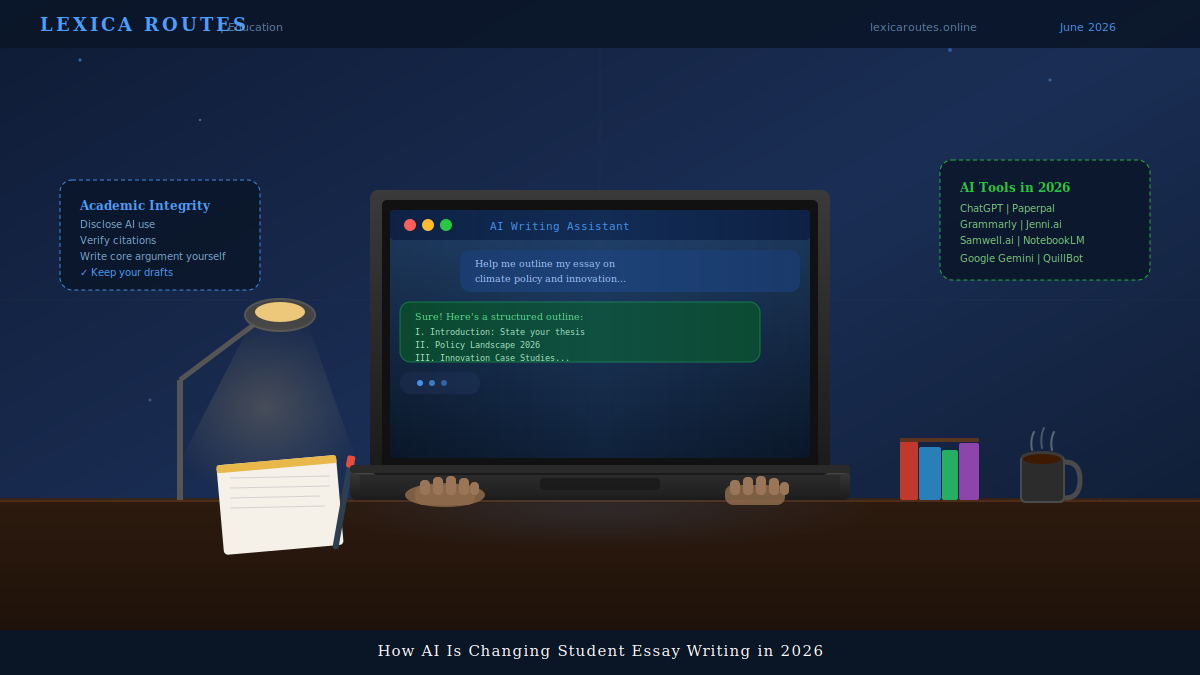
AI is not replacing student writers. It is changing what the writing process looks like before a word hits the page. Tools like ChatGPT, Google Gemini, and purpose-built academic platforms such as Paperpal and Samwell.ai are now being used for outlining, brainstorming, paraphrasing, grammar checks, and citation formatting.
The risks are well-documented and include plagiarism exposure, over-reliance that erodes critical thinking, citation fabrication, and AI hallucinations that produce plausible-sounding but incorrect references. These are not abstract concerns. Studies show that 40 to 93 percent of AI-generated references contain errors or fabrications, including fake DOIs, non-existent journals, and made-up titles.
The bigger picture, though, is that AI is genuinely useful when handled well. The practical hybrid workflow looks like this: draft your core argument yourself, use AI to refine structure and mechanics, then revise with your own analysis and verify every claim. That is the approach that keeps you in control and keeps your grade intact.
How Universities Are Responding in 2026
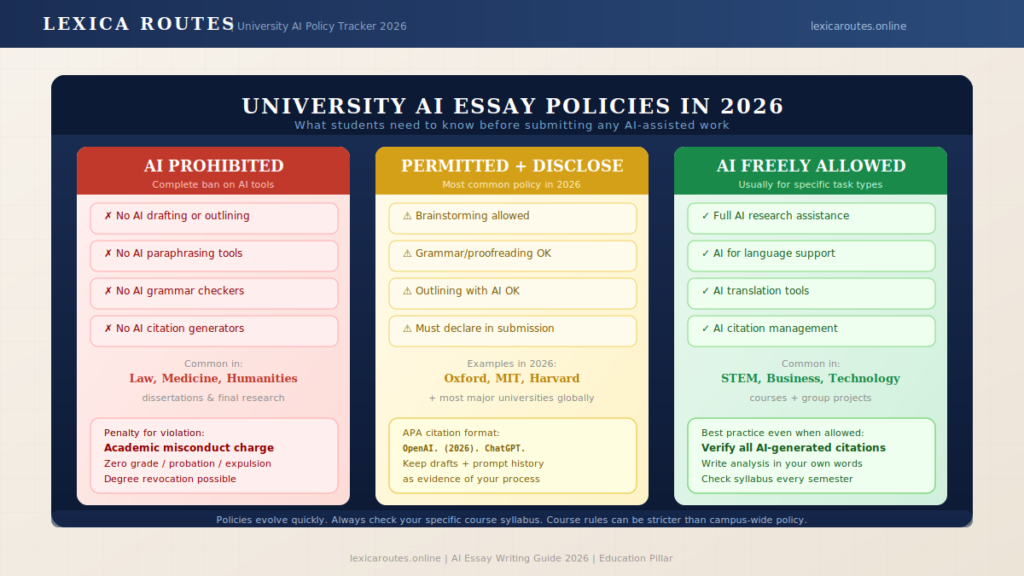
University policies have shifted dramatically since 2023. By 2026, authorship evaluation will be longitudinal. Universities are looking at patterns across time rather than isolating a single submission, with graduate programs in law, medicine, and humanities tightening guidelines around AI use in theses, dissertations, and final research projects.
Policies usually fall into three buckets: AI prohibited, AI permitted with disclosure, or AI allowed for limited tasks like outlining or proofreading. What has changed is how schools enforce these rules. Academic integrity offices increasingly recommend comparing flagged essays against a student’s earlier coursework before drawing conclusions, reviewing vocabulary range, sentence complexity, and structural consistency across semesters.
Detection tools like Turnitin are now standard, but they are not infallible. False positives can wrongly implicate students, with rates of roughly four per cent reported in some tools, while false negatives let AI content slip through. Bias toward non-native English writing has led some universities to scale back or deactivate AI detection features entirely. The takeaway for students: assume you will be asked to explain your work, not just submit it.
What Top Universities Currently Allow
Oxford, for example, permits AI to support research and studies but requires a declaration if it is used in any assessed work, and unauthorised use is treated as academic misconduct. Most institutions follow a similar framework. What was banned in 2023 is often allowed in 2026, if disclosed properly. Fail to comply, and AI use risks being flagged as plagiarism, leading to zeros, academic probation, or worse.
The safest approach across any institution is straightforward: check your specific course syllabus first, because course-level rules can be stricter than campus-wide policy.
Step-by-Step: How to Use AI for Essays Without Crossing the Line
Step 1: Check Your Course Policy Before You Start
Before opening any AI tool, find your course’s specific AI policy. Do not rely on what your university says generally. A department policy can be stricter, and pleading ignorance will not protect you. If the policy is unclear, email your instructor before submission, not after.
Step 2: Use AI for Structure and Brainstorming, Not for Writing
Open a tool like Paperpal, Jenni.ai, or even ChatGPT with a specific goal: generate an outline, list counterarguments, or identify gaps in your thinking. Do not paste a prompt and submit what comes back. Treat AI as an assistant with strong grammar skills but no real understanding of your field. That framing keeps you in control.
Step 3: Write the Core Argument Yourself
Your argument is what the essay is graded on. AI cannot replicate your interpretation of a source, your response to a specific lecture, or the angle your instructor is looking for. Write the analytical sections in your own words before touching any AI tool for refinement. This also protects you if your work is reviewed alongside your previous submissions.
Step 4: Use AI to Refine, Not Replace
Once your draft exists, AI becomes genuinely useful. Run it through Grammarly for grammar and fluency, use Paperpal to check academic tone, or use an AI paraphrasing tool to tighten a clunky paragraph. One-click rewrite options for entire paragraphs carry specific academic integrity risks; they are best used for small, local edits rather than wholesale revision.
Step 5: Verify Every Citation Manually
This is non-negotiable. AI-generated references are notoriously unreliable. Never submit AI-generated citations without manual verification through Google Scholar, PubMed, or CrossRef. Universities now use Turnitin and other tools to detect AI-generated references, which can trigger academic misconduct investigations.
Step 6: Disclose AI Use Where Required
Treat AI as a source. In APA format, for example, it is cited as: OpenAI. (2026). ChatGPT. Keep disclosures brief and factual. A short note in your methodology or acknowledgements section is usually enough unless your course specifies a different format.
Step 7: Keep Your Drafts and Notes
Keep drafts, outlines, and research notes. These materials can support your case and show how your work developed over time, if your work is ever questioned. A folder of timestamped drafts is cheap insurance against a false positive from any detection tool.
Common Mistakes Students Make with AI in 2026
Studies show students often fail to recognise grey-zone practices, behaviours that are not outright plagiarism but still compromise integrity, while faculty policies lag behind rapid adoption.
The most common mistakes are:
Submitting AI-generated citations without checking them. Relying on AI for the argument itself, not just the mechanics. Assuming that because a tool produces human-sounding text, it cannot be detected. Using AI more heavily in one assignment than in earlier ones, which creates a detectable shift in writing style.
The last point matters more than most students realise. Large deviations in writing sophistication between assignments may prompt follow-up questions, especially if writing sophistication appears to shift abruptly. However, improvement itself is not treated as evidence of misconduct without corroborating factors.
Pros and Cons of Using AI for Student Essay Writing
| Pros | Cons |
|---|---|
| Faster outlining and brainstorming | Risk of over-reliance and skill erosion |
| Better grammar and clarity | Citation fabrication is common |
| Useful for non-native English speakers | AI detection tools can produce false positives |
| Helps identify logical gaps in arguments | Policies vary by course, not just institution |
| Available 24/7, no waiting for office hours | Disclosed use still varies by instructor preference |
Our Take
AI is now part of student life in 2026. Pretending otherwise helps no one. The students who will get the most out of it are the ones who use it to think more clearly, not to write more quickly. Use AI to outline, refine, and check your work. Write the argument yourself. Verify every reference. Disclose when required.
If you want to go deeper on how AI is changing education beyond essay writing, read our guide to AI in the Classroom: How Teachers Are Using It in 2026 to see what is happening on the other side of the desk.
Frequently Asked Questions
Can universities detect if a student used AI to write an essay?
Yes, though no detection tool is perfect. Turnitin and similar platforms flag AI-generated text, and many universities now compare submissions against a student’s earlier work to identify unusual shifts in writing style. A single essay that sounds very different from your previous work may prompt follow-up questions.
Is it academic dishonesty to use ChatGPT to help write an essay in 2026?
It depends on your course policy. Many universities now allow limited AI use, such as brainstorming or grammar checks, as long as it is disclosed. Using AI to write the core argument without disclosure typically violates academic integrity rules. Always check your specific course syllabus.
What is the safest way to use AI for academic writing?
Use AI only for tasks your policy allows, such as outlining or proofreading. Write the analysis yourself. Verify every citation manually. Keep drafts and notes as evidence of your process. Disclose AI use wherever your course requires it.
Can AI tools fabricate references and citations?
Yes, and this is one of the most serious risks. Studies show that a high percentage of AI-generated references contain errors, including fake journal names and non-existent DOIs. Always verify citations manually through Google Scholar, PubMed, or your university library before submitting.
Will using AI to help with essays hurt my writing skills long-term?
It can, if you let AI do the thinking instead of you. Over-reliance erodes the critical thinking and argument-building skills that academic writing is designed to develop. The right approach is to use AI for mechanics and structure while doing the core analytical work yourself.
Related Posts
- AI in the Classroom: How Teachers Are Using It in 2026
- Microcredentials vs Degrees: Which Is Worth It in 2026?
- Best Free Online Courses with Certificates in 2026
Author: Written by the Lexica Routes editorial team, covering travel, education, and study abroad since 2025.