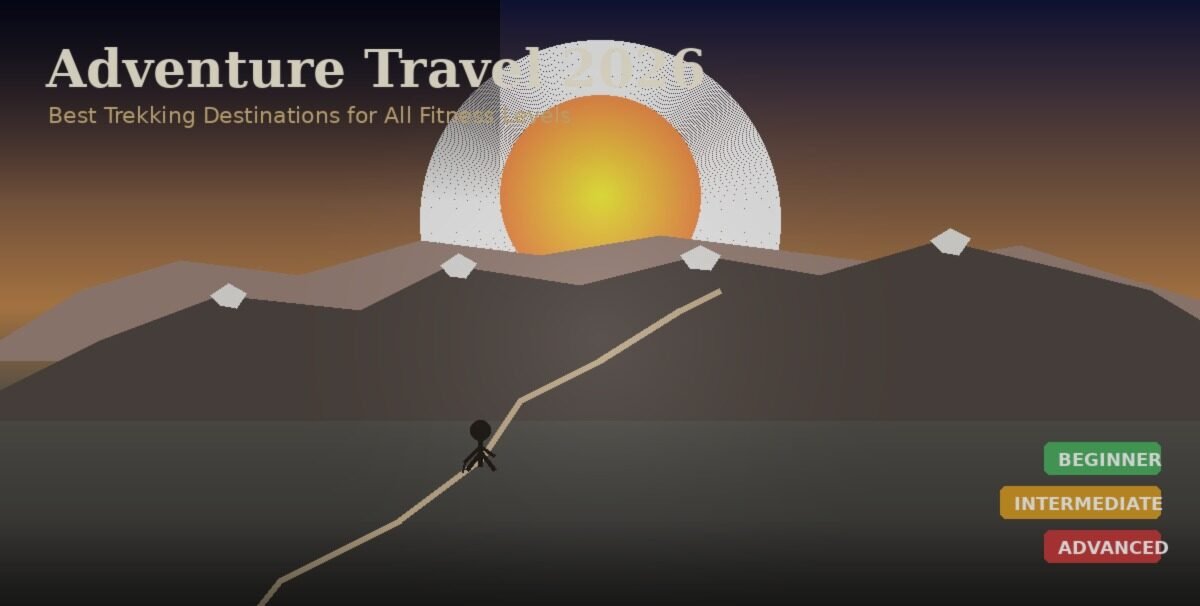
Adventure travel is having a serious moment. More people than ever are swapping beach sunbeds for mountain trails, and the data backs that up: self-guided and guided trekking trips saw some of their strongest booking numbers heading into 2026, with travelers prioritizing nature, sustainability, and genuinely physical experiences over passive holidays.
But here is the thing about trekking: the best destination for you depends entirely on where you are physically right now, not on what looks most impressive in someone else’s travel photos. This guide breaks down the top trekking picks for 2026 by fitness level, so you can find your right trail, not just a famous one.
What to Look for When Choosing a Trek
Before you book anything, four factors should shape your decision.
Fitness level and trail difficulty is the most important one. Honest self-assessment here saves a lot of misery at altitude. If you are not regularly hiking on uneven ground, jumping straight to a 14-day high-altitude expedition is a recipe for a very expensive bad time.
Altitude changes everything. Once you go above 3,000 metres, your body needs time to adjust, and skipping acclimatisation days is the most common reason treks end early. If you have never been above 3,000m, factor that in when comparing options.
Trip duration matters more than people expect. Kilimanjaro and Everest Base Camp both require 8 to 14 days minimum. If you have a week, routes like the Cotswold Way, the W-Trek in Patagonia, or day-trek circuits give you a full experience without rushing.
Permit requirements and crowd levels vary wildly by destination. The Inca Trail requires permits that sell out months in advance. Kilimanjaro and Everest Base Camp involve park fees. Checking these early prevents serious disappointment.
Best Trekking Destinations for Beginners
Cotswold Way, England
The Cotswold Way is one of the most underrated walking routes in the world for people new to multi-day trekking. The terrain is gentle to moderate, the trail is well-marked, and you are never far from a village pub. The full 164km route takes around 9 to 10 days, but plenty of walkers do shorter sections over a long weekend. According to Macs Adventure, self-guided hiking in destinations like this is surging in 2026 because it offers freedom with built-in support.
Best for: First-time multi-day hikers, families, cultural travel combined with walking Duration: 3 to 10 days Fitness required: Low to moderate
Wild Pacific Trail, Vancouver Island, Canada
Perched on the rugged west coast of Vancouver Island, Ucluelet is one of Expedia’s top trending destinations for 2026, with a 44 percent rise in traveler interest. The Wild Pacific Trail here is one of the most scenic beginner-friendly routes in North America, winding along clifftops with dramatic Pacific Ocean views. Day sections can be done independently, and the surrounding area offers kayaking and surfing for rest days.
Best for: Beginners wanting coastal drama without altitude risk Duration: 1 to 3 days Fitness required: Low
Best Trekking Destinations for Intermediate Hikers
Inca Trail to Machu Picchu, Peru
The Inca Trail is one of the most iconic treks in the world and sits in a comfortable intermediate bracket. The classic 4-day, 45km route involves some altitude (the highest pass is Dead Woman’s Pass at 4,215m), but the daily distances are manageable and the pace is built around acclimatisation. The payoff, arriving at Machu Picchu through the Sun Gate at sunrise, is genuinely difficult to match anywhere.
Permits sell out months in advance, so early booking is non-negotiable. For those who cannot get an Inca Trail permit, the Salkantay Trek covers similar terrain with fewer crowds and no permit lottery.
Best for: Fit hikers with some experience, history and culture enthusiasts Duration: 4 to 7 days Fitness required: Moderate
Tour du Mont Blanc, European Alps
The Tour du Mont Blanc loops around the Mont Blanc massif across France, Italy, and Switzerland, covering roughly 170km. It is the kind of trek where the scenery shifts every day and every valley feels different. The terrain is challenging but the alpine infrastructure is excellent, with mountain huts (refuges) spaced along the route. Most people complete it in 10 to 11 days. There are no technical sections, but you need a solid base of hill fitness before you go.
Best for: European travelers, hikers ready to step up from easy routes Duration: 10 to 12 days Fitness required: Moderate to high
Best Trekking Destinations for Advanced and Experienced Trekkers
Everest Base Camp, Nepal
Everest Base Camp remains the benchmark bucket-list trek. At 5,364m, the altitude is serious and the trip length of 12 to 14 days is non-negotiable for safe acclimatisation. The trail takes you through Sherpa villages, over suspension bridges, past Buddhist monasteries, and up through some of the most dramatic mountain terrain on Earth. You do not summit Everest. You reach the base camp, from which real expeditions set off, and the experience is humbling in every sense.
Mountain Kingdoms recommends at least five nights in the best teahouses available on the trail, with dedicated acclimatisation days built into every itinerary. Do not try to rush this one.
Best for: Experienced hikers comfortable at altitude, those with multi-day trekking history Duration: 12 to 16 days Fitness required: High
Kilimanjaro, Tanzania
Around 30,000 people attempt Kilimanjaro every year, passing through tropical rainforest, moorland, and alpine desert before reaching the summit glaciers at 5,895m. What surprises most first-timers is that Kilimanjaro is not technically difficult. There is no rock climbing, no ropes. It is a long, high-altitude walk. The challenge is almost entirely physiological. The June to October dry season offers the best trekking conditions and clearest skies.
For those not ready for the full summit attempt, Kilimanjaro Base Camp at around 4,500m is a strong standalone experience, with costs typically ranging from $600 to $900 per person including guides, porters, and park fees.
Best for: Advanced hikers seeking their first high-altitude summit experience Duration: 7 to 9 days Fitness required: High
Comparison Table: Top Trekking Destinations 2026
| Trek | Best for | Fitness Level | Duration | Rough Cost |
|---|---|---|---|---|
| Cotswold Way, England | Beginners, cultural walkers | Low to moderate | 3 to 10 days | $500 to $1,200 |
| Wild Pacific Trail, Canada | Coastal beginners | Low | 1 to 3 days | $100 to $400 |
| Inca Trail, Peru | Intermediate, culture lovers | Moderate | 4 to 7 days | $800 to $1,500 |
| Tour du Mont Blanc, Alps | Intermediate step-up | Moderate to high | 10 to 12 days | $1,200 to $2,500 |
| Everest Base Camp, Nepal | Advanced altitude trekkers | High | 12 to 16 days | $1,500 to $3,500 |
| Kilimanjaro, Tanzania | Advanced, first summit | High | 7 to 9 days | $600 to $2,500 |
Our recommendation
The best trek is the one that matches where you are right now. If you are new to this, the Cotswold Way or Wild Pacific Trail gives you a real multi-day adventure without the risks that come with overreaching. Once you have that base, the Inca Trail is the natural next step and one of the most rewarding experiences you can have anywhere.
For experienced trekkers ready to push into high-altitude territory, Kilimanjaro in the June to October window is hard to beat as a first summit. Everest Base Camp demands more time and preparation but delivers an experience that has no real equal.
Whatever level you are at, book early, train specifically for the elevation you are taking on, and get your permits sorted months in advance.
Frequently asked questions
What is the best trekking destination for beginners in 2026?
The Cotswold Way in England is one of the best starting points for beginner trekkers in 2026. The terrain is gentle, the trail is well-marked, and the route can be broken into shorter sections. For a more dramatic setting, the Wild Pacific Trail on Vancouver Island in Canada offers stunning coastal scenery with very manageable difficulty.
How fit do you need to be to trek Everest Base Camp?
You need a solid foundation of cardiovascular fitness and ideally some prior experience on multi-day trails before attempting Everest Base Camp. Daily hikes with a weighted pack in the months before your trip are the standard preparation. The challenge at EBC is primarily altitude, not technical terrain, so consistent aerobic training matters more than strength work.
Is the Inca Trail worth doing in 2026?
Yes, but you need to book permits early. The classic 4-day Inca Trail remains one of the most rewarding treks in the world, combining Andean mountain scenery with well-preserved Inca ruins and a sunrise arrival at Machu Picchu through the Sun Gate. Permits sell out months ahead, so anyone planning a 2026 trip should be looking at options now.
What is the best time of year to trek Kilimanjaro?
June to October is the best window for Kilimanjaro trekking. The dry season delivers clear skies, good trail conditions, and the best chance of summit visibility. January to March is a secondary dry season that also works well with fewer crowds, though the shoulder months between seasons bring unpredictable weather at high altitude.
Can you do a great trek in under one week?
Absolutely. The Inca Trail classic route is 4 days. Day-trek circuits around the Mont Blanc massif can be done in 5 to 6 days. In East Africa, Kilimanjaro Base Camp (not the summit) is achievable in 4 to 5 days. The key is choosing a route designed for your available time rather than trying to compress a longer trek.
Related posts
- Budget Travel Europe 2026: How to Spend Under $50 a Day
- Wellness Travel 2026: Science-Backed Retreats That Are Worth the Cost
Author: Written by the Lexica Routes editorial team, covering travel, education, and study abroad since 2025.