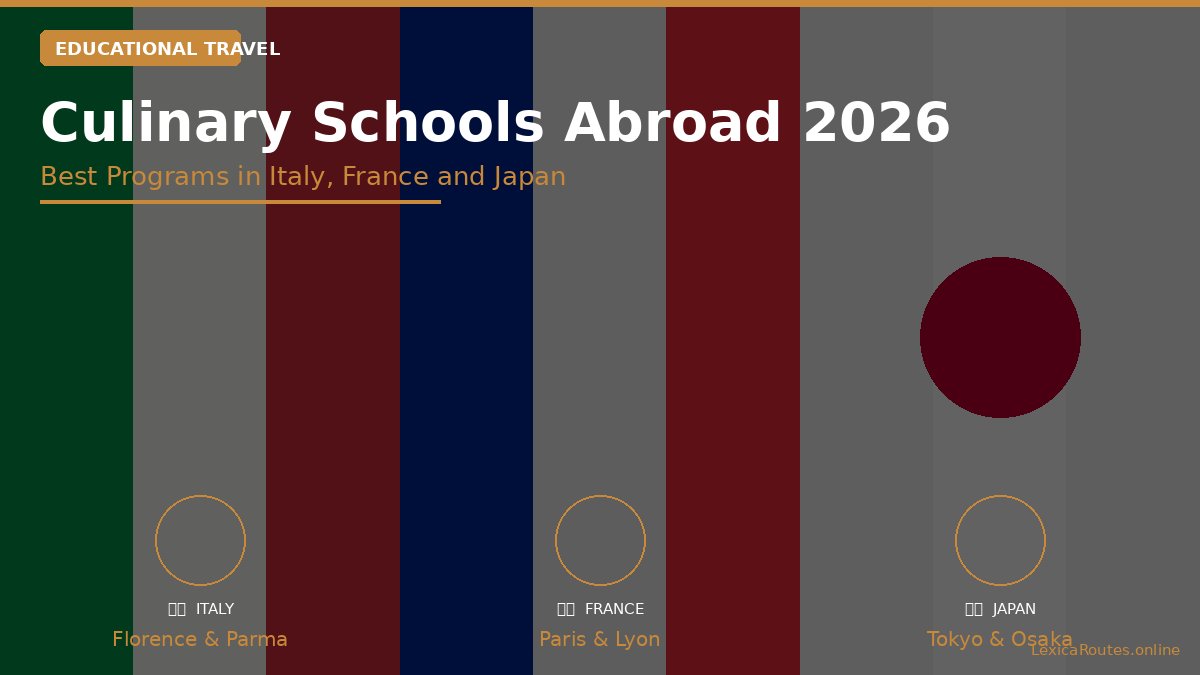
Choosing the right culinary school abroad in 2026 is one of the most important decisions an aspiring chef can make. The school you pick shapes not just your technical skills, but the culinary tradition you carry for life. Italy, France, and Japan sit at the very top of that conversation, each offering a fundamentally different path into world-class food. This listicle breaks down the best programs in each country, what they cost, who they suit, and what you actually get for your time and money. Whether you want to master a classical French sauce, hand-roll fresh pasta in Tuscany, or perfect Japanese knife discipline in Tokyo, this guide has the answer.
What to Look for in a Culinary School Abroad in 2026
Before we get into specific programs, it helps to know what separates a genuinely transformative culinary education from an expensive tourist experience. The best schools abroad in 2026 combine hands-on kitchen hours with real industry placement, strong alumni networks, and credentials that travel well internationally.
Program length matters more than prestige alone. A nine-month intensive at the right school will build more practical skill than a two-week summer course at a famous name. Look for programs that include internship placements in working restaurants, access to local markets and produce, and instruction from chefs with current industry credibility, not just classroom theory.
Cost is the other variable most guides underplay. Tuition fees for top culinary programs abroad typically run between 15,000 and 40,000 EUR per year, but living expenses, visa costs, and equipment kits add significantly to that figure. Budget planning before you apply is not optional.
Best Culinary Schools Abroad in Italy
Italy is the natural first stop for anyone serious about culinary school abroad. The country does not have one unified cuisine but dozens of distinct regional food cultures, and the best Italian culinary programs are built around that richness.
1. ALMA, The International School of Italian Cuisine, Parma
ALMA is Italy’s most respected professional culinary institution, based in Parma, the city that gives the world Parmigiano-Reggiano and Prosciutto di Parma. The flagship Diploma in Italian Cuisine runs for one year and covers regional Italian cooking in rigorous depth, from antipasto to dessert, with dedicated weeks focused on specific regional traditions.
The program costs approximately EUR 24,500 for the full diploma, which includes kitchen equipment and structured internship placement in a professional Italian restaurant. ALMA accepts international students and teaches in Italian and English, with language support available for non-Italian speakers entering the program.
Best for: Serious aspiring chefs who want a professional credential, regional depth, and a direct pathway into Italian restaurant kitchens.
2. Apicius International School of Hospitality, Florence
Apicius was Italy’s first international hospitality school, founded in Florence in 1997. It sits within Florence University of the Arts and offers programs ranging from short enrichment courses to full four-year undergraduate degrees in culinary arts, wine studies, and hospitality management.
What sets Apicius apart is its collaboration with the James Beard Foundation through the TuttoToscana program, a unique combination of Florence-based learning and New York City event production. Faculty include nutritionists, sommeliers, and Michelin-starred chefs. The school’s location in Florence also gives students access to one of the most food-rich cities in the world.
Best for: Students who want to combine culinary training with cultural immersion, or those looking for a credit-bearing program that transfers to a US undergraduate degree.
Best Culinary Schools Abroad in France
France remains the dominant force in classical culinary education globally. The techniques developed in French kitchens over the past two centuries form the foundation of nearly every professional kitchen in the world, and studying in France means learning from that source directly.
3. Le Cordon Bleu Paris
Le Cordon Bleu is the most recognized name in culinary education worldwide. The Paris campus, located near the Eiffel Tower and the Seine, offers the Grand Diplome, a nine-month program that combines the full Cuisine Diploma and the full Patisserie Diploma into a single rigorous qualification.
Tuition for flagship programs at Le Cordon Bleu Paris reaches approximately EUR 60,000 for the Grand Diplome in 2026, which includes a professional knife kit and all in-program activities. Le Cordon Bleu teaches around 20,000 students from over 130 nationalities each year, with programs delivered in both French and English.
The school’s alumni network spans every continent and every tier of the restaurant industry. If international recognition and prestige are priorities alongside rigorous classical technique, Le Cordon Bleu Paris remains the top choice in France.
Best for: Students targeting fine-dining careers, culinary entrepreneurship, or roles in major hotel groups globally.
4. Institut Paul Bocuse, Lyon
Lyon is widely considered France’s culinary capital, and Institut Paul Bocuse is its most prestigious training ground. The school offers undergraduate and postgraduate degrees in culinary arts and hospitality management, with a curriculum built around French gastronomy, product knowledge, and restaurant operations.
Programs at Institut Paul Bocuse integrate classroom theory with serious kitchen time from day one. The school’s connections to the Lyon restaurant scene also give students access to internship opportunities at some of the most respected kitchens in France. Tuition runs in a similar range to other elite French institutions, with programs available in French and English.
Best for: Students who want a full degree with strong French cultural immersion and Lyon’s world-class gastronomic environment at their doorstep.
Best Culinary Schools Abroad in Japan
Japan offers something that neither France nor Italy can fully replicate: a culinary philosophy built around restraint, precision, and the near-spiritual relationship between a chef and their ingredients. Studying culinary arts in Japan in 2026 means learning not just technique but a fundamentally different way of thinking about food.
5. Hattori Nutrition College, Tokyo
Hattori is Japan’s most internationally recognized culinary school and one of the few in the country specifically structured to welcome foreign students. Located in Shibuya, Tokyo, the college offers a one-year Culinary Course, a one-year Culinary Patisserie and Boulangerie Course, and a two-year Culinary High-Tech Business Administration program.
Hattori accepts international applicants who must obtain a Japanese student visa before enrolling. The curriculum blends traditional Japanese culinary arts with modern nutrition science, and the school has a strong emphasis on healthy, ingredient-led cooking techniques. The principal, Dr. Yukio Hattori, is a nationally recognized food authority in Japan.
Best for: International students who want a structured Japanese culinary qualification, hands-on training in a real restaurant environment, and a pathway into Japan’s food industry.
6. Tsuji Culinary Institute, Osaka
Tsuji is one of Japan’s largest and most respected culinary schools, based in Osaka, with a strong international reputation for Japanese and French cuisine training. It offers a one-year Culinary Arts Course, a two-year Culinary Arts and Management program, and a three-year Advanced Culinary Arts and Management track.
Tsuji’s breadth is its biggest advantage. Students can specialize in Japanese cuisine, French cuisine, pastry, or a combination, all within one institution. The school has dedicated English-language support for international students and a curriculum that puts knife skills, ingredient handling, and kitchen discipline at the center of every year of study.
Best for: Students who want flexibility across culinary traditions, or those specifically targeting a career in Japanese fine dining or kaiseki cuisine.
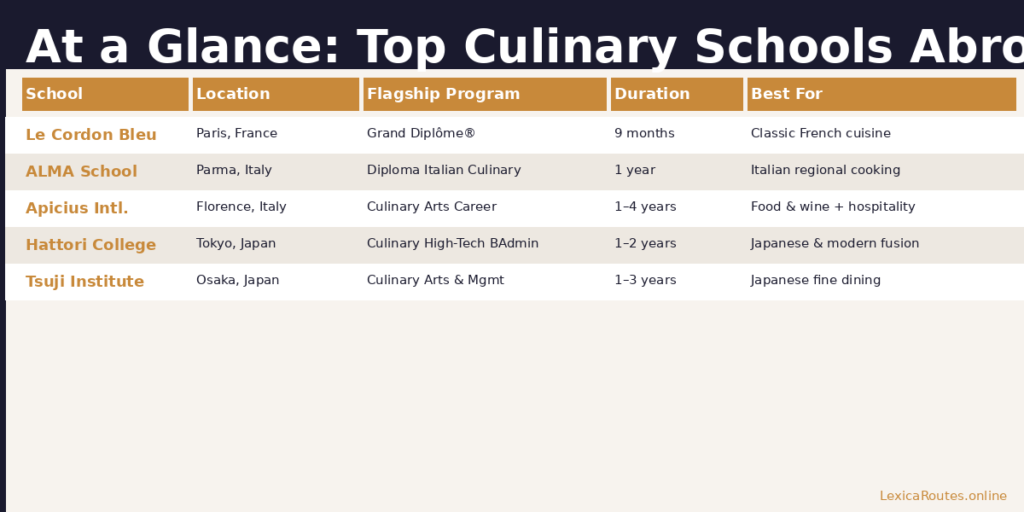
Summary: Top Culinary Schools Abroad at a Glance
| School | Location | Flagship Program | Duration | Approx. Cost | Best For |
| ALMA | Parma, Italy | Diploma Italian Cuisine | 1 year | EUR 24,500 | Professional Italian chefs |
| Apicius Intl. | Florence, Italy | Culinary Arts (Career) | 1 to 4 years | Varies by program | Cultural immersion + credits |
| Le Cordon Bleu | Paris, France | Grand Diplome | 9 months | EUR 60,000 | Classical French mastery |
| Institut Paul Bocuse | Lyon, France | BA Culinary Arts | 3 years | Comparable to LCB | Full degree + Lyon networks |
| Hattori College | Tokyo, Japan | Culinary High-Tech BAdmin | 1 to 2 years | Contact school | Japanese cuisine + nutrition |
| Tsuji Institute | Osaka, Japan | Culinary Arts and Mgmt | 1 to 3 years | Contact school | Japanese and French fusion |
────────────────────────────────────────────────────────────────────────────────
Bottom line
Italy, France, and Japan each represent a distinct and irreplaceable culinary world. If your goal is classical technique and global prestige, Le Cordon Bleu Paris leads the field. If you want to cook Italian at a professional level with serious regional depth, ALMA in Parma is the most respected credential you can earn. For Japanese cuisine, both Hattori in Tokyo and Tsuji in Osaka offer structured, internationally accessible programs that will teach you things no Western kitchen ever could.
The right culinary school abroad in 2026 depends entirely on what kind of chef you want to become and where you want to build your career. The programs on this list are the ones worth the investment. Start with the country whose food tradition excites you most, then go deeper from there.
Related reading: See our guide to international internships in 2026 and our breakdown of digital nomad student visas for students planning a longer study-abroad journey.
────────────────────────────────────────────────────────────────────────────────
Frequently asked questions
Which culinary school abroad is the best overall in 2026?
Le Cordon Bleu Paris holds the strongest international reputation for classical culinary training in 2026. However, the best school depends on your goals: for Italian cuisine, ALMA in Parma is the premier choice; for Japanese technique, Hattori Nutrition College in Tokyo or Tsuji in Osaka are the top options. Prestige matters less than the match between a program and your specific culinary direction.
How much does culinary school abroad cost in 2026?
Costs vary widely. Le Cordon Bleu Paris charges approximately EUR 60,000 for the full Grand Diplome program. ALMA in Parma runs around EUR 24,500 for its diploma. Japanese schools like Hattori and Tsuji price programs differently and require direct inquiry for current figures. Short certificate programs can cost significantly less, from a few thousand euros for a weeks-long intensive course.
Is it worth going to culinary school abroad versus learning on the job?
A culinary school abroad gives you structured credentials, a global peer network, and immersive exposure to a food tradition that is very hard to replicate on the job. On-the-job experience is invaluable, but it rarely gives you the cultural depth and technical foundation that comes from studying in Italy, France, or Japan. Most top chefs who trained abroad describe it as the experience that shaped their entire approach to food.
Can international students attend culinary school in Japan without speaking Japanese?
Yes, both Hattori Nutrition College and Tsuji Culinary Institute in Japan accept international students and provide English-language support. However, Hattori requires all international applicants to obtain a Japanese student visa before enrollment, and some kitchen instruction is conducted in Japanese. Learning basic Japanese before you arrive significantly improves the experience.
What is the shortest culinary program abroad available in 2026?
Le Cordon Bleu Paris offers short certificate and intensive courses lasting as little as two weeks. Apicius in Florence also runs enrichment classes covering Italian cooking, wine, and culture that can be completed in a month or less. ALMA offers a dedicated short course in Italian pasta making lasting three weeks for EUR 3,650. These shorter programs are ideal for enthusiasts or professionals adding specific skills, rather than those seeking a full credential.
────────────────────────────────────────────────────────────────────────────────
Related posts
- Digital Nomad Student Visas in 2026: Countries That Welcome You
- Study Abroad Is Booming: 8 Million Students Go Global in 2026
- Culinary Tourism 2026: Best Food Cities in the World Right Now
────────────────────────────────────────────────────────────────────────────────
Author: Written by the Lexica Routes editorial team, covering travel, education, and study abroad since 2025.