
Picking where to learn Spanish abroad is one of the most common and most confusing decisions a language student faces in 2026. Spain and Latin America both offer world-class immersion, but they deliver very different experiences in terms of cost, accent, culture, and long-term career usefulness. This guide compares the two regions directly and tells you which one suits your goals, budget, and learning style.
How the Two Regions Differ on Spanish
The first thing most students want to know is whether the Spanish you learn in one region will hold you back in the other. The honest answer is no, but the differences are real and worth knowing before you book.
Spain uses Castilian Spanish, which includes the distinctive “ceceo” pronunciation where the letters c and z are pronounced like the English “th.” You will also encounter the “vosotros” pronoun for informal plural “you,” which is used daily in Spain but rarely heard in Latin America. The vocabulary leans more formal in everyday conversation, and regional accents vary sharply between, say, Andalusia and Madrid.
Latin America covers 19 countries, so “Latin American Spanish” is not a single dialect. Mexican Spanish is widely considered the clearest and most neutral, which is why it dominates TV, dubbing, and international media. Argentine Spanish has Italian-influenced intonation and uses “vos” instead of “tu.” Colombian Spanish, particularly the accent from Bogota, is regularly ranked by linguists as among the most precise and easy to understand.
For students planning to work in the US, Mexico, or with Latin American clients, the Latin American variant is the more immediately practical choice. For students heading into European careers, Erasmus exchanges, or EU institutions, Castilian gives you the home-field advantage.
Cost Comparison: Spain vs Latin America
Cost is where the gap between the two regions becomes significant. Latin America is the clear winner for budget-conscious learners.
According to CIEE’s 2026 program data, a semester study abroad program in Latin America averages around $17,950, compared to roughly $20,950 for a European equivalent. For shorter language-only courses without university credit, the difference is even sharper.
In Latin America, language school programs typically run $400 to $1,000 per month, and many include homestay accommodation. Countries like Guatemala, Nicaragua, and Bolivia sit at the lower end. Argentina and Colombia offer excellent quality programs in the mid-range. Costa Rica and Peru are popular mid-tier options with strong infrastructure for international students.
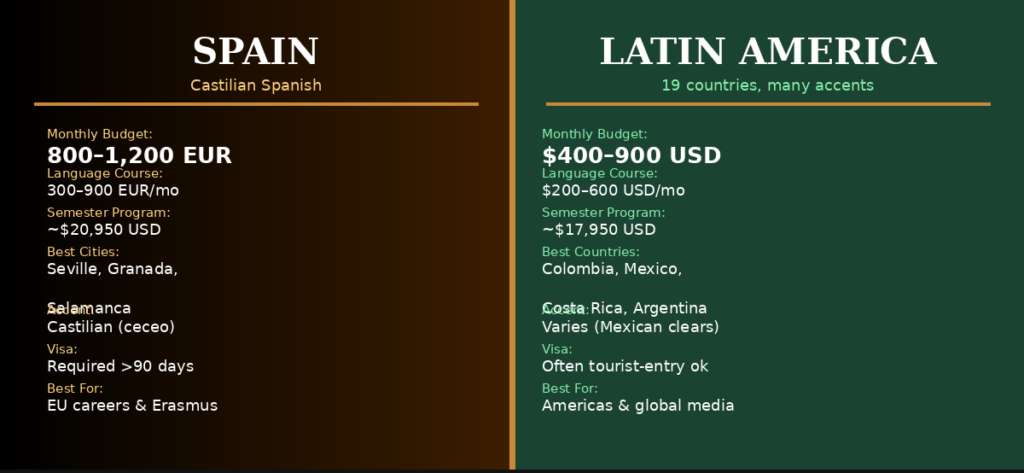
In Spain, students can expect to spend between 800 and 1,200 euros per month on living costs alone, depending on the city. Madrid and Barcelona sit at the top of that range, while Seville, Granada, and Salamanca are considerably more affordable. Language course fees on top of that typically run 300 to 900 euros per month for an intensive program.
The bottom line on cost: Latin America offers more learning for less money. Spain offers a premium experience at a premium price, though it is still a strong value compared to other Western European countries.
| Category | Spain | Latin America |
|---|---|---|
| Monthly living costs | 800 to 1,200 euros | $400 to $900 USD |
| Language course fees | 300 to 900 euros/month | $200 to $600 USD/month |
| Semester program avg. (CIEE) | ~$20,950 | ~$17,950 |
| Visa requirement | Required for stays over 90 days | Varies by country |
| Accent type | Castilian | Varies (Mexican, Colombian, Argentine etc.) |
| Career usefulness | EU and European markets | US, Latin American, and global media |
Which Is Better for Immersion?
True immersion depends less on the country and more on how you set up your time there. That said, the two regions create naturally different immersion environments.
In Spain, especially in smaller cities like Salamanca or Malaga, English is less dominant than in major Latin American capitals. This pushes students into Spanish faster in daily life. The culture of long lunches, evening tapas, and neighborhood cafe conversations creates natural speaking opportunities throughout the day. Spain also sits at the center of European travel, so weekends in Portugal, France, or Morocco are genuinely easy.
In Latin America, immersion quality varies more by destination. Buenos Aires has a large expat and English-speaking community, which can reduce language pressure. Rural Guatemala or a mid-sized Colombian city like Medellin will put you in Spanish all day, every day. Homestay options are abundant and often more affordable than in Spain, and many programs in the region are built around full cultural integration rather than just classroom hours.
If raw immersion speed is your priority, a well-chosen mid-tier Latin American city with a quality homestay is probably your most effective option.
Programs and Accreditation
Both regions have a strong supply of accredited programs. The Instituto Cervantes, Spain’s official government language and culture body, accredits Spanish schools globally and sets the DELE examination standard. Schools in Spain that carry Instituto Cervantes accreditation are a reliable benchmark for quality.
In Latin America, look for membership in IALC (the International Association of Language Centres) or endorsement through GoAbroad’s verified reviews. CIEE, Expanish, and Maximo Nivel operate well-established programs across multiple Latin American countries, with clear pricing and student support structures.
University credit programs, if that matters for your academic record, are generally easier to arrange through Spain due to the volume of formal partnerships with US and European universities.
Final Verdict
Spain wins on European career relevance, program formality, and the prestige of learning the language at its geographic origin. It costs more, but the experience is structured, the programs are well-accredited, and the travel access across Europe is unmatched.
Latin America wins on cost, accent neutrality for global professional use, immersion intensity in the right destinations, and sheer variety of experience across 19 countries. If your budget is limited, or if your career points toward the US, Latin American markets, or international media, Latin America is the stronger practical choice.
Our recommendation: if you are on a tight budget or planning to work in the Americas, choose Latin America and target Colombia, Mexico, or Costa Rica for the best balance of quality and value. If you have the budget and want a European base with formal academic recognition, Spain is excellent. Either way, commit fully to the language once you arrive.
Frequently Asked Questions
Is the Spanish learned in Spain the same as in Latin America?
The core grammar and vocabulary are the same, but the accents, some pronouns, and certain vocabulary words differ. Castilian Spanish uses sounds and expressions not common in Latin America, while Latin American Spanish varies by country. Students who learn in either region can communicate clearly across the Spanish-speaking world, though adjustment time is normal when switching between regions.
Which is cheaper for learning Spanish abroad in 2026, Spain or Latin America?
Latin America is consistently the more affordable option. Monthly living costs in countries like Guatemala, Colombia, and Mexico are a fraction of what you would pay in Madrid or Barcelona. Language school fees are also lower. For budget-conscious learners, Latin America offers much better value per month of study.
Which Spanish accent is easiest to understand when learning the language?
Colombian Spanish, particularly from Bogota, is widely regarded as one of the clearest and most neutral accents for learners. Mexican Spanish is also often recommended because it dominates global media, dubbing, and international business communication. Spain’s Castilian accent is distinct but not harder to learn if you are studying there full-time.
Do I need a visa to study Spanish in Spain or Latin America?
For Spain, non-EU students staying longer than 90 days need a student visa, which requires proof of enrollment, financial means, and health insurance. In Latin America, requirements vary by country and nationality. Many nationalities can enter on a tourist visa for short courses, but formal long-term study usually requires a student permit. Always check with the specific country’s consulate before applying.
What type of Spanish should I learn if I want to work in the United States?
For professional use in the United States, Latin American Spanish is the more practical choice. The majority of Spanish speakers in the US have Latin American backgrounds, and media, business, and customer-facing roles in the US market predominantly use Latin American variants. Mexican Spanish in particular is widely understood and professionally versatile.
Related Posts