A few years back, a friend booked what the brochure called an “authentic tribal village tour” in Southeast Asia. She paid a middleman travel agency, spent forty minutes being photographed next to people in staged costumes, and came home feeling vaguely awful about the whole thing. No money went to the community. The experience was basically a human zoo with a five-star lunch attached.
That story stuck with me. Because indigenous tourism ethical 2026 travel does exist, and it can be genuinely life-changing for both sides. But getting there requires more than good intentions. This guide walks you through exactly how to find, book, and experience indigenous cultural travel in a way that respects the people involved and actually helps them.
What ethical indigenous tourism actually means
The term gets thrown around a lot, but the practical meaning is simple. Ethical indigenous tourism is any travel experience that is designed, owned, and operated by the indigenous community itself, where the financial benefits go back to that community, and where visitors are guests rather than spectators.
The difference between that and exploitative tourism is huge. A third-party agency that hires local people as props and keeps most of the revenue is not ethical indigenous tourism, no matter how the brochure describes it. A community-run homestay in rural Oaxaca that uses microloans funded by tour fees to support local businesses? That is closer to the real thing.
The good news is that this sector is growing fast. The global indigenous tourism market was valued at around USD 46.7 billion in 2025, and community-led experiences have become significantly easier to find, often through official tourism boards, community cooperatives, and purpose-built booking platforms.
How to find legitimate, community-owned indigenous tours
This is where most people get tripped up. A Google search for indigenous tours returns a mix of genuine community operators and third-party packagers who have little real connection to the communities they market.
Here are the steps that actually work:
Step 1: Start with official indigenous tourism boards. Organisations like Ethical indigenous tourism, the Indigenous Tourism Association of Canada, and the American Indian and Alaska Native Tourism Association maintain verified directories of community-owned experiences. These are the most reliable starting points.
Step 2: Use specialist platforms. Sites like VisitNatives.com and Native American Tours specifically list indigenous-owned and operated experiences. Talaysay Tours in British Columbia is a good real-world example of a fully indigenous-run operator with a transparent mission.
Step 3: Ask the right question before booking. The single most useful question is: “What percentage of this tour fee goes directly to the community?” A legitimate operator will answer clearly. Vague answers or deflection are red flags.
Step 4: Check for authentic versus “Authentic” designations. Indigenous Tourism BC uses official Authentic Indigenous and Indigenous-owned designations that are verified, not self-declared. Look for equivalents in your destination country.
Step 5: Skip the all-inclusive package if you can. Large tour companies sometimes bundle indigenous experiences as a single segment of a wider trip. These arrangements often undercut community income. Booking directly with community operators gives more of your money to the right people.
Common mistakes travellers make (and how to avoid them)
Photographing without asking. This is the most common and most harmful mistake. Many sacred ceremonies, elders, and cultural objects are not available for photography. Always ask before pointing a camera. Accept no gracefully when it comes.
Buying mass-produced “authentic” souvenirs. If a carved item is available in fifty airport shops, it was not made by a local artisan. Buying directly from artisans at community markets is the way to ensure your money and appreciation both reach the right person.
Wearing ceremonial items as costumes. A headdress, a moko, a sacred textile. These are not fashion accessories. Cultural appreciation holds the culture with dignity; cultural appropriation reduces it to a commodity. The line is real.
Treating a community visit like a safari. Walking into someone’s home and immediately holding up a phone is rude in any culture. Slow down. Listen. Accept hospitality before pulling out the camera.
Assuming all indigenous cultures are the same. This one catches even experienced travellers off-guard. There are 634 recognized First Nations bands in Canada alone, each with distinct languages, traditions, and protocols. Research the specific community you are visiting, not “indigenous culture” as a general concept.
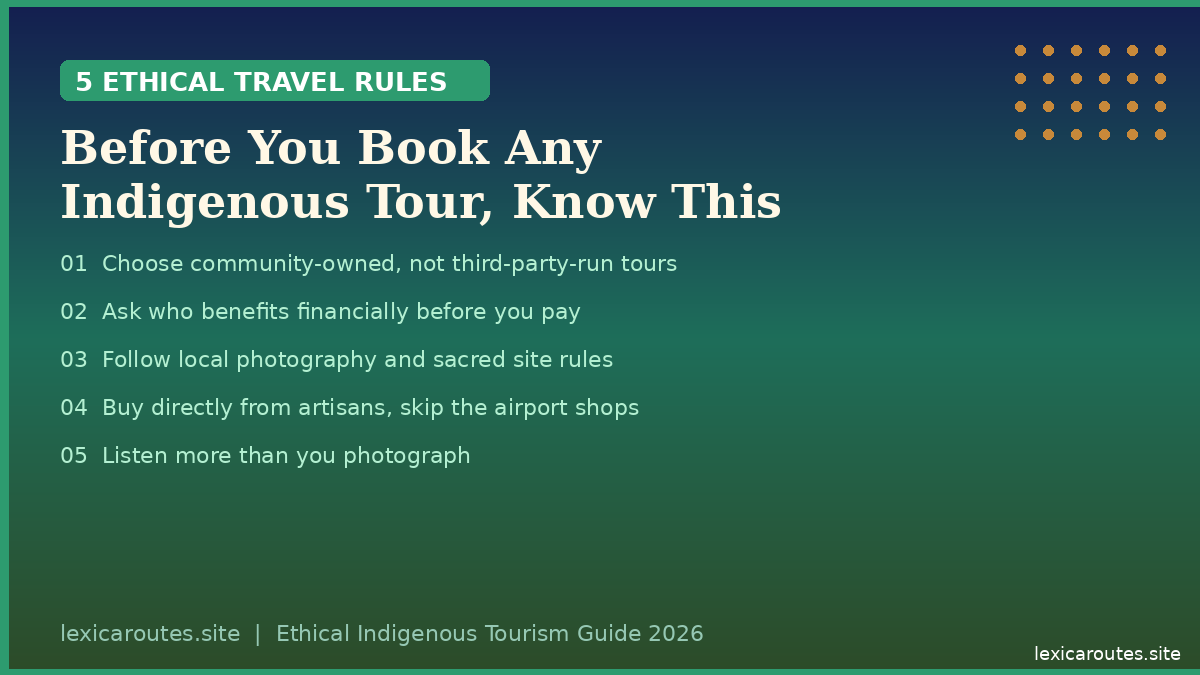
Step-by-step guide to preparing for an indigenous cultural experience
Before you go:
Research the land you are visiting. The Native Land Digital map lets you search any location and see which indigenous nations have historical and current connections to that territory. Knowing this before you arrive is a basic act of respect.
Read books or listen to podcasts by indigenous authors and creators from that region. Not travel bloggers writing about visiting the community, but voices from inside it.
Check whether photography, recording, or social media sharing of any experiences is restricted. Many operators will tell you this upfront; ask if they do not.
During the visit:
Follow your guide’s lead on everything, including pace, silence, and participation. If a ceremony is happening, you are a witness, not a participant, unless specifically invited.
Ask questions that show genuine curiosity, not performative ones. “How long has your family been doing this?” lands very differently from “Is this what you do every day?”
Spend money in the community. Eat at community-run food stalls. Buy directly from the artisan whose hands made the item.
After you leave:
Leave an honest review on the operator’s booking platform. For small community-run operators, a well-written review is genuinely impactful. Write the review on the platform they use, not a random third-party site where the revenue model does not benefit them.
COMPARISON
| Step | Action | Why It Matters | Time Needed |
|---|---|---|---|
| 1 | Use verified indigenous tourism directories | Ensures money reaches communities | 30 minutes |
| 2 | Ask who financially benefits before booking | Separates real operators from packagers | 5 minutes |
| 3 | Research the specific nation/community | Avoids treating all cultures as one | 1 to 2 hours |
| 4 | Check photography and sacred site rules | Prevents the most common act of disrespect | Pre-trip |
| 5 | Buy directly from artisans in-community | Keeps revenue local | During visit |
| 6 | Write a review on the operator’s own platform | Helps small operators grow | Post-trip |
VERDICT
Ethical indigenous tourism is not complicated, but it does require intention. The single most important thing you can do is choose operators where the community owns the experience and receives the revenue. Everything else follows from that.
The sector is growing, the tools to find good operators are better than they have ever been, and the experiences themselves are among the most meaningful travel offers in 2026. You will come back changed in the best way.
FAQ SECTION
What is ethical indigenous tourism and how is it different from regular cultural tourism?
Ethical indigenous tourism means the experience is designed, owned, and operated by the indigenous community, with the financial benefits flowing back to that community. Regular cultural tourism often involves third-party agencies that market a community’s culture without meaningful revenue sharing or community control. The key test is: who owns this experience and who profits from it?
How do I find indigenous-owned tours that are actually community-run?
Start with verified official directories. Indigenous Tourism BC, the Indigenous Tourism Association of Canada, and AIANTA in the US all maintain listings of certified community-owned operators. Platforms like VisitNatives.com and Native American Tours are also dedicated to connecting travellers with authentic indigenous-run experiences rather than packaged imitations.
Is it ever appropriate to take photos during an indigenous cultural visit?
It depends entirely on the specific community and context. Some operators actively encourage photography; others restrict it for sacred sites, ceremonies, or specific individuals. The rule is simple: always ask first, and accept no without argument. Many operators will brief you on photography guidelines before the experience begins.
How much does ethical indigenous tourism cost compared to mainstream tours?
Costs vary widely by region and experience type. Community-run day tours typically run between USD 50 and USD 200 per person. Multi-day homestay or cultural immersion programs can range from USD 150 to USD 800 or more. These prices are often comparable to or lower than mainstream tours, with the difference being that more of your money reaches the people hosting you.
What should I do if I accidentally offend someone during an indigenous cultural visit?
Apologise sincerely and simply. Do not over-explain or become defensive. Take the feedback as learning and adjust your behaviour. A genuine apology without excuses is almost always well received. The communities hosting you are accustomed to visitors who are learning, and most guides expect some missteps; what matters is how you respond to them.
RELATED POSTS
Author: Written by the Lexica Routes editorial team, covering travel, education, and study abroad since 2025.