My hiking boots sat untouched in the closet for almost two years. Life got busy, I told myself I was not fit enough, and every time someone mentioned trekking, I’d smile and say, “Maybe next year.” Then a friend dragged me onto a five-day section of the Camino de Santiago, and I came back a completely different person.
That trip taught me the most important lesson in adventure travel: there is a trekking destination for every fitness level in 2026, not just for people who spend weekends running marathons. From gentle Portuguese coastal paths to Nepal’s legendary mountain circuits, the best trekking destinations 2026 has to offer are more accessible than most people think. You just need to pick the right one.
Here is what I have learned from personal experience, from hitting the trail with sore knees and zero mountain experience to eventually crossing a 5,000-meter pass.
Why 2026 Is a Great Year to Start Trekking
Travelers are increasingly looking for places that feel spacious, wild, and less crowded, and destinations like Patagonia, Kyrgyzstan, and Namibia fit this trend perfectly. But the bigger shift happening in 2026 is that trekking has become genuinely inclusive. Tour operators, trail managers, and booking platforms have all caught up with the reality that people want active adventures without needing to be athletes.
Apps like AllTrails, Gaia GPS, and Komoot have completely changed how people plan multi-day routes. I used Gaia GPS throughout my Annapurna trek and it saved me on two occasions when cloud cover wiped out the trail markers entirely. If you are serious about any destination on this list, download your maps offline before you leave civilization.
The other big shift is accommodation. Mountain hut culture has evolved dramatically. You can now complete routes like the Dolomites Alta Via 1 with proper meals and a bed every night, ending long hiking days with espresso and pasta.
Best Trekking Destinations for Beginners
Camino de Santiago, Spain and Portugal
This is where I would send anyone who thinks they are not ready to trek. The Camino de Santiago is not one trail; it is a network of historic pilgrimage routes across Europe leading to the Cathedral of Santiago de Compostela in Galicia, Spain.
For first-time pilgrims, the Camino Francés from Sarria to Santiago is the most popular and beginner-friendly section, covering the last 100 km and the minimum distance needed to earn the Compostela pilgrim’s certificate. Alternatively, the Camino Portugues Coastal Route offers gentle terrain and ocean views, another fantastic choice for first-timers.
The terrain is mostly flat to gently rolling, villages with cafes appear every few kilometers, and luggage transfer services mean you walk with only a small daypack. The recommendation is to begin a consistent walking routine several months before departure, gradually building up to walking 8 to 12 miles with a light daypack. Honestly, even that felt excessive for the easier Camino sections. Comfortable walking shoes and a decent pair of moisture-wicking socks matter far more than training logs.
My one mistake on the Camino was cheap cotton socks. By day two, I had blisters that slowed me down for the rest of the week. Trekking poles are optional but highly recommended as they help with posture and take pressure off your knees, especially on steep descents. Focus on lightweight, synthetic, or Merino wool fabrics and avoid cotton as it is slow to dry.
Best Trekking Destinations for Intermediate Hikers
Annapurna Circuit, Nepal
This is the trek that properly changed my relationship with mountains. The Annapurna Circuit is a long-distance route in Nepal that passes through incredibly diverse landscapes including rhododendron forests, high-altitude desert plateaus, and traditional Gurung and Tibetan villages.
The Annapurna region is perfect for both beginners and experienced trekkers because of its diverse landscapes and accessibility. From rhododendron forests to high mountain passes, Annapurna treks deliver unmatched variety.
The permit situation for 2026 has been simplified. For the Annapurna Circuit Trek, you currently need only one mandatory permit: the ACAP (Annapurna Conservation Area Permit). The TIMS card is no longer enforced, and restricted permits are required only for special side trips like Upper Mustang or Nar Phu Valley.
The most challenging section is Thorong La Pass. The Annapurna Circuit Trek is considered moderate to challenging, mainly due to its high altitude, long duration, and diverse terrain. While it does not require technical climbing skills, it demands good physical fitness, endurance, and proper acclimatization.
One thing nobody told me before I went: altitude sickness does not care how fit you are. I watched an ultramarathon runner get badly hit at Manang while I felt completely fine. Slow down, drink extra water, and never skip an acclimatization day.
Planning a Nepal trek? The Nepal Tourism Board’s official trekking information covers permits, registered agencies, and safety guidelines for the 2026 season.
Watch: Annapurna Circuit Trek 2026 Complete Walkthrough – Nepal Trekking
Dolomites Alta Via 1, Italy
If Nepal feels like too much of a logistical leap, the Italian Dolomites offer something that should honestly be more famous than it is. The Alta Via 1 is a hut-to-hut trekking route through the Dolomites, a UNESCO World Heritage Site in northern Italy.
The Alta Via 1 is challenging in parts but well within reach for anyone in reasonable hiking shape. The trail is well marked, the distances are manageable, and the rhythm of hiking by day and resting in mountain huts at night makes the experience surprisingly accessible. Whether you choose the shorter Alta Via 1 North in 6 days, the wilder Alta Via 1 South in 7 days, or the full itinerary in 10 days, there is an option that matches your fitness level and available time.
The Alta Via 1 is generally considered the more accessible Dolomites option and is the better choice for many first-time hut-to-hut trekkers. It still requires good fitness, sure-footedness, and comfort with long mountain days, but it is usually less demanding than the Alta Via 2. Alta Via 2 has longer stages, more rugged terrain, and sections that may feel more exposed.
One critical tip: book your rifugios (mountain huts) months in advance. I learned this the hard way when I tried to book in April for a July trip and found several huts already full. The most popular sections fill by March or April each year.
For European trekking permits and hut bookings in the Dolomites, the Dolomites UNESCO Foundation provides trail conservation updates and responsible tourism guidance.
Best Trekking Destinations for Experienced Adventurers
Patagonia, Chile and Argentina
Patagonia takes top honors for serious trekking. The W Trek through Torres del Paine National Park delivers dramatic peaks, glaciers, and turquoise lakes on a challenging but manageable multi-day hike.
The weather in Patagonia is the defining challenge, not the terrain. Wind conditions can change from calm to 100 km/h gusts within an hour. The golden rule locals gave me: never summit anything in the afternoon. Start early, be back at camp by midday.
The best adventure trips are no longer only about scenery. Travelers want local guides, regional food, historic routes, and meaningful cultural exchange. In Patagonia, that cultural layer comes from gaucho culture, local estancias, and the remarkable ranger programs in the national parks.
For Camino route planning and distance calculators, Pilgrims Office Santiago de Compostela is the definitive official resource for credentials and route information.
Quick Reference: Best Trekking Destinations 2026 by Fitness Level
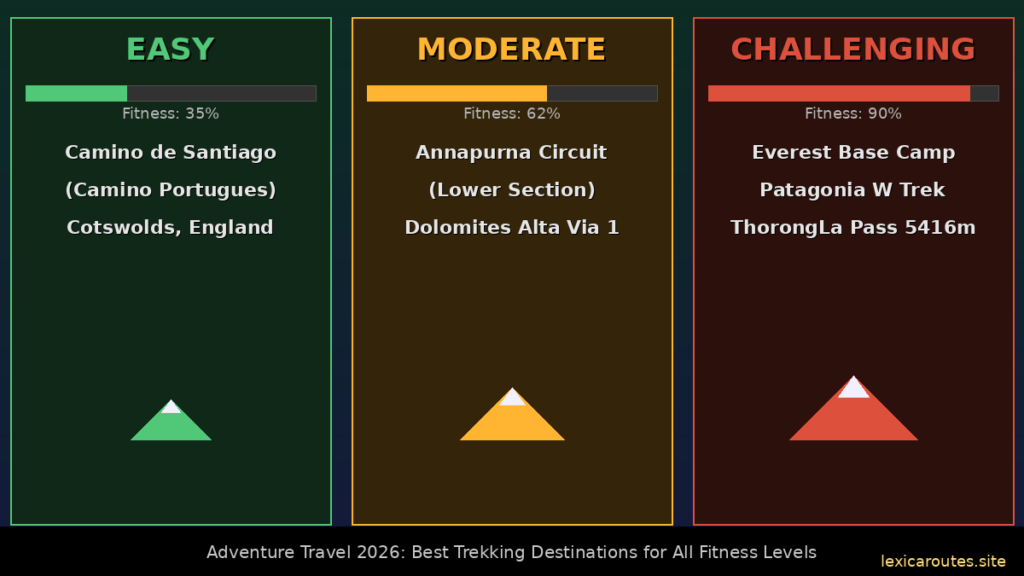
| Destination | Fitness Level | Duration | Key Feature | Best Season |
|---|---|---|---|---|
| Camino Portugues Coastal Route | Easy | 5 to 7 days | Flat coastal terrain, village support | Spring, Autumn |
| Camino Frances (Sarria to Santiago) | Easy to Moderate | 5 to 7 days | Cultural, pilgrim certificate | March to October |
| Dolomites Alta Via 1 | Moderate | 6 to 10 days | Rifugio network, UNESCO scenery | June to September |
| Annapurna Circuit (partial) | Moderate | 10 to 14 days | Diverse landscapes, teahouse trail | March to May, Sept to Nov |
| Annapurna Circuit (full, Thorong La) | Challenging | 14 to 21 days | 5,416m pass, Himalayan villages | March to May, Sept to Nov |
| Patagonia W Trek | Challenging | 5 to 9 days | Dramatic peaks, glaciers, unpredictable weather | Nov to March |
Our take
The best trekking destination for 2026 is whichever one you will actually book. Too many people spend years researching Nepal while never walking out the door. If you are just starting out, the Camino Portugues Coastal Route gets you on trail within weeks, not after months of training. If you have some hiking miles under your belt, the Dolomites Alta Via 1 will blow your expectations. And if you are ready for something genuinely life-changing, the Annapurna Circuit earns every piece of hype it gets.
Start where you are, not where you think you should be.
Frequently asked questions
What is the easiest trekking destination for beginners in 2026?
The Camino de Santiago, specifically the Camino Portugues Coastal Route or the final 100 km of the Camino Frances from Sarria, is the most beginner-friendly long-distance trekking experience available. The terrain is gentle, support infrastructure is excellent, and you can walk with just a small daypack if you use luggage transfer services.
How fit do you need to be for the Annapurna Circuit trek in 2026?
You need a moderate to good fitness level, with an ability to walk 5 to 8 hours per day at altitude for consecutive days. Technical climbing skills are not required. The bigger challenge is altitude acclimatization at Thorong La Pass (5,416 meters), so prior hiking experience at elevation and a slow, steady ascent schedule matters more than raw fitness.
What permits do you need for the Annapurna Circuit in 2026?
As of 2026 updates, the only mandatory permit for the standard Annapurna Circuit is the ACAP (Annapurna Conservation Area Permit). The TIMS card is no longer enforced on the main trail. Restricted Area Permits are only needed for side trips to Upper Mustang or Nar Phu Valley.
How early should I book rifugios for the Dolomites Alta Via 1 trek?
Book as early as possible, ideally by March or April for a July or August trek. Mountain huts along the Alta Via 1 are in high demand during peak summer season and the most popular sections typically sell out months in advance. Some huts do not accept online bookings and require direct email or phone contact.
Is the Camino de Santiago suitable for older or less mobile travelers?
Yes, with the right route selection. The Camino Portugues Coastal Route and the final section of the Camino Frances are among the most age-inclusive long-distance treks in the world. Luggage transfer services eliminate the need to carry heavy packs, rest days can be inserted at any point, and towns with accommodation appear regularly throughout both routes.
Author: Written by the Lexica Routes editorial team, covering travel, education, and study abroad since 2025.