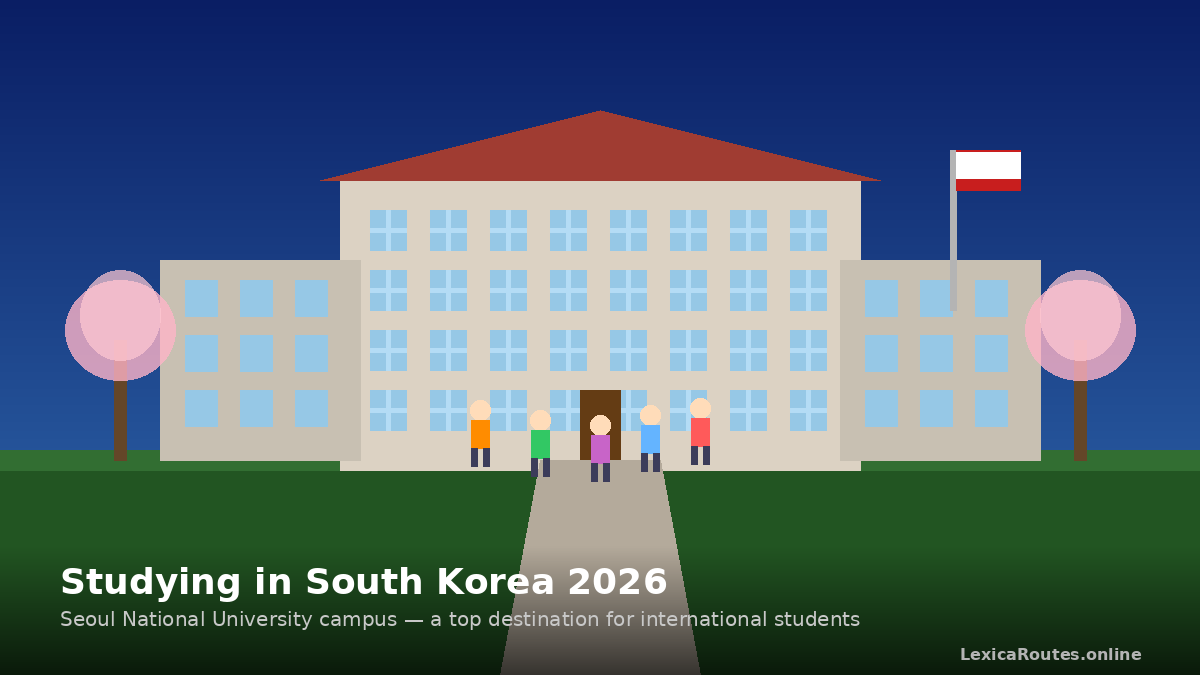
South Korea just rewrote the record books. The country set out to attract 300,000 international students by 2027 and hit that number two full years ahead of schedule. As of early 2026, more than 314,000 international students are now enrolled across Korean universities, making South Korea one of the fastest-growing study abroad destinations on the planet. If you have been thinking about studying in South Korea, the timing has never been better, and the competition has never been stiffer. Here is everything you need to know about what this surge means for applicants, visas, and scholarships right now.
What Happened: South Korea Smashes Its 300K Target
South Korea’s Ministry of Education launched the “Study Korea 300K” plan in 2023 with a bold ambition: pull in 300,000 international students by 2027 and crack the world’s top 10 study abroad destinations. Nobody expected it to happen this fast.
By August 2025, the 300,000 milestone had been crossed two years ahead of schedule. By February 2026, data from the Korea Immigration Service confirmed the total had climbed further to 314,397 students, spread across degree programmes, language training courses, and other academic pathways. That figure represents a 15 per cent rise year-on-year and a staggering 50 percent increase compared to January 2023.
The growth has been driven by a combination of South Korea’s rising global cultural profile, competitive tuition costs, and a government actively working to make the country more accessible to foreign students. According to the Korean Ministry of Education, the government deliberately eased Korean language requirements for university admission, expanded internship and employment pathways, and sped up visa processing to fuel the surge.
Who Is Coming to Korea? The Numbers Behind the Surge
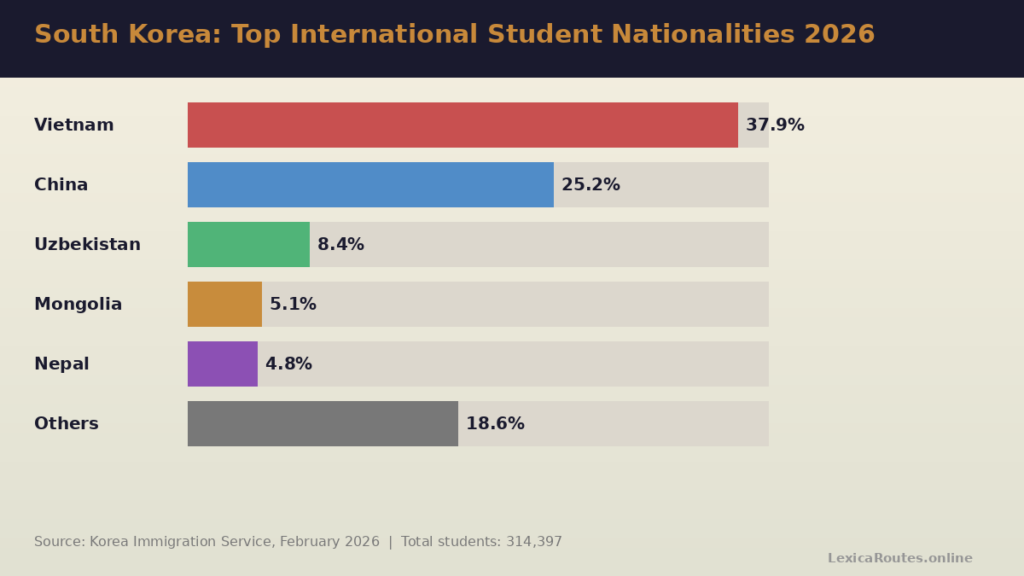
Vietnam is leading the charge. Vietnamese nationals now account for 37.9 percent of all international students in South Korea, with 115,939 students enrolled as of January 2026. China follows at 25.2 percent, with Uzbekistan, Mongolia, Nepal, and Myanmar also representing significant student populations. Students from the US, Japan, and Europe remain a smaller share but are growing steadily year on year.
The breakdown of visa types tells its own story. Of the 314,397 total students recorded in February 2026, 238,905 hold D-2 degree-seeking visas, while 75,033 are enrolled in Korean language training programmes on D-4 visas. Degree applications via D-2 entries hit 411,687 in 2025, up sharply from 348,096 in 2024, signalling that the pipeline of new students is still accelerating.
One key driver behind the numbers is domestic pressure. South Korea faces a declining domestic student population; the Ministry of Education projects only 298,178 first-grade domestic students entering the system in 2026, well below the 450,000 to 500,000 annual university capacity. International students are not just welcomed, they are needed.
What This Means If You Want to Study in Korea
The surge is good news and a caution in equal measure. More universities are recruiting internationally, scholarship slots are expanding, and support systems for foreign students are improving. But with over 310,000 students now in the system, competition for top programmes and funding is intensifying fast.
The D-2 Visa: What You Need
To study in South Korea, you will need a D-2 visa issued by a South Korean embassy or consulate in your home country. Requirements include a valid passport, proof of university acceptance, a bank statement showing a minimum of around $10,000 USD in funds, and a processing fee of roughly $30 for a single entry or $50 for multiple entries. English or Korean language proficiency documentation is also required.
The government has been working to speed up processing times as part of the 300K initiative, but increased volume means you should begin your application early at least 8 to 10 months before your intended start date.
The Global Korea Scholarship: Still the Best Route In
The Global Korea Scholarship (GKS), administered by Korea’s National Institute for International Education, remains the flagship fully funded route for international students. The 2026 cycle selects more than 2,000 students from 155 countries for master’s, doctoral, and research programmes. Benefits include full tuition coverage, a monthly living allowance of 900,000 KRW (roughly $670 USD) for degree students, on-campus housing, round-trip airfare, and medical insurance.
KAIST, one of South Korea’s leading science and technology universities, waives tuition for virtually all admitted international students and pays graduate stipends of 350,000 to 1,000,000 KRW per month. Seoul National University, Yonsei, Korea University, and POSTECH all offer merit scholarships covering 30 to 100 percent of tuition for strong international candidates.
According to ICEF Monitor’s analysis of the 300K milestone, scholarship availability and government funding for international education have been increasing consistently year on year as Korea chases its next enrolment targets.
The Sustainability Question: What Comes Next
The surge has brought a new challenge into focus. A April 2026 report by The PIE News noted that experts are calling for a shift from volume-driven enrolment to a more balanced, transparent approach. Over 90 percent of international students in South Korea say they want to stay and work after graduation, yet the path from study to employment remains unclear.
Work permit applications surged from 28,272 in 2023 to 81,859 in 2025, but the E-7 visa needed for post-study employment is difficult to obtain. Many employers remain unaware of the process or reluctant to take on the extra administrative work, and shifting immigration rules continue to create uncertainty.
In response, South Korea’s Ministry of Education and Ministry of Justice announced joint university inspections across April and May 2026, targeting institutions with compliance concerns and reviewing recruitment processes, academic support, and visa regulation adherence. The government’s message is clear: the quantity milestone has been met, and now quality assurance takes centre stage.
Key Facts at a Glance
| What | Detail |
|---|---|
| Total international students (Feb 2026) | 314,397 |
| Year-on-year growth | +15% overall; +22.2% in higher education |
| Largest nationality group | Vietnam (37.9% – 115,939 students) |
| Original target | 300,000 by 2027 |
| Achieved | August 2025 (two years early) |
| GKS 2026 monthly allowance | 900,000 KRW (degree students) |
| D-2 visa bank balance requirement | Approx. $10,000 USD |
Our Take
South Korea’s rise as a study abroad powerhouse is real, rapid, and still accelerating. The country hit its 300,000 target two years early and shows no sign of slowing down. For international students, that translates to more university options, more scholarship funding, and a genuinely compelling destination that pairs academic quality with one of the world’s most vibrant cultures. The post-study employment pathway is still a work in progress, but the government is clearly aware of the gap and moving to close it.
If studying in South Korea is on your radar, 2026 is a strong window to act. Applications are competitive but the funding options are generous.
Frequently Asked Questions
Is South Korea a good country to study abroad in 2026?
South Korea is one of the fastest-growing study abroad destinations in the world right now. With over 314,000 international students enrolled as of early 2026, strong scholarship options, and a government actively investing in international education, it offers a compelling combination of academic quality and cultural experience.
How many international students are currently in South Korea?
As of February 2026, South Korea hosts 314,397 international students, including 238,905 in degree programmes and 75,033 in Korean language courses, according to data from the Korea Immigration Service.
What visa do I need to study in South Korea?
You need a D-2 student visa for degree programmes or a D-4 visa for language training. Both are issued by a South Korean embassy or consulate in your home country and require university acceptance, proof of funds (approximately $10,000 USD), and language proficiency documentation.
What is the Global Korea Scholarship and is it fully funded?
The Global Korea Scholarship (GKS) is a fully funded government scholarship offering full tuition, a monthly allowance of 900,000 KRW, on-campus housing, round-trip airfare, and medical insurance. The 2026 cycle selects over 2,000 students from 155 countries for master’s, doctoral, and research programmes.
Can I stay and work in South Korea after completing my degree?
More than 90 percent of international students in Korea want to stay after graduation, but the post-study employment pathway via the E-7 visa remains challenging. The government announced new oversight and support measures in 2026 to improve the link between study and employment, so conditions are expected to improve over the next 12 to 24 months.
Related Posts
Author: Written by the Lexica Routes editorial team, covering travel, education, and study abroad since 2025.