Somewhere between your last overloaded group trip and your next scrolling session at 2am, the travel industry quietly decided it had had enough. The hushpitality travel trend 2026 is the hospitality world’s answer to a simple question: what if the most luxurious thing a hotel could offer was simply nothing? No buzzing itinerary. No lobby DJ. No pressure to document every moment for an audience. Just quiet, designed with intention. This article breaks down what hushpitality actually means, why it has become the dominant story in travel this year, which hotel brands are leading the shift, and what it means for travelers who are weighing a genuinely restorative trip against another holiday that leaves them needing a holiday.
What Happened: Hilton Names Hushpitality Its Top 2026 Travel Trend
In late 2025, Hilton published its annual Trends Report and gave a name to something millions of travelers were already feeling. The word was hushpitality, a portmanteau of hospitality and hush, describing a growing demand for travel experiences built around quiet, rest, and intentional disconnection. The report landed with unusual force because the data behind it was hard to argue with.
According to Hilton’s research, the number one reason people plan leisure travel in 2026 is to rest and recharge, with 56% of global respondents choosing that motivation above anything else. That figure topped sightseeing, adventure, cuisine, and cultural exploration. Time in nature came second at 37%, followed by improving mental health at 36%. The message from travelers to the industry was plain: we are exhausted, and we want you to help us actually recover.
Expedia reinforced the finding in its own 2026 outlook, identifying what it called “quietcations” as one of the defining travel behaviors of the year. The term refers to intentional trips booked specifically to escape overstimulation rather than to accumulate experiences.
Why It Matters: A Cultural Shift, Not Just a Fad
Hushpitality is not a niche wellness retreat concept dressed up in new language. It has moved into the mainstream of luxury hospitality, and the brands responding to it are some of the biggest names in the industry.
Accor has built a new ultra-luxury brand around the philosophy of quiet luxury. Hilton has expanded its digitally connected room program by 53% in a single year, partly because guests are using connected rooms to stream Calm, the meditation and sleep app, rather than to watch action films. The pattern is clear: guests want recovery, and the sharpest operators are building for that want rather than selling against it.
The drivers behind this shift are not mysterious. Burnout and digital overload have reshaped what travelers want from time away. Decision fatigue, the cognitive cost of navigating endless options, feeds, and notifications, has made genuine stillness feel genuinely scarce. For travelers who can afford to pay for scarcity, silence has become the flex.
What Hushpitality Actually Looks Like
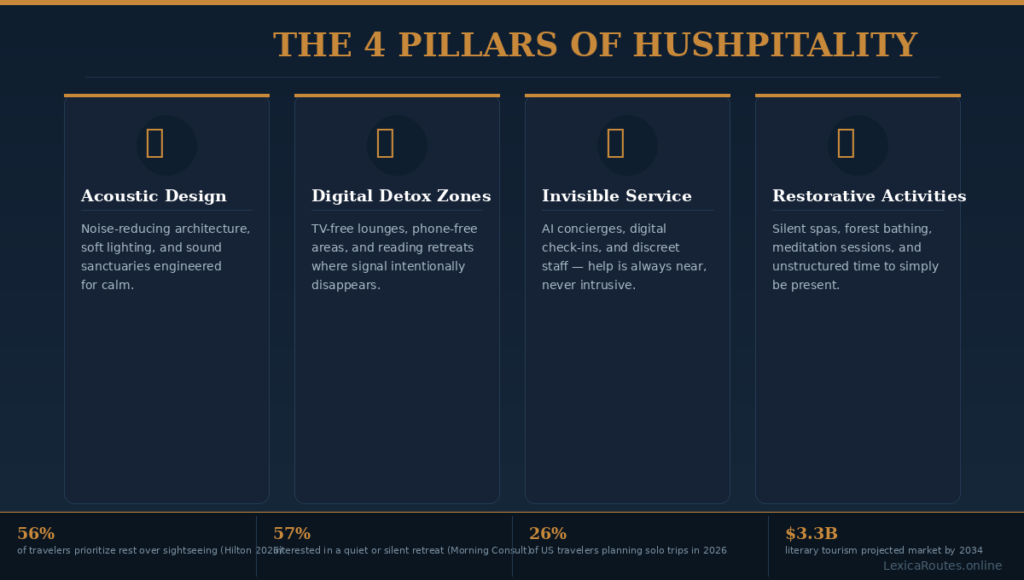
The term covers a range of real, tangible hotel choices that guests are already encountering. Understanding the four pillars helps separate genuine hushpitality from marketing language slapped onto a standard wellness package.
Acoustic design is the most architecturally intensive element. Properties are investing in noise-reducing materials, soft lighting schemes, and what some are calling sound sanctuaries, spaces engineered specifically to limit aural stimulation. At Haleakala Crater in Hawaii, one retreat uses volcanic stone with natural noise-absorbing properties as a design material. This is not a soft amenity. It is a capital investment.
Digital detox zones take a more behavioral approach. These include television-free lounges, phone-free common areas, and reading retreats. The data supporting their appeal is striking: according to a Morning Consult survey cited in the Hilton report, 57% of US travelers said they would be interested in attending a quiet or silent retreat, and 53% specifically expressed interest in a reading retreat. Literary tourism generated $2.4 billion in 2024 and is forecast to reach $3.3 billion by 2034.
Invisible service addresses the social dimension of travel fatigue. High-end travelers are increasingly requesting digital-only check-ins and AI concierges not because they dislike people but because traditional hotel reception involves a form of social performance that depletes energy rather than restoring it. Room service delivered with minimal contact and staff trained to remain discreetly available rather than attentively present are becoming standard features in hushpitality properties.
Restorative programming rounds out the offer. Silent spa sessions, forest bathing, guided meditation, and intentionally unstructured time have replaced the activity-dense itineraries that luxury hotels once used as their key differentiator. The most sought-after itinerary, as Skift noted in its 2026 luxury hotel analysis, may now be no itinerary at all.
Hotels Leading the Charge
Several properties have become reference points for what hushpitality looks like in practice. Zemi Beach House in Anguilla structures its entire experience around open-air calm, with architecture that encourages slower movement. Aman Kyoto integrates its buildings into the surrounding forest so deliberately that the environment itself does most of the sensory work. The Tokyo EDITION Toranomon creates the feeling of retreat within a dense urban setting through controlled lighting and restrained interiors.
At the budget-accessible end of the spectrum, independent boutique hotels are finding the trend favorable. As the team at Lulu’s Luxury Lifestyle observed, boutique operators have always competed on atmosphere rather than scale. For the first time in years, the mainstream luxury market is catching up to something small properties have understood for a long time.
What Comes Next
The industry consensus is that hushpitality is not peaking, it is expanding. The solo travel surge is a direct accelerant: more than one in four US travelers are planning solo trips in 2026, and solo travelers are disproportionately represented among those seeking silence and self-directed rest.
The economic reality is also shifting the geography of the trend. While the most immersive hushpitality experiences currently carry high price points, the underlying philosophy of fewer stimuli, more intentional design, service that recedes rather than performs translates to any tier of accommodation. Expect budget-friendly iterations to emerge over the next 12 to 24 months as the positioning filters down from ultra-luxury to mid-range.
For travelers already exhausted by performance-heavy travel culture, that shift cannot come quickly enough.
Key Facts Box
Key facts: Hushpitality travel trend 2026
| What it is | Hospitality designed around quiet, rest, and intentional disconnection |
|---|---|
| Who named it | Hilton, in its 2026 Trends Report; amplified by Expedia’s 2026 outlook |
| Key data point | 56% of global travelers now say rest and recharge is their top motivation to travel |
| Who it affects | All travelers led by luxury segment, filtering toward mid-range |
| When it takes effect | Already mainstream in 2026; budget-friendly versions expected by 2027 |
| Where to learn more | Hilton 2026 Trends Report; Skift 2026 luxury hotel analysis |
Verdict
Our take
Hushpitality is the travel story of 2026 because it is an honest response to a real problem. People are not traveling less, they are traveling differently, prioritizing recovery over stimulation and presence over performance. The hotels that understand this are investing accordingly, and the data from Hilton, Expedia, and independent analysts suggests the demand is structural rather than seasonal.
For travelers planning their next trip, the takeaway is practical: look for properties that emphasize acoustic design, limit digital noise, and lead with programming that involves doing less rather than more. Whether that is a reading retreat in Scotland, a forest-integrated ryokan in Japan, or a boutique coastal property that skips the DJ pool party, the booking shift is underway.
If you are also weighing where to travel solo this year, read our guide to the best solo travel destinations in 2026 for more options that align with this slower, more intentional approach.
FAQ Section
What exactly is hushpitality and where did the term come from?
Hushpitality is a hospitality philosophy built around quiet, rest, and intentional disconnection. The term was popularized by Hilton in its 2026 Trends Report, though the underlying concept had been developing across boutique and wellness-focused hotels for several years. It covers acoustic design, digital detox programming, low-interaction service models, and restorative activities like meditation and forest bathing.
Is hushpitality only for luxury travelers?
For now, the most immersive hushpitality experiences sit at the higher end of the accommodation market, where investment in acoustic architecture and bespoke programming is most viable. However, the core principles of fewer stimuli, quieter environments, staff trained to be present without being intrusive apply at any price point. Analysts expect mid-range and boutique operators to adopt the approach more broadly through 2027.
What is the difference between a hushpitality hotel and a standard wellness retreat?
A traditional wellness retreat typically centers on structured programs: yoga schedules, spa treatments, nutritional plans. Hushpitality is less programmatic and more environmental. The emphasis is on designing spaces and service models that reduce stimulation by default, rather than guiding guests through a curated sequence of recovery activities. Guests are often encouraged to set their own pace rather than follow a timetable.
Which hotel brands are most associated with hushpitality in 2026?
Hilton has been most public in naming and advocating for the trend. Accor has aligned its new ultra-luxury brand around quiet luxury principles. At the individual property level, Aman Kyoto, Zemi Beach House in Anguilla, and Eremito in Italy are frequently cited as exemplary hushpitality experiences. The Tokyo EDITION Toranomon is a well-known urban example.
How do I know if a hotel genuinely practices hushpitality or is just using it as a marketing term?
Look for specific, verifiable features: noise-reducing architecture or materials, phone-free zones in public areas, digital check-in options, absence of amplified music in common spaces, and programming that includes unstructured time rather than activity-dense schedules. Hotels that lead with acoustic design details and explicitly train staff in low-interaction service models are more likely to deliver the experience than those simply describing themselves as quiet or peaceful.
Related Posts
- Best Solo Travel Destinations in 2026 for Introverts and First-Timers
- What Is Slow Travel? Why Travelers Are Choosing Fewer Destinations in 2026
- Digital Detox Vacations: How to Plan a Trip Without Your Phone
Author: Written by the Lexica Routes editorial team, covering travel, education, and study abroad since 2025.