
Thinking about crossing Europe by train this year? You are not alone. Rail travel across the continent has surged in popularity as more travellers look for a slower, greener, and genuinely more scenic alternative to budget flights. The core question most first-timers land on is simple: Interrail or Eurail, and which pass option actually makes sense for their trip?
This guide cuts through the noise. We cover exactly how both pass systems work in 2026, which pass type suits different travel styles and budgets, where to get the most value, and what to watch out for before you buy. Whether you are a student on a summer trip or a couple planning a month through a dozen countries, there is a pass configuration that fits.
What to Look for in a European Rail Pass
Not every rail pass is worth buying for every trip. Before diving into specific options, it helps to understand the criteria that actually determine value.
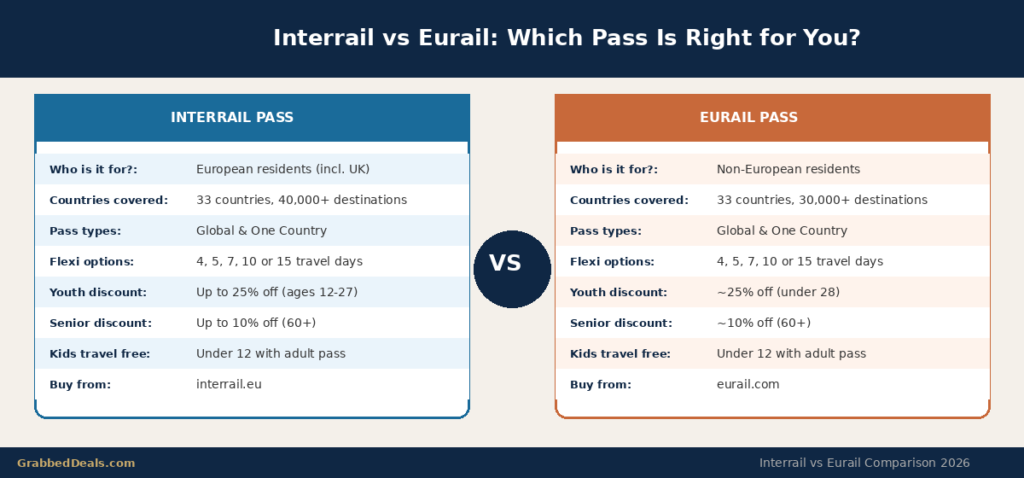
Residency first. The biggest fork in the road is where you live. If you are a European resident (including the UK), you buy an Interrail pass from interrail.eu. If you live outside Europe, you buy a Eurail pass from eurail.com. Both pass ranges cover the same 33 countries and the same trains, with identical fees for seat reservations, so an American and a British traveller can travel together with no practical difference in experience, one on a Eurail pass, the other on an Interrail pass.
Flexi vs Continuous. A Continuous pass gives unlimited travel for a fixed block of days: 15 days, 22 days, one month, two months, or three months. A Flexi pass gives you a set number of travel days to use within a longer window, with options of 4, 5, 7, 10, or 15 days inside one or two months. A travel day runs from midnight to 23:59, and night trains departing after 19:00 typically count as one day even when you arrive the next morning.
Reservation costs. The pass covers your train fare, but not always your seat. High-speed trains, night trains, and scenic rail services often charge an additional seat reservation fee. This is a real cost to factor into your budget before you buy.
Top Picks: Best Rail Pass Options for 2026
Best Overall: Eurail / Interrail Global Flexi Pass (7 Days in 1 Month)
For most first-time rail travellers tackling three to five countries, the 7-day Flexi Global Pass hits the sweet spot. Adult second-class prices for the Eurail Global Pass in 2026 sit at roughly 396 euros for 7 days within one month. You get enough travel days to cover the major hops without paying for days you will spend sightseeing on foot. This is the pass that works for the classic Amsterdam to Paris, Paris to Barcelona, Barcelona to Rome route when booked with early reservations.
Best for Long Trips: Continuous Global Pass (1 Month)
If you are backpacking for a month and moving every two or three days, a continuous pass removes all the mental arithmetic. A one-month continuous Global Pass costs around 703 euros in second class for adults. The maths only work in your favour if you are taking long-distance routes regularly, particularly across Germany, Switzerland, Austria, and the Netherlands where reservation fees are rare or absent.
Best Budget Option: Eurail / Interrail One Country Pass
Travelling one country deeply? The One Country Pass covers a single country with 3 to 8 travel days within a month. It is an ideal option for travellers who want to go from top to bottom of a single European country without the commitment of a global pass. Italy and Switzerland are the standout picks here, both for scenery and the density of rail connections. Note that in Italy, high-speed Frecciarossa trains still require a paid reservation on top of the pass.
Best for Young Travellers: Youth Global Flexi Pass
Travellers under 28 get roughly 25 percent off the standard adult global pass price, and travellers aged 60 and over receive around 10 percent off. For a 20-year-old on a summer Inter-Europe trip, the Youth Flexi Pass for 7 days in a month comes in well under 300 euros, making it one of the most cost-effective ways to cover serious ground by rail.
Best for Families: Adult Pass with Free Child Passes
Children under 4 travel free with no pass needed, and children aged 4 to 11 also travel free with a Child Pass when accompanied by an adult with a full Adult, Youth, or Senior pass. Up to two children can travel free with each adult pass holder. For a family of two adults and two kids, the pair of adult Global Flexi passes effectively covers four travellers, making rail travel significantly cheaper than four individual flight tickets for a multi-country trip.
Reservation Costs: What the Pass Does Not Cover
This is where a lot of first-timers get caught off guard. The pass unlocks the train network, but seat reservations on high-speed and night services cost extra on top.
In France, every TGV and most Intercity services require a reservation, generally costing between 10 and 30 euros per journey. In Italy, Frecciarossa and Frecciargento services require reservations of 10 to 13 euros. In Spain, AVE and most long-distance Renfe trains charge 10 to 23 euros per booking. Eurostar between London, Paris, Brussels, and Amsterdam carries a pass-holder reservation fee of 30 euros in standard class, with limited availability that sells out months ahead in summer.
On the flip side, Germany’s ICE and IC services, Switzerland’s entire SBB national network, the Netherlands’ Intercity trains, Belgium’s IC, Austria’s Railjet within Austria, and most regional trains across Europe require no reservation at all. Build your trip around reservation-free legs wherever possible if you want to keep costs predictable.
According to the Seat61 guide to European rail passes, the Rail Planner app (available free on iOS and Android) lets you filter routes by “no reservation required” specifically for this reason.
Top Picks Summary Table
| Pass | Best for | 2026 Price (Adult, 2nd Class) | Verdict |
|---|---|---|---|
| Global Flexi 7 days / 1 month | First-timers, 3-5 countries | ~€396 | Best all-rounder |
| Global Continuous 1 month | Long backpacking trips | ~€703 | Worth it for daily movers |
| One Country Pass (Italy/Switzerland) | Single-country deep dives | From ~€150 | Great value for focused trips |
| Youth Global Flexi 7 days | Under 28, summer travel | ~€297 | Best budget pick |
| Adult + Child Pass combo | Families with young kids | Adult price only | Outstanding family value |
Our recommendation
For most travellers planning a Europe rail trip in 2026, the Global Flexi Pass with 7 travel days within one month is the most practical and cost-efficient choice. It gives you enough travel days to cover major cross-border routes while leaving margin for reservation-free regional exploring in between. Buy directly on eurail.com or interrail.eu; approved resellers like Rail Europe and Klook sell the same passes at identical prices, but the official sites are the most reliable for changes and refunds.
If you are heading primarily through Germany, Austria, Switzerland, and the Benelux countries, lean toward a longer continuous pass. If France, Italy, and Spain form the backbone of your itinerary, budget an extra 60 to 120 euros for seat reservations on top of the pass cost.
Bottom line
The Interrail and Eurail pass systems are genuinely good value for multi-country European rail travel in 2026, but only when you match the pass type to your actual itinerary. A flexi pass on a fast-moving trip through Western Europe, a continuous pass for a slow month-long adventure, or a one-country pass for a focused regional trip each serve a different traveller well. Do the maths against point-to-point tickets before you buy, factor in reservation fees, and you will board your first train in Europe knowing exactly what you paid for.
For more help planning your route, read our guide to slow travel in Italy, which covers the best regional train connections for travellers who want to stay longer and spend less.
Frequently asked questions
Which is the best rail pass for a first trip to Europe in 2026?
The Interrail or Eurail Global Flexi Pass with 7 travel days within one month is the best starting point for most first-timers. It covers 33 countries, gives you flexibility on which days you travel, and costs around 396 euros for an adult in second class. If you are under 28, the Youth version brings that closer to 297 euros.
Is an Interrail or Eurail pass worth the cost compared to booking individual tickets?
It depends heavily on your route and how far in advance you book. The pass pays off most clearly on long-distance routes like Paris to Barcelona or Zurich to Vienna where walk-up tickets run well above 100 euros. On short or regional routes booked weeks ahead, individual tickets often win on price. The Rail Planner app lets you estimate route costs before committing to a pass.
Do I need to book seat reservations if I have a rail pass?
On many trains in Germany, Switzerland, Austria, and the Netherlands you can board freely with no reservation. However, most high-speed services in France, Italy, and Spain, as well as all Eurostar journeys, require a paid seat reservation on top of your pass. Budget between 10 and 30 euros per reservation for these legs, and book Eurostar reservations as early as possible as pass-holder quota is limited.
What age groups qualify for discounts on Interrail and Eurail passes?
Travellers aged 12 to 27 qualify for the Youth Pass at around 25 percent off the adult price. Travellers aged 60 and over receive around 10 percent off with the Senior Pass. Children aged 4 to 11 travel free with a free Child Pass when accompanied by an adult pass holder, and children under 4 need no pass at all.
How do I buy an Interrail or Eurail pass and when should I activate it?
Buy directly at interrail.eu (for European residents) or eurail.com (for everyone else). Digital mobile passes are delivered instantly to the Rail Planner app. You need to activate your pass within 11 months of the issue date, and unused standard passes are refundable or exchangeable before activation. Activate early enough to book seat reservations for high-demand routes.
Author: Written by the Lexica Routes editorial team, covering travel, education, and study abroad since 2025.



1 comment