Planning your FIFA World Cup 2026 travel is unlike any tournament trip before it. For the first time, three nations, the United States, Canada, and Mexico, are co-hosting the world’s biggest football event across 16 cities and 104 matches. Whether you’re flying in from Europe, Asia, South America, or Africa, this guide covers everything you need to plan a smooth, unforgettable trip to the tournament that kicks off on 11 June 2026.
What Makes FIFA World Cup 2026 Different
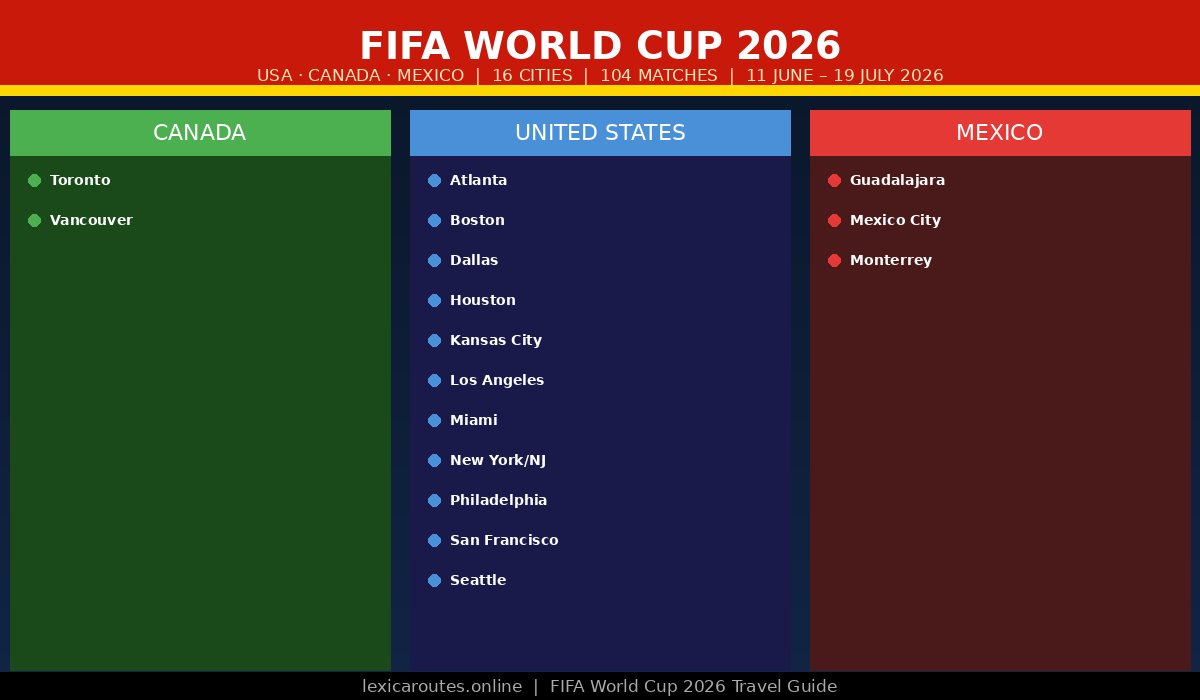
The scale is genuinely unprecedented. With 48 teams competing across three countries, fans face a more complex planning challenge than any previous World Cup. The 16 host cities span over 4,500 kilometres, from Vancouver in the north to Guadalajara in the south.
The expanded 48-team format means more group stage matches and more chances to catch your team in action. But it also means more competition for tickets, accommodation, and flights.
United States (11 cities): Atlanta, Boston, Dallas, Houston, Kansas City, Los Angeles, Miami, New York/New Jersey, Philadelphia, San Francisco Bay Area, Seattle.
Canada (2 cities): Toronto, Vancouver.
Mexico (3 cities): Guadalajara, Mexico City, Monterrey.
Each city brings something different. Mexico City’s Estadio Azteca carries decades of World Cup history. MetLife Stadium in New York/New Jersey holds 82,500 fans. SoFi Stadium in Los Angeles and Hard Rock Stadium in Miami offer two of the most iconic settings in American sport.
How to Get Tickets: The Only Safe Way
Tickets are the single most important part of your planning. Everything else flows from which matches you secure.
FIFA has run several sales phases already. Standard individual tickets for marquee matches, including the opening game and the final, are scarce, with remaining inventory concentrated in hospitality packages. Group stage tickets range from roughly $120 to $350, semi-final seats can reach $1,800, and final tickets start at $1,000.
Purchase only through FIFA’s official ticketing platform or your national football association’s supporter scheme. All FIFA 2026 tickets are mobile-only, delivered through the official FWC2026 Mobile Tickets app. Screenshots and printed copies will not be accepted at stadium gates.
Hospitality packages bundling premium seats with food and lounge access remain available through On Location, the official hospitality provider, via fifa.com/hospitality.
Fraud is a serious risk. Watch for fake resale sites mimicking official branding, social media offers for underpriced seats, and sellers requesting payment via bank transfer. If a deal looks too good, it almost certainly is.
Visa Requirements: Three Countries, Three Sets of Rules
Travelling across three host nations means navigating three separate entry processes. This is the most complex administrative part of FIFA World Cup 2026 travel and requires early action.
United States: Fans from countries outside the Visa Waiver Program must apply for a B1/B2 tourist visa. The U.S. State Department has introduced the FIFA Priority Appointment Scheduling System (FIFA PASS), which offers earlier interview slots for fans with confirmed match tickets purchased directly from FIFA. This does not waive standard checks, and holding a ticket does not guarantee entry. Appointment wait times have been long, so apply as early as possible.
Canada: Most international visitors need either an Electronic Travel Authorization (eTA) or a full visitor visa, depending on nationality.
Mexico: A standard visitor visa applies for nationalities without visa-free entry. Check requirements based on your passport.
If you are planning a multi-country itinerary, secure permissions for every country on your route before departure. Always carry your physical passport. Digital copies are not accepted at land borders or airports.
Accommodation: Book Now, Book Flexible
Hotel availability around host stadiums is tightening fast, particularly in New York/New Jersey, Los Angeles, Dallas, and Miami. Prices in key host cities have already risen sharply around opening, knockout, and final dates.
Book with free cancellation. Until you know which city your team will play in, locking into non-refundable rooms is a genuine risk. Many specialist platforms have released dedicated World Cup inventory tied to ticket packages, so look for bundles that offer flexibility.
If hotels near the host stadium are sold out or overpriced, satellite cities with good transport links can save a significant amount while still getting you to the ground on time. Plan your route around your tickets rather than the other way around.
Fan Zones: The Free Match-Day Experience
Even without a ticket, you can experience the tournament atmosphere. Official FIFA Fan Festivals are running in several U.S. and Canadian host cities, with live match broadcasts on massive screens, local food, entertainment, and interactive football activities. Entry is free.
Philadelphia’s Fan Festival is at Fairmount Park’s Lemon Hill. Vancouver’s takes place at the open-air Amphitheatre at the PNE, backed by the North Shore Mountains. Miami’s is at Bayfront Park, a waterfront venue with space for thousands. These events offer a genuine match-day atmosphere without the stadium cost.
FIFA World Cup 2026 Travel: Quick-Reference Summary
| Planning Item | Action Required | When to Act |
|---|---|---|
| Match tickets | Buy via FIFA official channels only | Now, limited availability |
| U.S. visa | Apply and opt into FIFA PASS | As early as possible |
| Canada eTA/visa | Apply per nationality | 2+ months before travel |
| Mexico visa | Check nationality requirements | 2+ months before travel |
| Accommodation | Book with free cancellation | Now, prices rising |
| Flights | Book early, demand is high | Now |
| Mobile ticket app | Download FWC2026 app | Before match day |
| Travel insurance | Cover medical, cancellation, luggage | Before departure |
Bottom line
The FIFA World Cup 2026 is a once-in-a-generation event, and the planning effort matches the scale of it. Secure tickets through official FIFA channels first, then build your visa applications, flights, and accommodation around your confirmed match schedule. Book rooms with free cancellation to stay flexible, use the FIFA PASS system for U.S. visa scheduling, and check Canada and Mexico entry requirements independently.
If you’re still building your plans, see our guide to [the best North American cities for sports travel in 2026] for what to do beyond match day across the major host cities.
Frequently asked questions
What visa do I need for FIFA World Cup 2026 travel to the United States?
Fans outside the U.S. Visa Waiver Program need a B1/B2 tourist visa. The FIFA PASS system offers earlier interview appointments for fans with confirmed tickets purchased directly from FIFA. Holding a ticket does not guarantee a visa or entry. Apply well in advance, as wait times have been significant in many countries.
How much do FIFA World Cup 2026 tickets cost?
Group stage tickets start at roughly $120 to $350. Round of 16 and quarter-final seats range from around $250 to $900. Semi-final tickets run from $600 to $1,800, and final tickets start at $1,000. Hospitality packages start at approximately $650 per match.
Can I travel between the USA, Canada, and Mexico on the same trip?
Yes, but each country has its own entry rules. Most international fans will need an ESTA or B1/B2 for the U.S., an eTA or visitor visa for Canada, and a visitor visa for Mexico depending on nationality. Always carry your physical passport; digital copies are not accepted at borders.
Are FIFA World Cup 2026 tickets available as paper tickets?
No. All tickets are mobile-only, delivered through the official FWC2026 Mobile Tickets app. Screenshots and printed copies will not be accepted at stadium entry. Download the app and ensure your ticket is loaded before match day.
Is attending the FIFA World Cup 2026 worth it for international fans?
The combination of 48 teams, 104 matches, 16 cities across three countries, and the scale of the fan experience makes this one of the most accessible World Cups ever in terms of match availability. Planning complexity is higher than a single-country tournament, but fans who act early on tickets, visas, and accommodation will find the trip well worth it.