Spending under $50 a day in Europe sounds like a fantasy reserved for people who survived on instant noodles in 2005. In 2026, it is not only possible but genuinely enjoyable, as long as you know which countries to target, where to sleep, and how to eat like a local instead of a tourist.
This step-by-step guide walks you through exactly how to do it.
What You Need Before You Start
Before you book anything, get these three things sorted:
1. A realistic destination shortlist. Not every European country will cooperate with a $50-a-day budget. Eastern and Central Europe are your best allies. Western Europe is workable with discipline. Scandinavia will eat your budget alive. Start your planning by dividing the continent into budget tiers (covered in Step 1 below).
2. Flexible travel dates. Timing is one of the most powerful cost levers available to you. Summer travel in June through August pushes accommodation prices up by 30 to 50% compared to shoulder season. If you can travel in May, September, or October, you will unlock meaningfully lower costs without sacrificing good weather in most regions.
3. A no-foreign-transaction-fee card. ATM fees in Europe average $2 to $5 per withdrawal. Carry a card that waives them, and withdraw larger amounts less frequently.
Step 1: Choose the Right Destinations
This is where most budget travelers go wrong. They plan a Western Europe itinerary full of Paris, London, and Amsterdam, then wonder why $50 a day does not go anywhere.
The geography of European travel costs breaks down roughly like this:
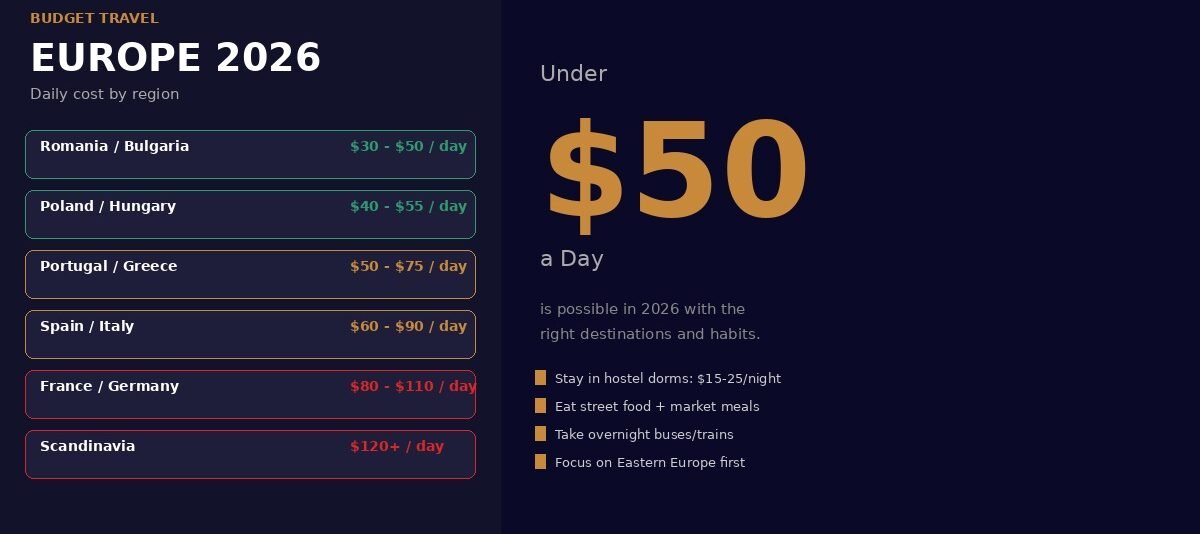
- Eastern Europe (Romania, Bulgaria, North Macedonia, Serbia): $30 to $50 per day all-in on a budget. These are not compromise destinations. Romania’s Transylvanian countryside, Bulgaria’s Black Sea coast, and Serbia’s food scene offer genuine travel experiences at prices that make Western Europeans do a double take.
- Central Europe (Poland, Hungary, Czech Republic, Balkans): $40 to $60 per day. Cities like Krakow, Budapest, and Sarajevo punch well above their weight culturally while staying squarely inside a tight budget.
- Southern Europe (Portugal, Spain, Greece): $50 to $75 per day on a careful budget. Portugal remains one of the continent’s standout values. Lisbon and Porto deliver world-class food and architecture at prices that still feel reasonable compared to their northern counterparts.
- Western Europe (France, Italy, Germany, Netherlands): $70 to $100+ per day. Still doable below $80 with hostel stays, self-catering, and free attractions, but requires consistent discipline.
Practical tip: Start your trip in Eastern Europe and work west as your funds allow. Your money stretches furthest at the beginning, and you build confidence with cheaper systems before taking on pricier cities.
Step 2: Sort Your Accommodation
Accommodation is typically your largest daily expense. Getting this right unlocks everything else.
Hostel dorms are your primary tool. A dorm bed in Eastern and Central Europe runs $10 to $20 per night. In Western Europe, expect $25 to $40. The best hostels include a communal kitchen, which lets you self-cater breakfasts and some dinners, compressing your food costs significantly.
Budget guesthouses and private rooms in Eastern Europe frequently come in under $35 per night, giving you privacy without blowing the budget. In summer, book at least two weeks ahead in popular cities.
Overnight trains and buses deserve a special mention here. A night train from Budapest to Krakow or Prague to Vienna does double duty: it moves you between cities while you sleep, saving you a night’s accommodation cost. Factor this into your itinerary deliberately rather than as a fallback.
Avoid booking accommodation inside the historic old town of major tourist cities. Neighborhoods one metro stop out typically cost $15 to $30 per night less for equivalent quality.
Step 3: Eat Like a Local, Not a Tourist
Food is the most flexible line item in your budget and the easiest place to either save or overspend.
The “supermarket luxury” approach works consistently well across Europe. Picking up fresh bread, local cheese, fruit, and a bottle of regional wine from a Mercadona in Spain, a Biedronka in Poland, or a Lidl anywhere costs $6 to $10 and produces a more memorable meal than most mid-range restaurants. Eaten in a park or by a river, it is genuinely one of the better experiences budget travel offers.
For hot meals, target lunch menus over dinner. Many European restaurants, particularly in Spain, France, and Italy, offer a set lunch (menu del dia, plat du jour, or similar) for $8 to $15 that includes a main course, bread, and sometimes a drink. The same meal ordered a la carte at dinner costs twice as much.
Street food and market stalls are your other reliable option. A portion of pierogies in Krakow, a burek in Sarajevo, or grilled fish at a Bulgarian seaside market costs $3 to $6 and is frequently the best food in the city.
A realistic daily food budget of $12 to $18 is achievable across Eastern and Central Europe. In Southern and Western Europe, budget $18 to $25 if you mix self-catering with one sit-down meal.
Step 4: Move Between Cities Without Overspending
Intercity transport is where hidden costs accumulate fast if you are not paying attention.
Budget airlines (Ryanair, Wizz Air, easyJet) look cheap on the surface, but checked baggage fees, airport transfer costs, and seat selection charges erode the savings quickly. Always calculate the full door-to-door cost, including how far the airport is from the city center.
Regional trains and buses in Eastern Europe are consistently affordable. A train from Bucharest to Brasov costs around $10 for a 2.5-hour scenic ride. Prague to Vienna runs roughly $20 to $30. These routes are slower than budget airlines but drop you in the city center and carry no hidden fees.
The Eurail Global Pass makes financial sense if you are covering multiple countries quickly, particularly on Western European routes where individual high-speed rail tickets can run $60 to $150 per leg. For slower Eastern Europe-heavy itineraries, buying point-to-point tickets is usually cheaper.
Within cities, a day transit pass typically costs $5 to $15 and covers unlimited metro, bus, and tram use. Most European city centers are compact enough that walking handles much of the sightseeing for free.
Step 5: Keep Activities from Breaking the Budget
Europe’s best experiences skew free. Walking historic old towns, hiking in national parks, swimming on public beaches, and visiting open-air markets cost nothing. Free walking tours (tip-based, usually $5 to $10) operate in almost every major European city and consistently outperform paid group tours for first-time visitors.
When paid attractions matter, city cards often bundle entry to multiple museums with unlimited transit for $25 to $50 per day and represent good value if you plan to visit three or more paid sites in a single city. Booking online in advance is almost always cheaper than paying at the door.
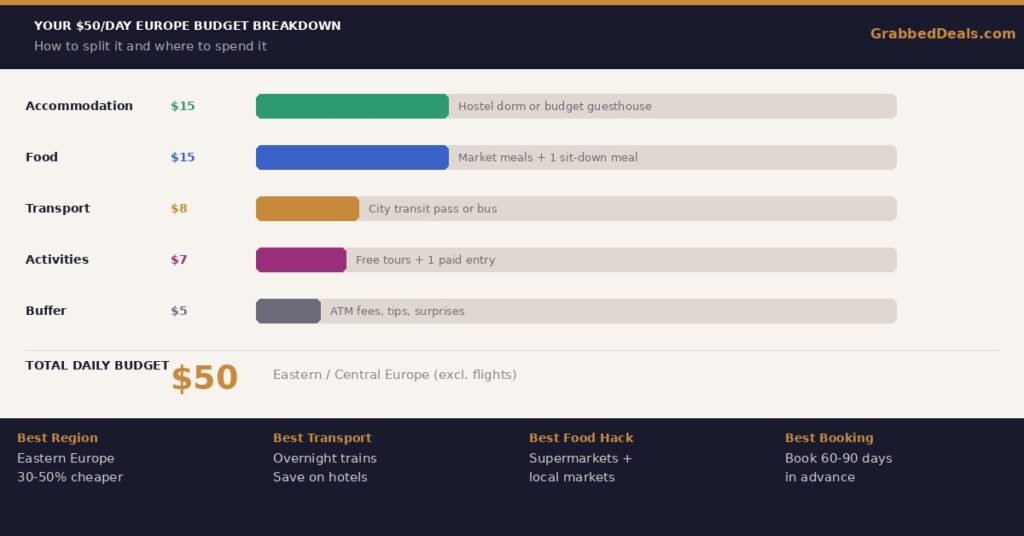
Summary Box: Your $50/Day Europe Budget at a Glance
| Category | Daily Budget | Notes |
|---|---|---|
| Accommodation | $12-$18 | Hostel dorm; overnight trains for transit nights |
| Food | $12-$18 | Market meals + 1 sit-down or street food |
| City transport | $5-$8 | Day pass; walk where possible |
| Activities | $5-$7 | Free tours + 1 paid entry |
| Buffer | $4-$6 | ATM fees, tips, surprises |
| Total | $38-$57 | Eastern/Central Europe; adjust up for Western |
Estimated time per step: Destination research (1-2 hours), accommodation booking (30 minutes per city), daily planning (15 minutes each morning).
External Resources
- For official train routes and live ticket pricing across 45+ countries, Trainline’s European rail network is the most reliable starting point when building your intercity travel plan.
- Hostel reviews and real traveler cost breakdowns are consistently accurate on Hostelworld’s destination guides, which include current dorm pricing updated monthly.
- The European Union’s official travel information portal covers entry requirements, ETIAS authorization timelines, and healthcare access across member states.
Final Verdict
Budget travel in Europe in 2026 is not about suffering through bad hostels or skipping the things that make travel meaningful. It is about making deliberate choices: starting in Eastern Europe where your money goes furthest, eating at markets and local lunch spots rather than tourist restaurants, using night trains as free hotels, and leaning into the continent’s extraordinary wealth of free public spaces, beaches, and historic sites.
A $50-a-day budget across Eastern and Central Europe is realistic and repeatable. In Western Europe, $70 to $80 keeps you comfortable without deprivation. The single biggest lever is timing: shift your trip from July to May or September and you immediately reclaim 20 to 30% of your budget.
For more practical planning, read our guide to the best Interrail and Eurail routes for first-time Europe travelers.
Frequently Asked Questions
Is traveling Europe on $50 a day actually realistic in 2026?
Yes, but it depends heavily on where you go. In Eastern European countries like Romania, Bulgaria, and Serbia, $30 to $50 a day covers accommodation, food, transport, and activities comfortably. In Western Europe, $50 a day is tight and requires hostel dorms, self-catered meals, and free attractions. Treat $50 as your floor for Eastern Europe and your stretch target for Western Europe.
What is the cheapest country to visit in Europe right now?
North Macedonia, Albania, and Serbia consistently rank as the most affordable European destinations in 2026, with daily budgets possible under $40 all-in. Romania and Bulgaria are close behind at $30 to $50 per day, and both offer a richer tourist infrastructure with more English spoken.
How long does it take to plan a proper budget Europe trip?
A solid foundation takes four to six hours: one to two hours mapping destinations and a rough route, one hour researching and booking accommodation for the first few cities, and thirty minutes comparing intercity transport options. The rest you can figure out as you go. Over-planning a budget trip often leads to rigidity that costs money when plans change.
What happens if I go over budget on some days?
Budget creep is normal. Check your spending at the halfway point of your trip and adjust forward rather than trying to retroactively compensate. Shifting to a cheaper destination, spending a day in a national park rather than a city, or moving to a smaller town for a couple of nights resets daily costs quickly without sacrificing the trip.
Do I need travel insurance for a budget Europe trip?
Yes, without exception. A single medical incident in Western Europe without insurance can run into thousands of euros. Reliable budget-friendly policies from SafetyWing, World Nomads, or Hey Mondo typically cost $30 to $80 for a two-week trip, which is a trivial line item against the risk of not having coverage.
Related Posts
Author: Written by the Lexica Routes editorial team, covering travel, education, and study abroad since 2025.






2 comments