Not every trip teaches you something. But some destinations hand you a history lesson you will never forget. UNESCO World Heritage Sites are not just beautiful places to photograph. They are the 1,248 locations the world has agreed are too important to lose. Some are ancient, some are raw, and a handful added in 2025 are reshaping what educational travel even means.
Whether you are a student planning a gap year, a traveler who wants more than a selfie, or someone building a study abroad itinerary around real-world knowledge, this list is for you. These 10 sites do not just look impressive. They teach history, ecology, democracy, grief, science, and the full complexity of being human.
How We Chose These Sites
Not every UNESCO site makes the cut for genuine educational value. The 10 here were selected based on three criteria: depth of historical or scientific significance, accessibility for independent or student travelers, and the quality of on-site interpretation. Some are iconic. A few are newly added and still under the radar. All of them will leave you smarter for visiting.
1. Cambodian Memorial Sites, Cambodia
What you learn: The mechanics and memory of genocide
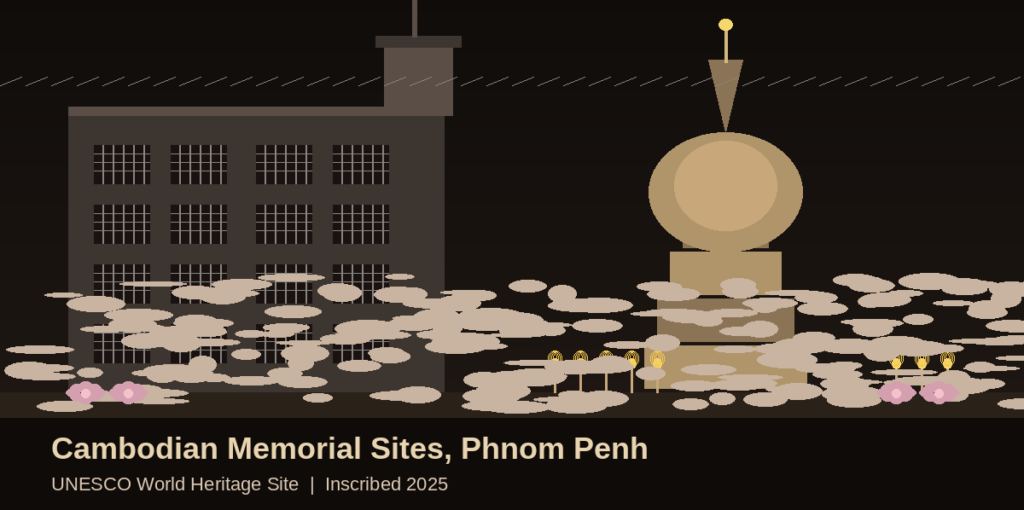
Three sites make up this 2025 addition to the World Heritage List: the former M-13 prison, the former S-21 prison (now the Tuol Sleng Genocide Museum), and the Choeung Ek Genocidal Center. The Khmer Rouge regime was responsible for the deaths of around 1.7 million Cambodians in the 1970s, and these places are where much of that horror unfolded.
UNESCO describes them as sites “from centres of repression to places of peace and reflection.” Visiting is not comfortable. At Choeung Ek, a memorial pagoda holds the remains of victims. Fragments of clothing still emerge from the soil around the mass graves. But that discomfort is the point. This is what UNESCO calls “difficult heritage,” and engaging with it honestly is one of the most important things a traveler can do.
Pair this with a visit to the Royal Palace and the National Museum of Cambodia in Phnom Penh to give the tragedy its full historical context.
Best for: History students, human rights educators, gap year travelers seeking perspective.
2. Minoan Palatial Centres, Crete, Greece
What you learn: Europe’s first advanced civilization
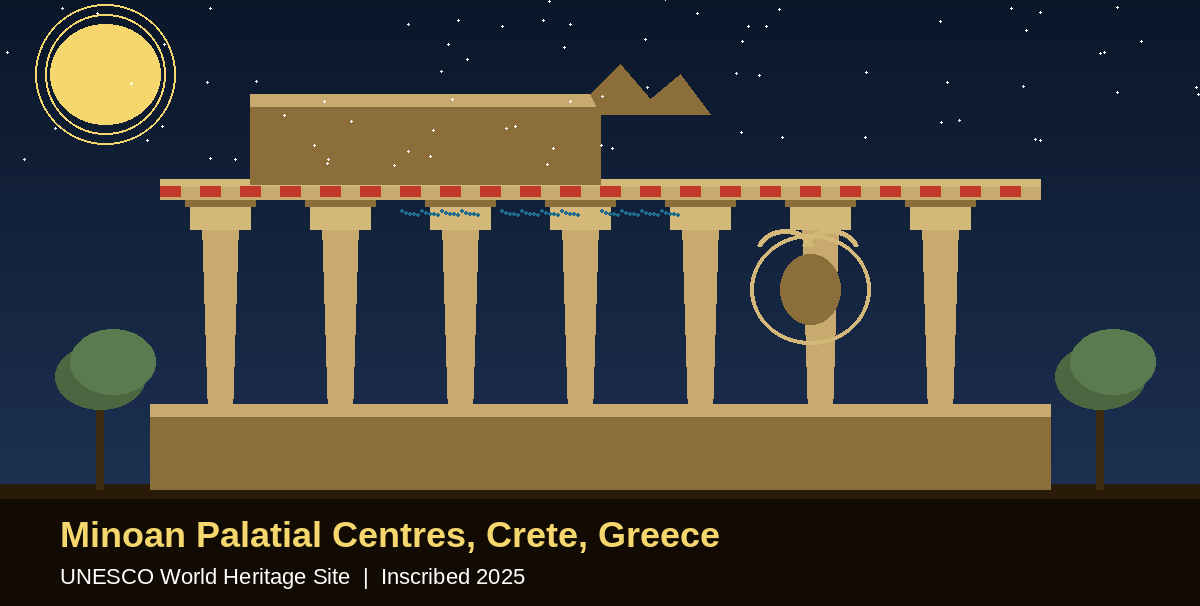
Six Minoan archaeological sites on the island of Crete were added to the World Heritage List in 2025: Knossos, Phaistos, Malia, Zakros, Zominthos, and Kydonia. Built between 1900 and 1100 BCE, these palatial complexes predate classical Greece by centuries and represent the Bronze Age civilization that gave Europe its earliest literate society.
At Knossos, you walk through rooms with intact frescoes showing dolphins, bull-leaping ceremonies, and court life. The site also had running water and advanced drainage systems thousands of years before Rome. Seeing that flips a lot of assumptions about who was “advanced” and when.
Crete’s Minoan sites are accessible by ferry or budget flight from Athens and are easily covered over two to three days.
Best for: Archaeology students, classical history enthusiasts, study abroad programs in the Mediterranean.
3. The Acropolis of Athens, Greece
What you learn: The origins of democracy, philosophy, and Western civic life
The Acropolis has been a World Heritage Site since 1987 and still earns its place at the top of any educational travel list. The Parthenon, the Temple of Athena Nike, and the Erechtheion are not just ancient ruins. They are the physical record of a society that invented democratic governance, codified philosophical inquiry, and set aesthetic standards that Western architecture still follows today.
The Acropolis Museum at the base of the hill is one of the finest in the world. It contextualizes each structure with recovered sculptures, written records, and digital reconstructions. Allow at least half a day here and go early to beat the crowds.
Best for: Political science and philosophy students, anyone studying Western civilizations.
4. Palaces of King Ludwig II, Bavaria, Germany
What you learn: The psychology of power, fantasy, and 19th-century Romanticism
Neuschwanstein, Linderhof, Schachen, and Herrenchiemsee were added to the World Heritage List in 2025. UNESCO describes them as “records in stone of the ideal fantasy world which the king built as a refuge from reality.” Ludwig II ruled Bavaria in the second half of the 19th century, bankrupted the royal treasury building these palaces, and was declared mentally unfit before dying under mysterious circumstances.
The educational angle here is less obvious but genuinely rich. These palaces sit at the intersection of art history, political history, and psychology. They also raise interesting questions about how architecture serves as ideology, how Romantic nationalism shaped European identity, and why the line between visionary and unhinged is always drawn by whoever holds power.
Best for: Art history, European history, students of politics and cultural studies.
5. Megaliths of Carnac, Brittany, France
What you learn: Prehistoric society, collective labor, and ancient astronomy
Around 3,000 standing stones are arranged in long parallel alignments across the Breton landscape at Carnac. These structures predate Stonehenge and represent one of the largest concentrations of megalithic monuments on Earth. Nobody knows with certainty what they were for. That ambiguity is exactly what makes them educationally powerful.
Visiting Carnac forces you to think about how human societies organized collective labor before writing, money, or formal government. The on-site museum provides strong archaeological context, and guided tours explain the leading theories about the stones’ astronomical and ceremonial significance.
Best for: Archaeology, anthropology, and prehistoric cultures coursework.
6. Murujuga Cultural Landscape, Australia
What you learn: Indigenous knowledge systems and the world’s oldest continuous rock art tradition
Added to the World Heritage List in 2025 through a process led by local Aboriginal communities, Murujuga on the Burrup Peninsula in Western Australia is home to up to one million petroglyphs. These engravings depict animals, human figures, and ecological scenes, and they span thousands of years of continuous cultural practice.
What makes Murujuga exceptional educationally is the depth of knowledge embedded in the rock art. These are not decorations. They are records of climate change, species migration, and cultural ceremony created and maintained by the Murujuga Aboriginal people over tens of thousands of years. Aboriginal-led tours are available and provide interpretation that no textbook can replicate.
Best for: Students of Indigenous studies, ecology, environmental history, and anthropology.
7. Xixia Imperial Tombs, Ningxia, China
What you learn: A forgotten empire and the limits of historical memory
The Xixia Imperial Tombs at the foothills of the Helan Mountains in northwestern China were added to the World Heritage List in 2025. The site includes 9 imperial mausoleums and 271 subordinate tombs from the Xixia Dynasty, which ruled between 1038 and 1227 before being defeated and systematically erased from history by Genghis Khan’s Mongol forces.
More than 7,000 artifacts excavated from the site are on display at the Xixia Imperial Tombs Museum nearby. Visiting teaches you something important about how history gets written, who gets remembered, and why entire civilizations can disappear from the record when the victors decide they should.
Best for: World history students, East Asian studies programs, travelers interested in the Silk Road.
8. Machu Picchu, Peru
What you learn: Incan engineering, astronomy, and pre-Columbian civilization
Machu Picchu is one of the most recognized sites on Earth and has been a World Heritage Site since 1983. What makes it genuinely educational rather than just photogenic is the sheer ambition of what the Inca built. The city sits at 2,430 meters above sea level and was constructed without iron tools, wheels, or mortar. The astronomical alignments built into the architecture are precise enough to track solstices and equinoxes.
The site is now managed under a timed-entry system to manage visitor numbers. Book months in advance if you are traveling in peak season. The on-site interpretive signage has improved significantly in recent years, but hiring a licensed guide makes a substantial difference to how much you actually learn.
Best for: Latin American studies, engineering and architecture students, and travelers wanting to understand pre-Columbian history.
9. Auschwitz-Birkenau, Poland
What you learn: The Holocaust, the mechanics of industrialized genocide, and the necessity of remembrance
Inscribed in 1979, Auschwitz-Birkenau remains one of the most visited and most studied UNESCO sites on Earth. The former Nazi concentration and extermination camp is where approximately 1.1 million people, the majority of them Jewish, were murdered between 1940 and 1945. UNESCO cites it as a place of remembrance and serves as a warning for humanity.
The Auschwitz-Birkenau Memorial and Museum offers guided tours led by trained educators, an extensive permanent exhibition, and outreach programs for schools and universities. It is not a site to visit casually, but it is one of the most important places a student of 20th-century history can see in person.
Best for: History students, human rights courses, educators, and anyone committed to understanding the 20th century honestly.
10. Yen Tu Mountain Range, Vietnam
What you learn: Buddhist philosophy, pilgrimage culture, and Vietnamese spiritual identity
Vietnam’s ninth UNESCO World Heritage Site was added in 2025 and spans 20 locations across the Yen Tu Mountain Range in the provinces of Quang Ninh, Bac Giang, and Hai Duong. The site is closely associated with King Tran Nhan Tong, who abdicated his throne in the 13th century to become a Buddhist monk and founded a uniquely Vietnamese school of Buddhism at Yen Tu.
The mountain has been a pilgrimage destination for centuries. Walking sections of the ancient pilgrimage trail, visiting the pagodas and meditation halls, and engaging with the living religious community here offer a form of learning that is very different from a classroom or museum.
Best for: Religious studies, Asian history, travelers on educational gap years across Southeast Asia.
| Site | Country | Added | What You Learn | Best For |
|---|---|---|---|---|
| Cambodian Memorial Sites | Cambodia | 2025 | Genocide history | History, human rights |
| Minoan Palatial Centres | Greece | 2025 | Bronze Age civilization | Archaeology, classics |
| The Acropolis | Greece | 1987 | Democracy, philosophy | Political science |
| Palaces of Ludwig II | Germany | 2025 | Romanticism, power | Art history |
| Megaliths of Carnac | France | 2025 | Prehistoric society | Anthropology |
| Murujuga | Australia | 2025 | Indigenous knowledge | Indigenous studies |
| Xixia Imperial Tombs | China | 2025 | Forgotten empires | World history |
| Machu Picchu | Peru | 1983 | Incan engineering | Latin American studies |
| Auschwitz-Birkenau | Poland | 1979 | Holocaust history | Modern history |
| Yen Tu Mountain Range | Vietnam | 2025 | Buddhist philosophy | Religious studies |
Our take
UNESCO World Heritage Sites are not a tourist checklist. They are a map of what humanity has agreed is worth understanding, protecting, and passing on. The 26 sites added in 2025 alone span genocide memorials, prehistoric rock art, Bronze Age palaces, and sacred pilgrimage trails. That breadth is the point. There is no single story of human history, and the best educational travel forces you to sit with more than one version of it at once.
Frequently asked questions
Are UNESCO World Heritage Sites worth visiting for educational purposes?
Yes, and more so now than ever. UNESCO sites are selected specifically because of their outstanding cultural, historical, or natural significance to humanity. Many offer dedicated educational programs, guided tours, and on-site museums designed to give visitors genuine depth. The 2025 additions in particular, including genocide memorials and Indigenous cultural landscapes, bring a new range of educational contexts to the list.
Which UNESCO World Heritage Sites are best for students?
The Acropolis, Machu Picchu, and Auschwitz-Birkenau rank among the most educationally rich for students because of the depth of on-site interpretation and the breadth of academic disciplines they connect to. For 2025 additions, the Cambodian Memorial Sites and the Minoan Palatial Centres of Crete are both exceptional choices for students of history, anthropology, and archaeology.
How many UNESCO World Heritage Sites are there in 2026?
As of the 2025 additions, there are 1,248 UNESCO World Heritage Sites across more than 170 countries. The total is updated annually by the World Heritage Committee. No new additions have been announced yet for 2026.
Can you visit UNESCO World Heritage Sites independently or do you need a guide?
Most UNESCO sites are accessible independently, though the quality of your experience varies significantly depending on on-site interpretation. Sites like Machu Picchu and the Cambodian Memorial Sites strongly benefit from a licensed local guide, both for depth of understanding and for ethical reasons around context and sensitivity. Carnac and Knossos have strong self-guided options.
Which UNESCO sites were newly added in 2025?
UNESCO added 26 new sites in 2025 during the 47th session of the World Heritage Committee in Paris. Highlights include the Cambodian Memorial Sites, the Minoan Palatial Centres of Crete, the Palaces of King Ludwig II in Bavaria, the Murujuga Cultural Landscape in Australia, the Megaliths of Carnac in France, and the Yen Tu Mountain Range in Vietnam.
Related posts