Spain has quietly handed international students one of the most significant policy upgrades in years. Under rules now fully in effect for 2026, international students in Spain can work up to 30 hours per week while studying in Spain 2026 work rights now include automatic work authorization for anyone enrolled in higher education. If you are planning to study in Spain, or you are already there and unsure what you are actually allowed to do, this is the update you need to read.
What Has Changed: From 20 Hours to 30 Hours
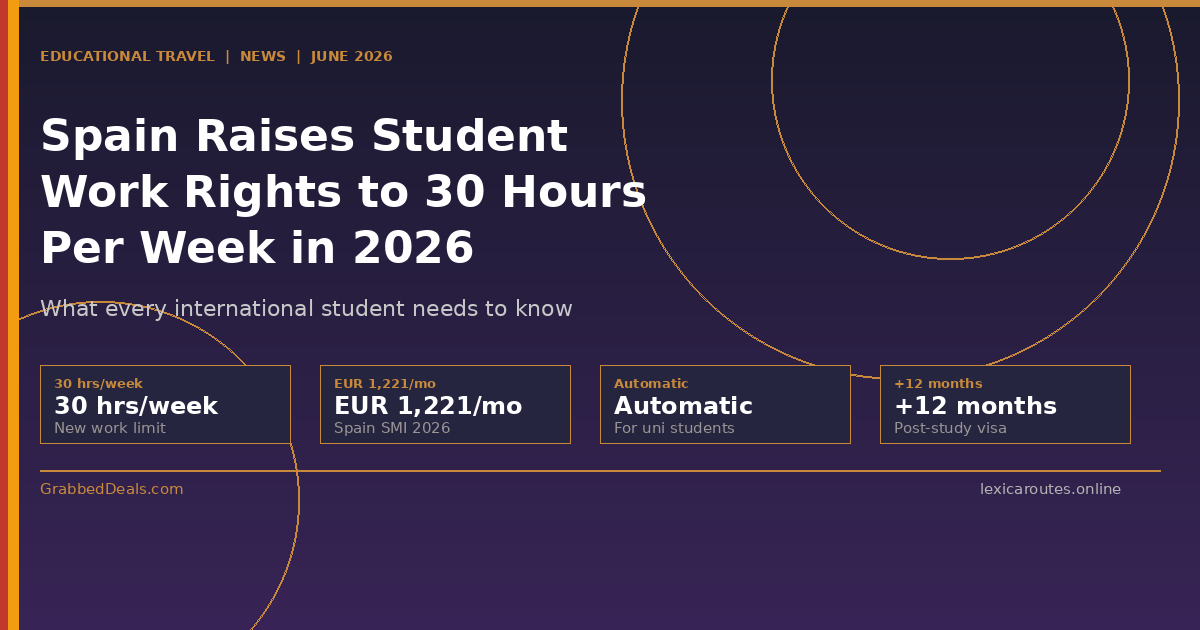
The headline change is straightforward. Spain has raised the weekly work limit for international students from 20 hours to 30 hours. That is a 50 percent increase in legal working time, and it applies across the board whether you are employed by a company or working independently as a freelancer.
The second change is arguably more impactful: for students enrolled in higher education programs (university degrees, master’s programs, and PhDs), the work authorization is now automatic. Your Study Stay Authorization (the TIE, or Foreigner Identity Card) now includes the right to work built in. Employers no longer need to file a separate work permit request with the immigration office before hiring you. That removes a significant administrative barrier that previously slowed students down for weeks or months.
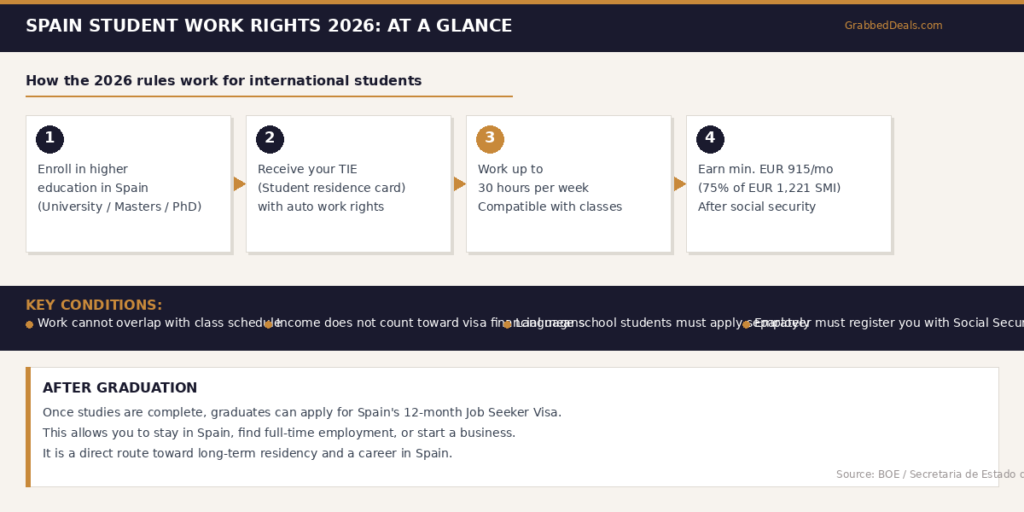
The rule comes with two non-negotiable conditions. First, your work must not overlap with your class schedule. Your studies remain the primary reason you are in Spain, and any job contract must reflect that by being part-time and compatible with your lectures. Second, your employment income cannot count toward the financial means you declared when applying for your student visa. You are still required to demonstrate independent financial support outside your wages.
What You Will Earn: The 2026 Minimum Wage
Spain’s national minimum wage, the Salario Minimo Interprofesional (SMI), was raised to 1,221 euros gross per month in February 2026, an increase of 3.1 percent from the 2025 level. This is the baseline pay floor your employer must respect regardless of sector.
As a part-time student working 30 hours per week (75 percent of a standard 40-hour workweek), you would be entitled to approximately 915 euros gross per month at minimum. In cities like Madrid or Barcelona, where monthly living costs can reach 1,400 euros or more, that wage covers a meaningful portion of rent, food, and transport. It is not full financial independence, but it is a genuine contribution.
Your employer is responsible for registering you with Spain’s Social Security system (Alta en la Seguridad Social) before your first working day. Social security contributions of around 6.5 percent will be deducted from your gross pay, but most students earning near minimum wage will fall below the income tax threshold and pay no personal income tax.
Key facts summary
| What | Detail |
|---|---|
| New weekly work limit | 30 hours per week (up from 20) |
| Who qualifies automatically | Higher education students (university, master’s, PhD) with a valid TIE |
| Minimum wage (2026 SMI) | 1,221 euros/month gross (14 payments), approx. 915 euros for 30h/week |
| Work must | Not overlap with classes; remain part-time |
| Post-study option | 12-month Job Seeker Visa available after graduation |
Who Qualifies (and Who Does Not)
Not every student in Spain gets automatic work authorization. The rules differ based on what you are studying.
If you are enrolled in a regulated higher education program at a Spanish university, a master’s degree, or a PhD, your TIE includes work rights automatically. No extra applications are needed. You find a job, your employer checks your TIE, and they register you with Social Security. That is the full process.
If you are taking a language course at a private language school, even one accredited by the Instituto Cervantes, the situation is different. Private language school students are not covered by the automatic authorization and must apply for a separate work authorization, typically filed by the employer on their behalf. This process is known as the Autorización de compatibilidad de estudios y trabajo.
A point that trips up many students: if your TIE says “no autorizado a trabajar” (not authorized to work), that does not mean you cannot work legally. It is often an administrative default on the card, not a legal prohibition. Higher education students can still activate their work authorization through the correct process even if this phrase appears on their card.
What Happens After You Graduate
Spain added another layer of flexibility that makes the overall package more attractive for long-term planners. When you finish your studies, you now have up to one year to find employment before your student status expires. This is delivered through Spain’s Job Seeker Visa, which grants a 12-month stay to allow graduates to transition into the full-time labor market or establish a business.
For students who have spent several years building a professional network, language skills, and Spanish work experience, this path is a realistic route toward long-term residency in Spain.
The 30-hour work rule is part of a wider push by the Spanish government to attract and retain international student talent, as outlined in the country’s broader immigration reform strategy published through the Boletín Oficial del Estado (BOE). You can review the official regulatory framework via Spain’s immigration authority directly at the Secretaría de Estado de Migraciones.
For a full overview of Spain’s student visa conditions, the Ministry of Foreign Affairs consular guide remains the authoritative starting point. Independent tracking of the rule changes can also be found through the immigration resource site Entre Tramites, which covers the automatic TIE authorization in detail.
Final verdict
Spain’s 2026 student work update is a meaningful, practical improvement for anyone planning to study there. The shift from 20 to 30 hours, combined with automatic authorization for higher education students, removes friction and gives students real earning power. At around 915 euros gross per month at minimum wage, working 30 hours a week covers a solid portion of living costs in most Spanish cities, even if it will not fully fund life in Madrid or Barcelona.
The catch-all rule still applies: studies come first, and your employer needs to structure your contract accordingly. But for students who want to study, gain real work experience, and build a life in Spain, the 2026 framework is considerably more supportive than it was even a year ago.
If you are comparing study destinations in Europe, see our guide to teaching and studying abroad across Asia and Europe, or explore our full breakdown of the best countries for international students right now on Lexica Routes.
Frequently asked questions
Can international students in Spain work full-time during university holidays in 2026?
The 30-hour weekly cap applies year-round, including during academic holiday periods. Spain’s student work rules do not distinguish between term time and holidays for the purposes of the weekly limit. Your contract must remain part-time at all times.
Does the automatic 30-hour work authorization apply to language school students?
No. The automatic work authorization embedded in the TIE applies only to students enrolled in regulated higher education programs such as university degrees, master’s programs, and PhDs. Students at private language schools must apply separately for work authorization, usually through their employer.
What if my TIE card says I am not authorized to work?
That phrase on your card is often an administrative default rather than a legal ban. Higher education students have the right to work under Spanish immigration law regardless of what is printed on the card. You or your employer can activate the authorization through the Oficina de Extranjeria without needing to alter your visa category.
How much will I earn working 30 hours a week in Spain in 2026?
Based on the 2026 SMI of 1,221 euros gross per month for a 40-hour week, working 30 hours entitles you to approximately 915 euros gross monthly. After the mandatory social security deduction of around 6.5 percent, your take-home pay would be roughly 856 euros per month. Most students at this income level pay no personal income tax.
Can I stay in Spain after graduating to look for work?
Yes. Spain offers a 12-month Job Seeker Visa for graduates who want to stay in the country and transition into full-time employment or entrepreneurship after completing their studies. You must apply before your student authorization expires and demonstrate that you have completed your program.
Related posts