Choosing between IELTS and TOEFL is one of the first real decisions international students face when planning to study abroad. Both tests prove your English proficiency, both are accepted by thousands of universities worldwide, and yet picking the wrong one can slow down your application or hurt your score. In 2026, the gap between the two exams has narrowed significantly, but there are still clear situations where one is the smarter choice. This guide breaks down everything you need to know, including the major TOEFL format overhaul that took effect in January 2026 that most comparison articles still haven’t caught up with.
What changed with TOEFL in January 2026
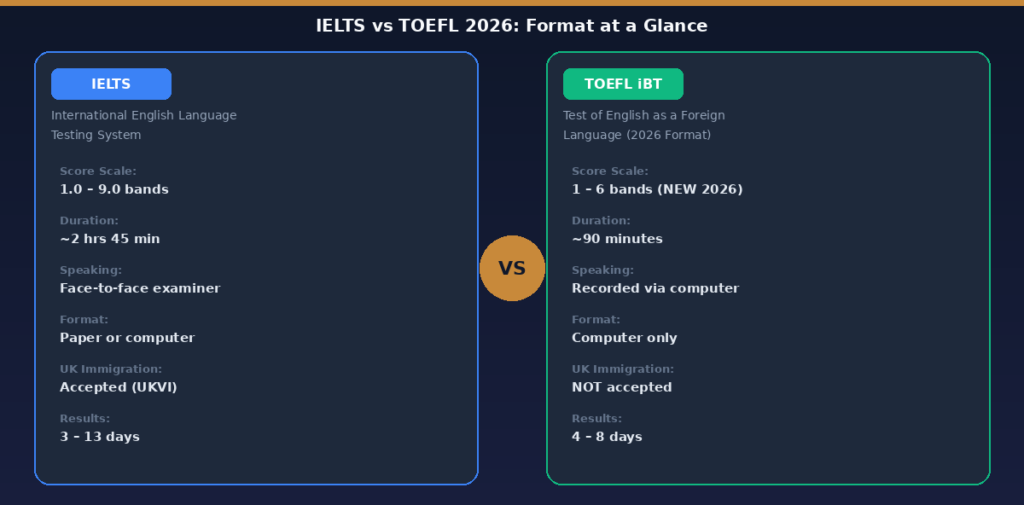
This is the update most students aren’t aware of yet. As of January 21, 2026, the TOEFL iBT switched to a new 1–6 band scoring scale, replacing the old 0–120 format, and the test now runs at approximately 90 minutes, down from two hours. The new version includes adaptive testing in Reading and Listening, plus several new task types. If you’ve been reading older guides comparing these two tests, a lot of that information is now outdated.
IELTS, by contrast, has kept its core structure stable. IELTS has no major announced changes to its core format for 2026, according to British Council, IDP, and Cambridge. It still runs at roughly two hours and 45 minutes and retains the face-to-face speaking component that many students find more natural.
How the two exams compare on format and experience
At their core, IELTS and TOEFL test the same four skills: Listening, Reading, Writing, and Speaking. But the experience of sitting each exam is quite different.
TOEFL continues to focus on academic English in a fully computer-based environment, while IELTS offers both Academic and General Training modules that are suitable for study, work, and migration purposes.
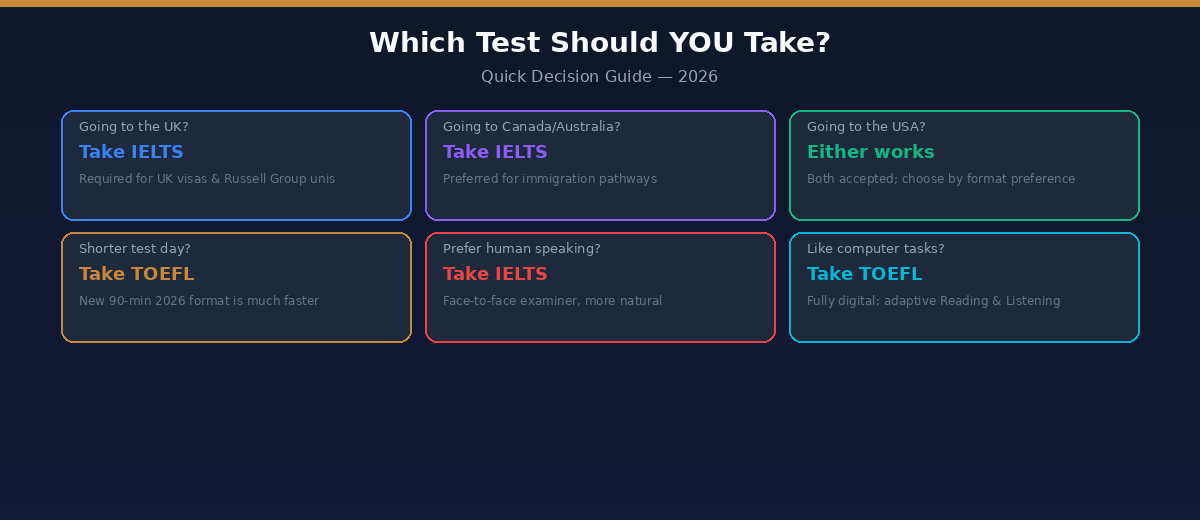
The speaking section is where most students notice the biggest difference. IELTS Speaking involves a face-to-face interview with a human examiner, either in person or via video call for the online version. TOEFL Speaking is recorded via microphone with no human interaction at all. For students who feel more comfortable in a conversation, IELTS is usually the better fit. For those who find the pressure of a live examiner stressful, the structured silence of TOEFL can work in their favor.
TOEFL is entirely computer-based and conducted in one sitting, which requires strong stamina for focused work. IELTS is more flexible, with the speaking section often scheduled on a different day.
Which universities and countries prefer which test
This is the most practical question, and the answer depends almost entirely on where you’re planning to go.
For UK universities or UK visa applications, IELTS is the clear choice. TOEFL is not accepted for UK immigration purposes, and most Russell Group universities, including Oxford, Cambridge, and LSE, list IELTS as their benchmark requirement. For US universities, both tests are accepted on equal footing. For Canada and Australia, IELTS is more widely preferred, particularly for immigration pathways.
In 2026, most universities globally accept both IELTS and TOEFL equally, provided minimum score requirements are met. Differences tend to arise at the program level, where some departments specify section-by-section cutoffs or prefer one test based on assessment style rather than overall credibility.
If you’re applying to US institutions specifically, TOEFL, administered by ETS, is computer-delivered and focuses on academic English with integrated tasks combining reading, listening, writing, and speaking, which aligns closely with how American universities assess academic work. That said, IELTS acceptance at US schools has grown steadily and is now the norm rather than the exception.
Scoring: understanding how they compare
The new TOEFL 1–6 scale takes some adjustment if you’re used to the old format. ETS has published an official score comparison table for the new TOEFL 1–6 scale and IELTS. A TOEFL overall score of 5.0 corresponds to an IELTS 7.0, and a TOEFL score of 4.5 corresponds to an IELTS 6.5.
For context on what universities actually require, in the USA, top universities such as Harvard, Yale, Princeton, and Stanford typically require a minimum IELTS score of 7.0, while MIT requires 7.5 and Columbia requires 8.5. In the UK, most universities require between 6.5 and 7.0, with King’s College London setting its minimum at 7.5. Top Canadian and Australian universities generally require around 6.5.
Results turnaround is similar for both. IELTS computer-based results are available within 3 to 5 days, while paper-based results take up to 13 days. TOEFL iBT results appear within 4 to 8 days. Both tests have a score validity period of 2 years from the test date.
Cost and availability in 2026
IELTS is managed by British Council, IDP, and Cambridge, and the test fee is approximately US$255, though this varies by country. TOEFL is managed by ETS and is accepted by over 12,000 institutions globally.
Both exams typically cost between $200 and $300 USD depending on your location. Preparation timelines are similar too, with most students requiring 6 to 12 weeks of focused study before test day.
TOEFL is available over 60 times a year, while IELTS is offered multiple times monthly across more than 140 countries. Both offer a reasonable number of test dates, so availability is rarely a deciding factor.
Comparison Table
| Feature | IELTS | TOEFL iBT (2026) |
|---|---|---|
| Test duration | ~2 hrs 45 min | ~90 minutes (new 2026 format) |
| Scoring scale | 1.0–9.0 bands | 1–6 bands (new 2026 scale) |
| Speaking format | Face-to-face with examiner | Recorded via computer (no examiner) |
| Test delivery | Paper or computer | Computer only |
| Cost (approx.) | US$200–$255 | US$200–$300 |
| Results timeline | 3–13 days | 4–8 days |
| Score validity | 2 years | 2 years |
| UK immigration | Accepted (UKVI-approved) | Not accepted |
| US universities | Widely accepted | Widely accepted |
| Canada/Australia | Preferred | Accepted (check program) |
Final verdict
For most students, the destination drives the decision. If you’re heading to the UK or applying for UK immigration, take IELTS, full stop. If Canada or Australia is your goal, IELTS is again the safer choice for immigration routes, though both tests work for university admissions. For US-bound students, the choice genuinely comes down to which format suits your strengths. TOEFL’s new 2026 format is shorter and more adaptive, which some students will find less draining. IELTS gives you a human speaking interaction and more scheduling flexibility.
The best advice before you decide: take one practice test of each. Many students find that the right answer becomes obvious after just a few hours of trial preparation.
Frequently Asked Questions
Is IELTS or TOEFL harder in 2026?
Neither exam is universally harder. Difficulty depends on your strengths. Students who prefer face-to-face conversation and mixed question formats typically find IELTS more manageable. Students who are comfortable with computer-based tasks and integrated reading-writing exercises often prefer TOEFL. Take a diagnostic practice test for both before committing.
Which test should I take for UK university admissions?
Take IELTS. Almost all UK universities, and particularly the Russell Group, list IELTS as their primary requirement. TOEFL is also accepted by many UK institutions for academic purposes, but for UK visa applications, only UKVI-approved IELTS is valid. TOEFL is not accepted for UK immigration at all.
What is the new TOEFL format in 2026?
As of January 21, 2026, TOEFL iBT moved to a new 1–6 band scoring scale, replacing the old 0–120 scale. The test is now approximately 90 minutes long (down from two hours), uses adaptive testing in Reading and Listening, and includes several new task types. Many older comparison guides still reference the previous format, so check official ETS resources for current details.
How much does each test cost in 2026?
Both tests cost between $200 and $300 USD, depending on your country and test center. IELTS is typically around $200 to $255. TOEFL fees vary slightly more by region. Check the official ETS website for TOEFL pricing and your local British Council or IDP office for IELTS fees in your country.
Can I use both IELTS and TOEFL for the same university application?
Most universities will accept either, so you typically only need one. However, check your specific program requirements, as some departments specify section-level score minimums that may differ between the two tests. When in doubt, check the admissions page for each program you’re applying to directly.
Related Posts