Workforce Pell Grants Are Coming: The Biggest Change to Federal Aid in Decades
For the first time since Pell Grants were introduced in 1965, students in short-term workforce training programs will be able to access federal grant money. Starting July 1, 2026, the Workforce Pell 2026 expansion, passed under President Trump’s One Big Beautiful Bill Act, opens federal aid to programs as short as eight weeks. If you are a working adult, career changer, or anyone priced out of longer degree programs, this change could directly affect how you pay for training. Here is exactly what it means and what you should do now.
What Happened
Congress passed the One Big Beautiful Bill Act in July 2025, which included the Workforce Pell expansion. Before this legislation, Pell Grants could only be applied to programs of at least 600 clock hours, lasting a minimum of 15 weeks. That requirement locked out millions of learners pursuing certificates in fields like healthcare, skilled trades, and information technology.
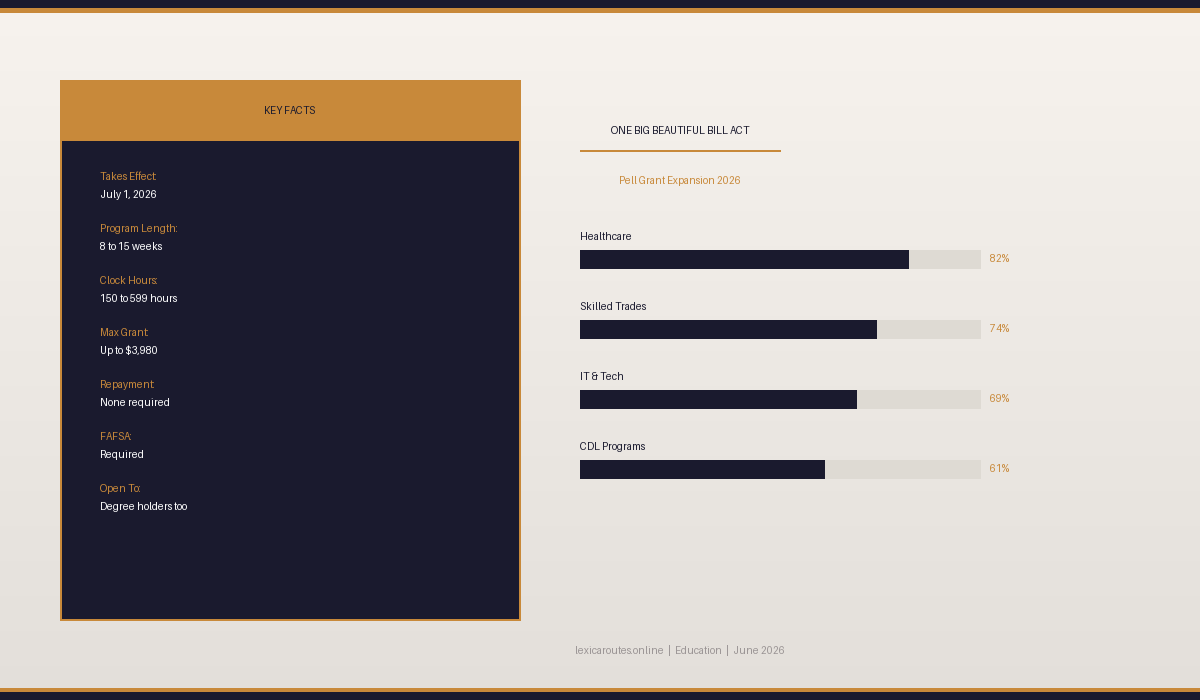
The new law changes that entirely. Starting July 1, 2026, programs between 150 and 599 clock hours that can be completed in as little as 8 to 15 weeks may become eligible for Workforce Pell Grants for the first time.
The U.S. Department of Education issued a Notice of Proposed Rulemaking in March 2026 to establish the new program, describing it as a key provision that will enable students to use federal grant funds to enroll in high-quality, short-term programs offering education in high-skill, high-wage, or in-demand sectors.
Why It Matters
This is not a minor update. It is the most significant expansion of federal student aid eligibility in generations. Before this bill passed, Pell Grants could only be used for programs that are at least 600 clock hours and 15 weeks long, meaning many high-quality short-term training programs designed to quickly prepare students for in-demand jobs were excluded entirely.
The programs most likely to qualify include entry-level healthcare roles such as certified nursing assistants and phlebotomists, commercial driver’s license programs, welding, industrial maintenance, and IT certifications.
The Congressional Budget Office projects that the program could support roughly 100,000 new learners over the next decade, with an average grant of approximately $2,200.
Importantly, unlike student loans, this money does not need to be repaid. The explicit goal is keeping students out of debt for credentials that lead to work quickly.
One key detail many students will miss: unlike traditional Pell Grants, which are available only for undergraduate students who have not yet received a bachelor’s or professional degree, Workforce Pell Grants may be available to students who already have undergraduate degrees. That opens the door for career changers returning to shorter programs later in life.
What Students Should Know Before Enrolling
Not every short program will qualify automatically, and students need to understand what to look for before committing.
Program length: Programs must be between 150 and 599 clock hours and between 8 and 15 weeks.
Governor approval is required: Each program must receive sign-off from the state’s governor in consultation with the state workforce board. This links eligible programs to verified labor market needs in your state.
Accountability benchmarks apply: Programs must demonstrate at least 70% completion and 70% job placement within six months, and show that tuition costs do not exceed the earnings gains students realize within three years.
Your lifetime Pell limit is affected: Under the Higher Education Act, students have a lifetime limit of roughly six academic years of Pell eligibility. Workforce Pell Grants count toward students’ lifetime allotment, so students who use Pell for a short-term credential will have fewer semesters of eligibility available should they choose to pursue a degree later. Think carefully before drawing down this benefit.
FAFSA is still required: Student eligibility will be similar to the existing Pell Grant program. Students will have to fill out a FAFSA and eligibility will be tied to income.
Grant amounts are prorated: Students getting Workforce Pell Grants will receive less money than a typical Pell Grant because they are in shorter programs. Per a Department of Education analysis, students could receive up to $3,980, depending on the length of the program and how many hours of instruction students receive in that time.
Key Facts
| What | Workforce Pell Grant expansion |
|---|---|
| When it takes effect | July 1, 2026 |
| Who qualifies | Low-to-moderate income students, including degree holders |
| Program length | 8 to 15 weeks (150 to 599 clock hours) |
| Maximum grant amount | Up to $3,980 (prorated) |
| Repayment required | No |
| FAFSA required | Yes |
What Comes Next
The law authorizing Workforce Pell is scheduled to go into effect July 1, but that does not mean students will start receiving money right away. Schools will have to get approval from both the state and federal governments that their proposed program meets all the requirements before students can access funding. Actual rollout at many institutions may land closer to fall 2026 or spring 2027.
Governors must work with state workforce boards, higher education agencies, and employers to build the necessary approval processes and data systems.
For students, the practical step now is to identify programs at accredited community colleges and trade schools in your state that are pursuing governor approval, and to confirm FAFSA eligibility ahead of enrollment. Review program outcomes data on the College Scorecard, check official rules at the U.S. Department of Education, and read the student protections framework from The Institute for College Access and Success.
Final verdict
The Workforce Pell 2026 expansion is a genuine shift in how federal aid works. For working adults, career changers, and anyone who needs a faster, cheaper route into a well-paying field, this is the most important financial aid development in years. But students must approach it carefully: check that a program is governor-approved, understand how it affects your lifetime Pell eligibility, and verify completion and employment outcomes before enrolling. The money is real, the opportunity is significant, and the quality will vary.
Frequently Asked Questions
What is a Workforce Pell Grant in 2026?
A Workforce Pell Grant is a new form of federal financial aid available starting July 1, 2026, that allows eligible students to use Pell funds for short-term, career-focused training programs lasting between 8 and 15 weeks. It was created under the One Big Beautiful Bill Act signed in 2025.
Who is eligible for a Workforce Pell Grant?
Eligibility follows standard Pell Grant income requirements and requires a completed FAFSA. Unlike traditional Pell Grants, Workforce Pell is also open to students who already hold a bachelor’s degree, making it accessible to career changers returning to shorter programs.
How much money can students receive from a Workforce Pell Grant?
The grant is prorated based on the length of the program. Students can receive up to $3,980 depending on instructional hours. This is less than the standard Pell maximum of $7,395 because programs are shorter.
Does a Workforce Pell Grant need to be repaid?
No. Like traditional Pell Grants, Workforce Pell does not require repayment. It is a federal grant, not a loan. However, it counts toward a student’s lifetime Pell eligibility limit of approximately six academic years.
Will Workforce Pell Grants be available at all colleges from July 2026?
Not immediately. Programs must receive governor approval and meet federal accountability benchmarks before students can access funding. Full rollout at most schools is expected by fall 2026 or spring 2027.