If you are weighing up whether to spend three or four years of your life and a significant amount of money on a university degree, you deserve a straight answer. Not a motivational poster. Not a recruiter’s pitch. Just honest data. Here is what the numbers actually say about whether a university degree is worth it in 2026, who it works for, and where the real risks lie.
What the Latest Data Shows About Degree ROI
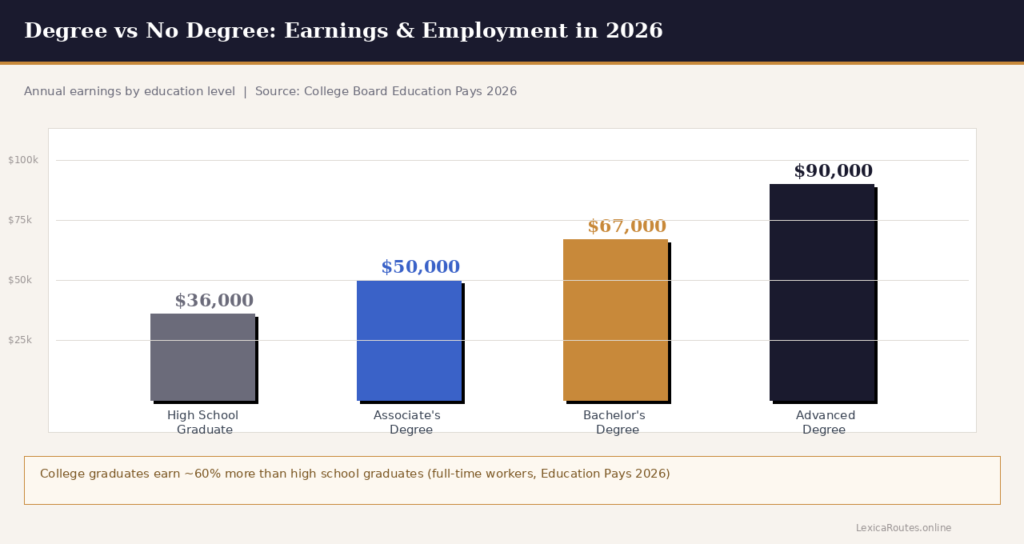
The College Board’s Education Pays 2026 report, published in April 2026, is the most comprehensive look at higher education returns available right now. The headline finding is clear: full-time working adults with a four-year degree earn around 60% more than those with only a high school diploma.
That translates to a meaningful income gap. Workers with a bachelor’s degree bring in a median of around $80,000 annually, compared to roughly $47,000 for high school graduates, according to analysis from Transylvania University drawing on Bureau of Labor Statistics data.
The Federal Reserve Bank of New York puts the average return on a college degree at around 12.5%, which outperforms many long-term investments. And according to the College Board’s Education Pays 2026 report, the typical graduate recoups the total cost of their degree by their mid-30s, often earlier if they received financial aid.
On the employment side, the unemployment rate for degree holders aged 25 to 34 was 3.1% in 2025, compared to 5.8% for those without a degree. Among mid-career adults aged 35 to 44, 40% of bachelor’s degree holders and 58% of those with advanced degrees earned above $100,000. For high school graduates in the same age group, that figure was just 13%.
Who Benefits Most From a Degree in 2026
The ROI of a degree is not uniform. What you study and where you study it matters as much as whether you go at all.
Major matters more than ever
Early-career graduates in mechanical engineering and computer science fields are earning above $80,000, while performing arts graduates in the same age group earn closer to $44,000. The gap is real, but it narrows over time as experience accumulates and career paths develop.
Completion is the biggest variable
Students who leave university without finishing their degree face the worst of both worlds: student debt without the credential that boosts earnings. The average time to complete a bachelor’s degree has stretched to over five years, up from 4.3 years in 1972. Non-completion remains the single biggest financial risk in higher education.
Institution type shapes outcomes
Colleges with higher graduation rates consistently produce stronger outcomes for their students. The University of North Carolina system, for example, found a median lifetime return of around $500,000 for graduates after accounting for tuition costs, based on research conducted with the Burning Glass Institute.
The Case Against a Degree in 2026
None of this means a degree is the right choice for everyone. There are legitimate reasons to pause.
The average investment to earn a bachelor’s degree, including tuition, fees, and lost potential earnings during study, sits at roughly $273,000, according to analysis by Education Data. That is a serious commitment, and not every pathway delivers the same return.
Artificial intelligence is genuinely reshaping entry-level work. Tasks that once helped new graduates build experience, such as report writing, data analysis, and basic coding, are increasingly automated. This does not make a degree less valuable, but it does mean graduates need more than their diploma. Employers in 2026 consistently rank communication, critical thinking, and teamwork above technical skills alone when evaluating new hires.
Trade and vocational qualifications are also delivering strong returns in this market, particularly in skilled trades, healthcare support, and infrastructure roles. A microcredential or professional certification in the right field can outperform a general degree, particularly in the short to medium term.
Pros and Cons
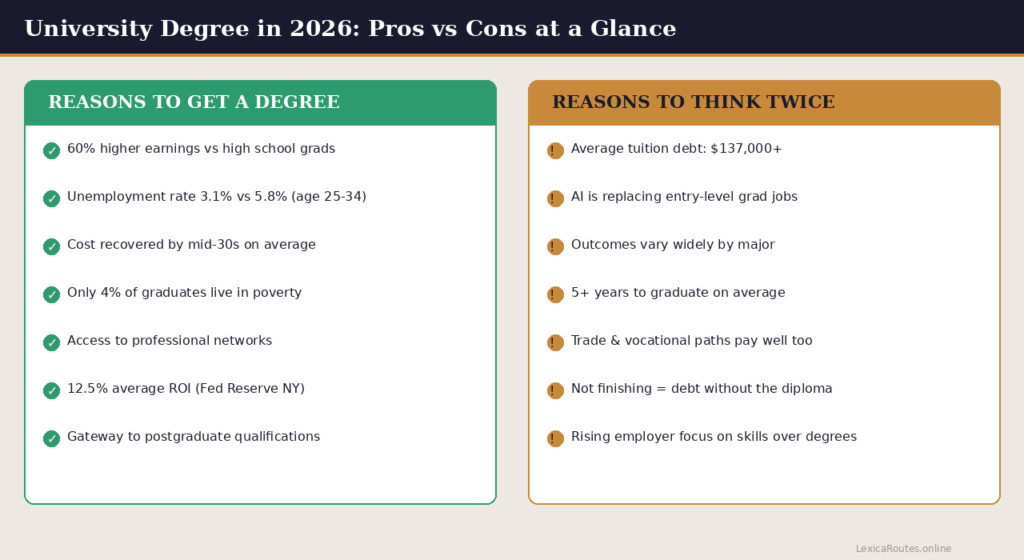
| Pros of Getting a Degree | Cons to Consider |
|---|---|
| 60% higher earnings vs high school graduates | Average investment over $273,000 including lost income |
| Unemployment rate 3.1% vs 5.8% without a degree | AI replacing many traditional entry-level roles |
| Cost recovered by mid-30s on average | Outcomes vary significantly by major and institution |
| Only 4% of graduates live in poverty vs 13% without | Average graduation takes 5+ years |
| 12.5% average ROI per Federal Reserve Bank of NY | Not finishing = debt without the diploma |
| Opens door to postgraduate qualifications | Strong alternatives exist: trade, vocational, microcredentials |
External Source Spotlight
According to APLU research drawing on data from over 30 million students, median lifetime earnings are $1.2 million higher for bachelor’s degree holders compared to those whose highest qualification is a high school diploma. That is a figure that holds across decades of data, not just the current moment.
Final Verdict
For most students, a university degree is still worth it in 2026. The earnings premium is real, the employment advantage is real, and the lifetime returns hold up under scrutiny. But the keyword is most. A degree at a high-graduation-rate institution, in a field with clear career alignment, completed on time, delivers strong ROI. A degree from a low-completion institution, in a vague field, with no work experience built alongside it, is a much weaker bet.
The honest answer is not “yes, always” or “no, the system is broken.” It is: a degree is worth it when it is chosen deliberately, supported properly, and matched to your actual goals. If you are weighing your options, also read our guide to microcredentials vs degrees in 2026 before making your decision.
Frequently Asked Questions
Is a university degree still worth it in 2026?
For most students, yes. Full-time workers with a four-year degree earn around 60% more than high school graduates, and the typical graduate recoups the cost of their degree by their mid-30s. However, outcomes depend heavily on what you study, where you study, and whether you complete the degree.
What is the average return on investment for a university degree in 2026?
The Federal Reserve Bank of New York estimates the average ROI for a bachelor’s degree at around 12.5%, which outperforms many traditional long-term investments. Over a career, bachelor’s degree holders typically earn $1.2 million more in lifetime earnings than those without a degree.
Is it better to get a degree or a microcredential in 2026?
It depends on the field and your goals. Microcredentials and vocational qualifications deliver strong short-term returns in trades, healthcare, and tech roles. Degrees remain the stronger long-term investment for careers in business, law, medicine, and research, particularly when the degree is from a high-completion-rate institution.
What happens financially if you drop out of university?
Dropping out is the worst financial outcome in most cases. You may carry student debt without the credential that raises earning potential. The College Board’s data shows that completion is the single biggest predictor of strong financial returns from higher education.
Which university degrees have the best earnings in 2026?
STEM fields consistently lead. Early-career graduates in mechanical engineering and computer science earn above $80,000. Health sciences and business also perform strongly. Performing arts and some humanities fields start lower but often close the gap significantly by mid-career.