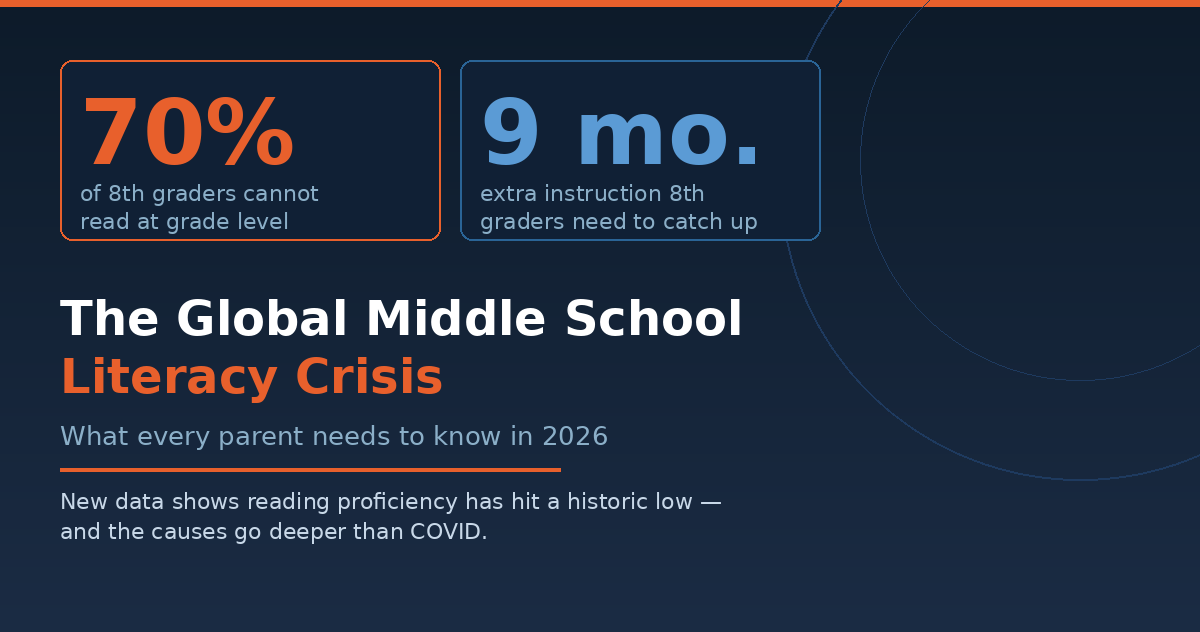
If your child is in middle school right now, the middle school literacy crisis 2026 data should be on your radar — and not because it is alarmist, but because it is real and verifiable. According to the 2024 National Assessment of Educational Progress (NAEP), 70% of 8th graders in the United States are reading below the proficient level. That is not a new problem caused by a single bad year. It is the result of decades of underinvestment in adolescent reading instruction, compounded sharply by pandemic-era disruptions. This article breaks down what the data actually says, what drove us here, and what parents can realistically do about it today.
What the 2026 Data Is Actually Telling Us
The numbers out of the most recent national assessment are difficult to spin. The 2024 NAEP results show that only 30% of 8th graders read at or above proficiency, a figure that represents decades of stagnation. The data goes further. Research from NWEA confirms that 6th graders currently need nearly five extra months of reading instruction to reach pre-pandemic levels, 7th graders need close to seven months, and 8th graders need almost a full additional year of targeted support to close the gap. These are not marginal shortfalls. They represent students entering high school without the reading tools they need to access science, history, or even complex math problems.
The crisis is not uniquely American either. A World Bank report from late 2025 confirmed that low literacy rates among adolescents are a worldwide challenge, with low- and middle-income countries facing the steepest obstacles. Even in wealthy nations, the data trends are moving in the wrong direction. Graduating seniors in the US are reading at their lowest level in 30 years, according to reporting from the New York Times in late 2025, and students themselves say they are aware of the decline and concerned about it.
Why This Crisis Runs Deeper Than COVID
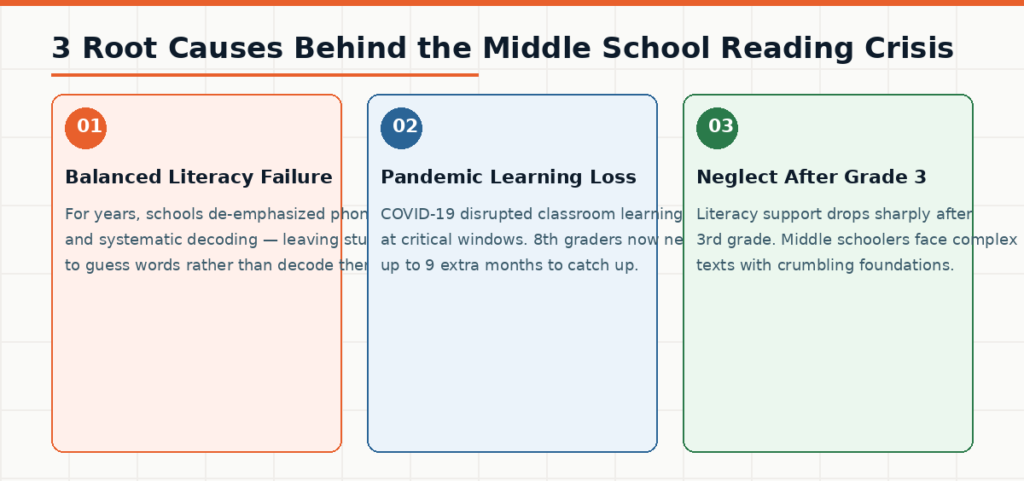
It is tempting to trace everything back to school closures and remote learning. The pandemic unquestionably made things worse, particularly for younger students who were in critical early literacy windows during 2020 and 2021. Those children are now in middle school. In high-poverty schools, reading score declines during the pandemic were 2.5 times larger than in low-poverty schools, according to NWEA data, meaning the crisis is landing hardest on the students who already had the fewest resources.
But the roots go back further. For years, a teaching philosophy known as balanced literacy dominated elementary schools across the country. While well-intentioned, this approach emphasized exposing children to rich literature rather than explicitly and systematically teaching phonics, phonemic awareness, and decoding skills. The science of reading has since made clear that structured, explicit phonics instruction is what actually produces fluent readers. Many students who appeared fine in early elementary school hit a wall in middle school when texts became more complex and their underdeveloped decoding skills could no longer carry them. Around 40% of teachers in grades 3 through 8 still misunderstand how word-reading develops, and many rely on personal instinct rather than research-backed methods.
The Warning Signs Parents Often Miss
One of the reasons the crisis deepens quietly through middle school is that older students become skilled at hiding their struggles. They develop compensation strategies: skimming, guessing from context, avoiding reading altogether, or deflecting with classroom behavior. Teachers often do not identify the problem until a student can no longer demonstrate comprehension of grade-level texts.
Parents are not always given the information they need to catch it early. Adolescent literacy policies that require schools to screen students and notify families about reading deficiencies are not universal. Without that transparency, a parent may not realize their 7th grader is functioning two years below reading level until the consequences have already compounded across multiple subjects.
What Schools Are Starting to Do About It
Some states are taking meaningful action. Indiana passed a comprehensive adolescent literacy law in 2024 that extends targeted reading support through grade 8, requires parent notification when students fall behind, and mandates district-level annual reporting. These accountability structures matter because they force the kind of transparency that has been missing for years.
Across the country, school leaders are moving toward structured literacy instruction — an evidence-based method aligned with the science of reading that covers phonemic awareness, phonics, fluency, vocabulary, and comprehension in a systematic way. Research consistently shows that 95% of students can learn to read when given proper structured literacy instruction. The challenge is retraining thousands of teachers who were taught under the balanced literacy model and who need not just new techniques but genuine professional development and ongoing support.
The NWEA released a policy report in July 2025 warning of the growing middle school reading crisis and calling for high-dose interventions: small group instruction, differentiated support, and repeated practice at appropriate reading levels. District leaders in Denver, Salinas, and Hampton County have begun implementing these approaches with early promising results.
What Parents Can Do Right Now
Parents are not powerless here. Experts at K-12 Dive and the Education Development Center are clear: parent involvement matters at the middle school level, even when teenagers push back against it. Here is what research supports:
Ask your child’s school directly what literacy screening has been done and what their current reading level is. You are entitled to this information, and in states with adolescent literacy policies, the school is required to share it. If your child is falling behind, ask what specific interventions are in place, who is delivering them, and how progress is being tracked.
At home, the single most impactful thing parents can do is help their child rebuild a connection to reading by tying it to their genuine interests. A student who resists every assigned text may read voraciously about gaming, sports, fashion, or true crime. Content area reading — even outside school — builds vocabulary and comprehension. Talking to your teen about what they read, asking one question about their day’s texts, and normalizing the idea that reading is a skill you keep developing rather than one you either have or do not have makes a measurable difference over time.
Key Facts: Middle School Literacy Crisis 2026
| What | Detail |
|---|---|
| What happened | 2024 NAEP data confirmed 70% of 8th graders read below proficiency |
| Who is affected | Middle school students globally, with greatest impact on low-income students |
| When it reached crisis point | Long-building trend sharpened by COVID-era disruptions in 2020-2021 |
| What the gap looks like | 8th graders need up to 9 extra months of instruction to reach pre-pandemic levels |
| Where reform is happening | Indiana, several other states with new adolescent literacy legislation |
| What parents can do | Ask schools for screening data, encourage interest-led reading at home |
The middle school literacy crisis in 2026 is not a new problem that appeared overnight. It is the accumulated result of decades of misaligned reading instruction, compounded by pandemic disruptions, and only now receiving the policy attention it has long needed. The data is clear, the causes are understood, and the solutions — structured literacy, screener-based identification, and strong family involvement — are available. The gap between knowing what works and implementing it at scale is the real challenge. For parents, the most urgent step is not waiting for schools to flag a problem: ask, advocate, and stay involved. For students currently in middle school, catching up is possible with the right support in place.
If you want to understand how school-level decisions shape your child’s academic future, read our guide to how phone bans in schools are changing classroom learning in 2026.
Frequently asked questions
How many middle school students cannot read at grade level in 2026?
According to the 2024 National Assessment of Educational Progress, 70% of 8th graders in the United States are reading below the proficient level. That means only 3 in 10 eighth graders can read at the standard expected for their grade. The numbers have remained largely stagnant since the 1990s, with a sharp worsening following the COVID-19 pandemic.
Is the middle school literacy crisis only a US problem?
No. A World Bank report published in late 2025 confirmed that low adolescent literacy rates are a global challenge, particularly acute in low- and middle-income countries. Even in wealthier nations, national reading scores are declining. Graduating seniors in the US are reading at their lowest level in 30 years according to reporting from late 2025, and similar patterns are documented across Europe and Australasia.
What caused reading skills to drop in middle school students?
The decline has multiple causes. For decades, many schools used a balanced literacy approach that de-emphasized systematic phonics instruction, leaving students without strong decoding skills. The COVID-19 pandemic then disrupted critical learning windows. Students who were in early elementary school during 2020 and 2021 are now in middle school and carrying significant reading gaps. Around 40% of teachers in grades 3 through 8 also misunderstand how word-reading develops, relying on methods not backed by the science of reading.
How can I tell if my child has a literacy problem in middle school?
Warning signs include avoiding assigned reading, guessing at words from context rather than decoding them, struggling to keep up across subjects like science and history, and showing frustration or disengagement with schoolwork. Ask your child’s school directly what literacy screening they conduct and what your child’s current reading level is. Many states now require schools to notify parents when students fall below grade-level reading benchmarks.
What actually works to help middle school students catch up with reading?
Research points to structured literacy instruction, which covers phonics, phonemic awareness, fluency, vocabulary, and comprehension in an explicit and systematic way. At home, connecting reading to your teenager’s genuine interests helps rebuild motivation. Schools implementing small-group, high-dose intervention programs based on NWEA guidance have shown early improvements. The most important factor is early identification: the sooner a gap is caught, the faster it can be closed.
You might also like