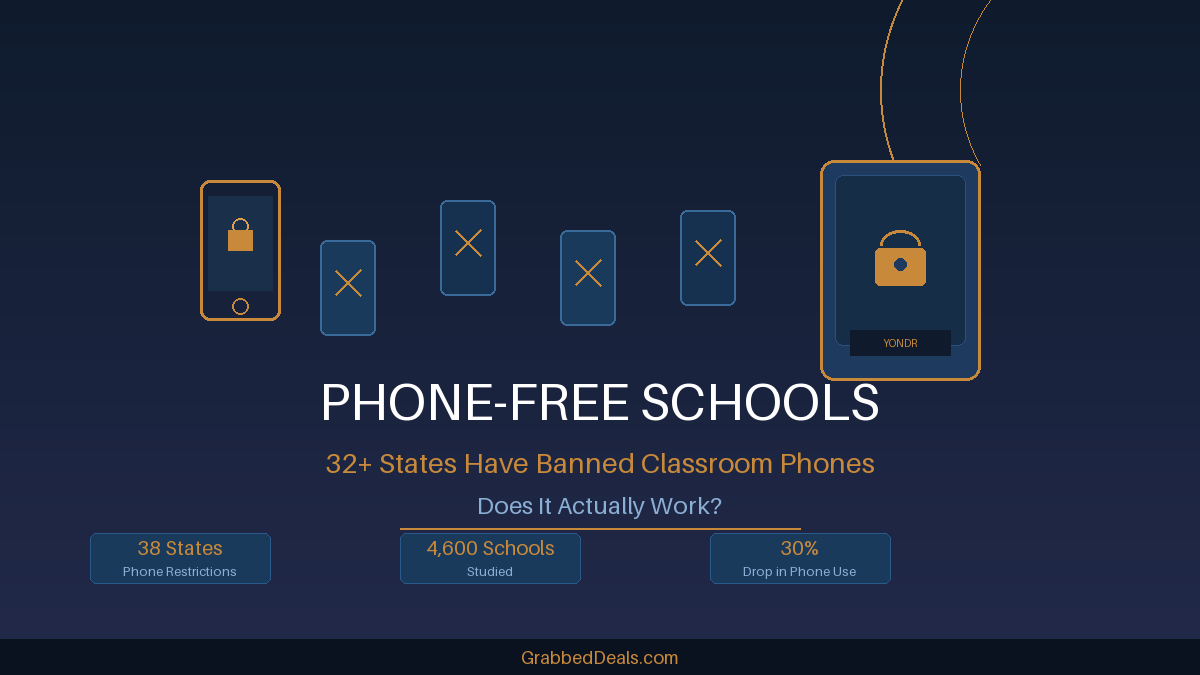
Your child’s school may have just banned phones. Or maybe it is about to. Either way, you have probably heard the claims: fewer distractions, better grades, healthier kids. But what does the evidence actually say? As more than 32 states now have some form of classroom phone restriction or ban in place, a landmark study published in May 2026 by researchers at Stanford, Duke, the University of Michigan, and the University of Pennsylvania has finally given us the most comprehensive look yet at whether phone bans deliver on their promise. The results are more complicated than the headlines suggest, and every parent, teacher, and administrator deserves to understand them clearly.
How We Got Here
Phone bans in schools did not appear overnight. Florida became an early mover in 2023 by restricting classroom phone use, and other states quickly followed. Fast forward to mid-2026, and the movement has become one of the most bipartisan education policies in recent memory. Republican and Democratic governors alike have signed phone restriction bills into law, a rare alignment that speaks to how widely the issue resonates with voters and parents.
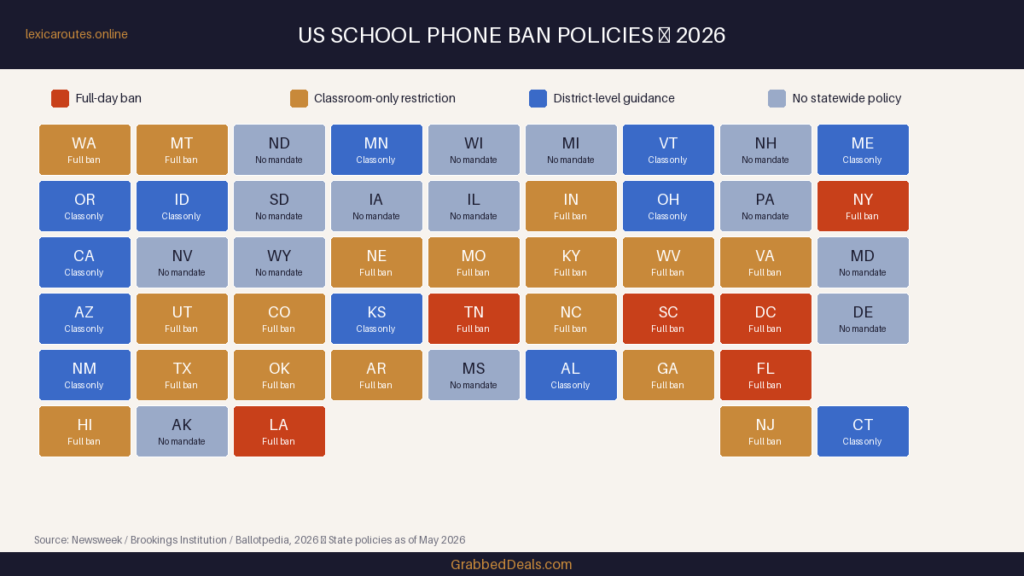
The numbers are striking. As of early 2026, at least 38 states and Washington D.C. have enacted statewide restrictions or directed districts to curb student phone use in schools. Some states have opted for full-day bans, prohibiting devices from the moment a student walks through the school gate until the final bell. Others restrict use only during instructional time. A smaller group, including Alabama, Idaho, and Connecticut, issue guidance that encourages districts to set their own policies rather than mandating a statewide rule.
The driving force behind the push is not just academic distraction. The U.S. Surgeon General’s advisory linking social media to the youth mental health crisis gave legislators a compelling public health angle. Schools found themselves positioned not just as education providers, but as frontline defenders of adolescent wellbeing.
Key Findings: What the 2026 Research Tells Us
The biggest study ever conducted on school phone bans landed in May 2026, and its findings deserve a careful read rather than a quick headline.
Researchers at Stanford, Duke, the University of Michigan, and the University of Pennsylvania analyzed data from approximately 4,600 schools over seven years. Crucially, they used data from Yondr, the company behind lockable phone pouches used in thousands of schools. This approach gave the study something that previous research lacked: actual confirmation that phones were being kept away, not just policies promising they would be.
The headline finding is that phone bans produced no meaningful net change to test scores. Schools that locked phones away saw no measurable improvement in math or reading results. The bans also did not move the needle on bullying rates, classroom attendance, or self-reported attention levels. That is a sobering outcome for policymakers who invested in phone-free policies specifically to boost academic performance.
However, the picture is not all negative. Schools using lockable pouches did see phone usage on school grounds drop by 30% within the third year of implementation. Teachers consistently reported fewer distractions in the classroom. And over a longer time horizon, two trends emerged that offer some reason for cautious optimism. In the first year of a ban, student wellbeing scores dropped and disciplinary rates rose, suggesting a difficult adjustment period. But by the third year, both indicators had returned to or exceeded their baseline levels.
Who Benefits Most and Who Struggles
The research reveals a meaningful divide by school level. High schools saw slightly positive effects from phone bans, while middle schools showed slightly negative outcomes in the same period. Researchers cautioned that these differences may reflect how students at different developmental stages respond to device restrictions.
For teachers, the relief is real. A 2024 Pew Research Center survey found that around 72% of high school teachers described student phone use as a major problem in their classrooms, a figure that makes the teacher-reported improvement in focus one of the most consistent findings across studies. Schools in districts that have held firm on enforcement for multiple years report the strongest results, suggesting that consistency matters more than the specific policy design.
Parents are broadly supportive. A recent NBC News poll found that 79% of adults support smartphone restrictions in schools. A Pew Research Center study from 2025 showed that 75% of U.S. adults back banning phone use during class in middle and high schools, up from 68% just months earlier.
The main concern raised by critics is emergency safety. If a student cannot reach a parent during a crisis, parents argue, the ban creates a genuine risk. Supporters counter that during emergencies, schools want students following adult instructions, not scrolling through notifications.
Pros and Cons Table
| Pros | Cons |
|---|---|
| Teachers report significantly fewer classroom distractions | No measurable short-term improvement in test scores |
| 30% drop in in-school phone use within 3 years (Yondr data) | Student wellbeing dips in year one of implementation |
| Long-term wellbeing and discipline rates improve | Enforcement is difficult and inconsistent in many schools |
| Bipartisan political support makes policies durable | Parents worry about emergency communication with children |
| Strong public and parental backing (75-79% approval) | Middle schools show slightly negative early outcomes |
How Schools Are Implementing Bans
The “how” matters as much as the “whether.” Schools with no-show policies, meaning students are told to keep phones in bags but there is no enforcement mechanism, consistently underperform in research compared to schools using physical containment solutions like lockable pouches.
Yondr pouches are the most widely documented tool. Students seal their phone in a magnetically locked pouch at the start of the school day and unlock it at a station near the exit when school ends. The system removes ambiguity and takes enforcement off teachers’ plates, which is one reason 72% of high school teachers previously said enforcing phone policies was their most challenging aspect of the rule.
Several states are funding implementation. New York allocated $29 million for New York City schools alone, working out to $35 per student. New Jersey launched a dedicated Phone-Free Schools Grant program. Federal funding streams including Title I and Title IV-A can also be directed toward phone management tools, which has made the policy more accessible to under-resourced districts.
COMPARISON TABLE
Phone Ban Approaches by State Type
| Approach | States | Key Feature | Best Suited For |
|---|---|---|---|
| Full-day ban | Florida, Louisiana, New York (NYC) | No phones on school grounds all day | Maximum focus, high enforcement |
| Classroom-only ban | California, Arizona, Ohio | Restricted during instructional time | Balanced access vs. focus |
| District-level guidance | Alabama, Idaho, Connecticut | Schools set own rules | Communities wanting local control |
| No statewide policy | Illinois, Maryland, Michigan | Fully local | Districts with existing strong policies |
Our Verdict
The evidence on school phone bans is honest in a way that politicians rarely are. These policies do not produce a quick academic turnaround. Anyone who told parents otherwise was overpromising. What the data does show is something more gradual: a real reduction in classroom distraction, a rough adjustment period for students, and meaningful long-term improvements in wellbeing and behavior when schools hold the line consistently.
If your school has recently introduced a ban, the first year may feel counterproductive. Research suggests that is normal. The payoff, according to the best available evidence, comes in year two and three, not week one.
For parents trying to decide how to feel about their child’s school joining the phone-free movement, the honest answer is this: it is not a miracle cure, but it is unlikely to make things worse and may make the school environment meaningfully calmer over time.
Read our guide to the best EdTech apps for kids in 2026 to find digital learning tools that schools and parents can use productively outside the classroom.
Frequently asked questions
Do phone bans in schools actually improve grades?
Based on the largest study to date, published in May 2026 by researchers at Stanford, Duke, the University of Michigan, and the University of Pennsylvania, phone bans have not produced measurable improvement in test scores in the short term. The study analyzed data from approximately 4,600 schools over seven years and found no significant net change in math or reading results after a ban was introduced.
How many states have banned phones in schools in 2026?
At least 38 states and Washington D.C. have enacted some form of statewide restriction on student phone use as of 2026. The specific approach varies widely: some states have full-day bans, others limit use only during instructional time, and some issue guidance that allows districts to set their own rules. Over 30 states had policies in place by early 2026, with more restrictions coming into effect throughout the year.
What is a Yondr pouch and does it work?
A Yondr pouch is a magnetically sealed bag that students place their phones in at the start of the school day. The phone is locked inside and can only be unsealed at a special unlocking station, usually placed near the school exit. Research using Yondr data found that schools using the system saw in-school phone usage drop by 30% within three years, making it one of the more reliably enforced phone restriction tools available.
Are there safety concerns with banning phones in schools?
Yes, and this is the most debated aspect of phone ban policies. Critics argue that students may need to contact parents or emergency services and that removing phone access creates a safety risk. Supporters counter that during emergencies, students should be following staff instructions rather than using personal devices, and that schools have other communication channels in place. Most policies include exceptions for students with medical needs or IEPs.
What do parents think about school phone bans?
Support among parents is high. A 2025 Pew Research Center study found that 75% of U.S. adults support banning phone use during class in middle and high schools, up from 68% just months earlier. A separate NBC News poll found that 79% of adults back smartphone restrictions in schools broadly. Despite this strong public backing, parents remain divided on full-day bans versus classroom-only restrictions.






1 comment