Teacher burnout is no longer a quiet issue that educators talk about in staffrooms. In 2026, it has become one of the most documented crises in public education, with the data to match. More than half of the teaching workforce is affected, classrooms are feeling the impact, and school districts across the country are under real pressure to act before the shortage deepens further.
Here is what the latest research shows, what is driving the problem, and what schools are actually doing about it now.
How Bad Is Teacher Burnout in 2026?
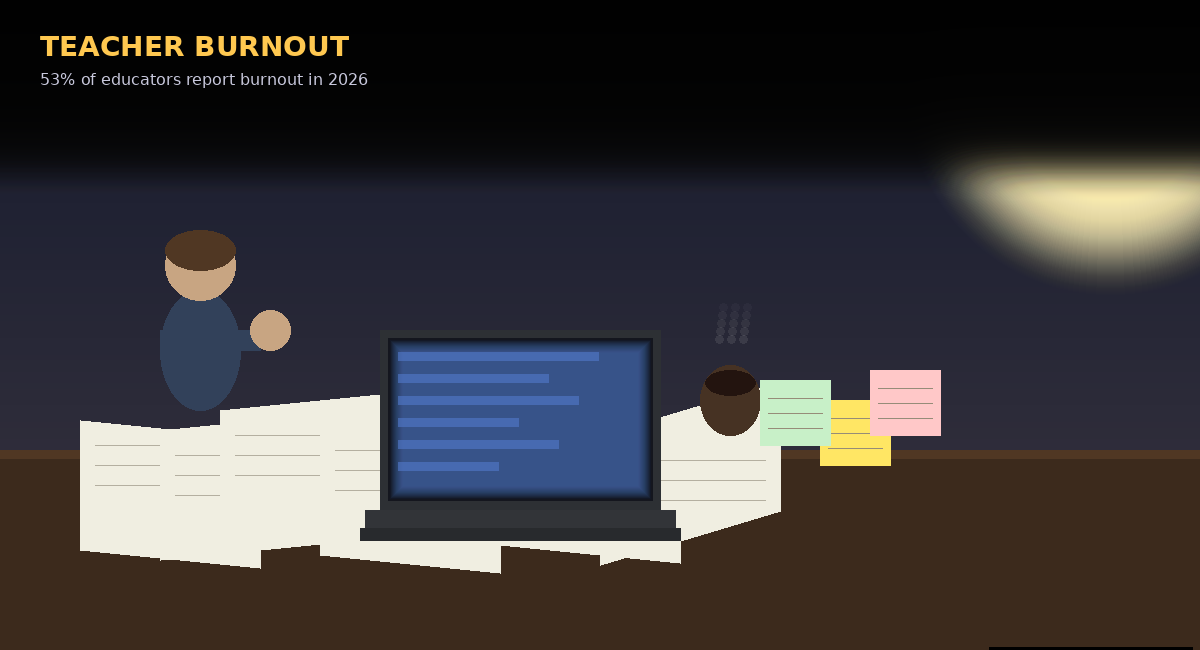
According to the RAND Corporation’s 2025 State of the American Teacher survey, 53% of K-12 teachers reported feeling burned out. That figure is down slightly from 60% in 2024, but it still means the majority of the profession is struggling. Female teachers are disproportionately affected, with rates consistently above 60%, and Black and Hispanic teachers report burnout at 58 to 59%.
The financial cost alone makes this a school district emergency. Research by the Learning Policy Institute puts the cost of replacing a single teacher at between $11,860 and $24,930, depending on district size. Nationally, teacher turnover costs school systems an estimated $2.2 billion per year. That figure doesn’t even account for the dip in student performance that consistently follows high-turnover periods.
New teachers are leaving the fastest. An Education Resource Strategies analysis found that 30% of first-year teachers left their school in the 2022 to 2023 school year alone. For many districts, the pipeline is emptying faster than it can be refilled.
What Is Driving Educator Burnout Right Now?
The causes are well-documented and remarkably consistent across surveys and studies. Teachers are not burning out for one reason. They’re burning out because multiple pressure points have compounded at the same time.
Workload beyond the classroom. The average teacher now works 49 hours per week, which is 10 hours above their contracted hours. Much of that extra time goes to administrative tasks, coverage duties, and paperwork that pulls them away from actual teaching. A Gallup and Walton Family Foundation survey found that teachers using AI tools weekly gained nearly six extra hours back per week. That figure reveals just how heavy the administrative burden has become.
Pay that doesn’t reflect the job. The average teacher base salary in 2025 was $73,000, with teachers in states without collective bargaining earning an average of $60,300. More than half of teachers in those states received no pay increase in the 2024 to 2025 school year. In practice, many teachers are funding classroom supplies out of their own pockets and working second jobs to cover living costs.
Student behaviour and mental health. The Pew Research Center reports that half of all teachers surveyed rated classroom behaviour as fair or poor. In addition, 48% of teachers say their students are affected by anxiety and depression. Teachers have increasingly been pushed into counselling roles they were never trained for, while school counsellor shortages mean that support infrastructure is thin.
Staffing gaps that create a cycle. Across the country, 86% of school districts report open positions, and 57% of schools in high-poverty areas are understaffed. When a colleague leaves, remaining staff absorb the workload, which accelerates their own path toward burnout.
What Schools Are Actually Doing About It
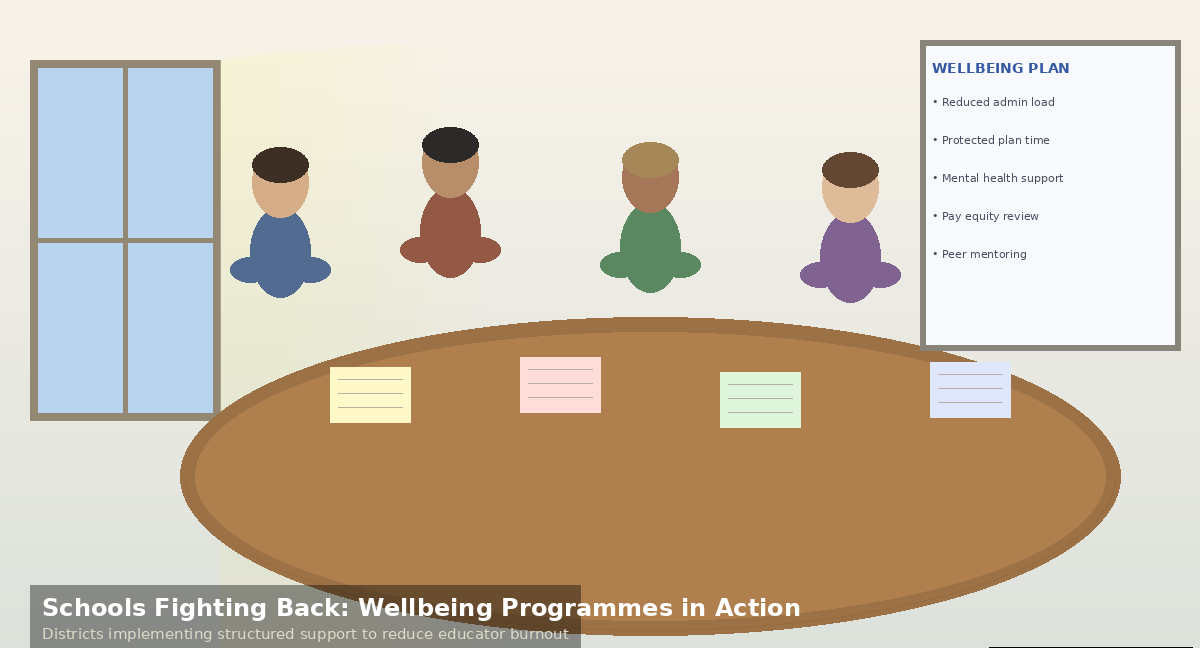
The good news is that awareness has translated into action in a growing number of districts. The interventions that are working share a common thread: they address structural problems rather than offering individual coping strategies.
Reducing the Administrative Load
Research from the Learning Policy Institute is clear that the single most effective action schools can take is reducing the non-teaching workload. Some districts are hiring dedicated administrative support staff so that teachers are not the default person for every task. Others are piloting AI-assisted lesson planning, where early results show teachers cutting Sunday planning sessions from three hours to under 45 minutes.
Protected Planning Time and Flexible Schedules
One of the most consistent complaints in teacher surveys is that planning periods are not actually protected. Teachers are routinely pulled to cover other classes or attend unscheduled meetings. Districts that have hired permanent floating substitute teachers report improvements in teacher morale and retention, because regular staff are no longer on constant standby.
RAND’s 2025 data found that 46% of teachers cannot enjoy their private life compared to 13% of comparable working adults. Some districts are now offering flexible scheduling models, including job sharing and team teaching arrangements, to address this gap.
Mental Health and Peer Support Programmes
Programmes like the Healing Schools Project, which emerged during the pandemic, work directly with school districts to provide educator wellbeing support through healing circles, leadership training, and retreats. Around 3,000 educators have worked with the organisation so far. The model is built on the idea that psychological safety for teachers translates directly into more stable classrooms for students.
Districts are also rolling out Employee Assistance Programmes that go beyond generic counselling referrals. The focus has shifted toward normalising mental health conversations at the leadership level and providing practical, accessible support early, before exhaustion reaches a crisis point.
Pay and Recognition Reforms
Compensation reforms are moving slowly at scale but are gaining ground in individual districts. Some are offering targeted pay increases for hard-to-staff subject areas, including special education, mathematics, and science. The Hawaii Department of Education, for example, offers a $10,000 annual bonus for special education teachers. Recognising staff achievements through awards programmes and public community acknowledgements has also been shown to improve morale and retention without requiring large budget increases.
Key Facts at a Glance
| Metric | Figure |
|---|---|
| K-12 teachers reporting burnout (2025 RAND data) | 53% |
| Average weekly hours worked | 49 hours |
| Annual national cost of teacher turnover | $2.2 billion |
| First-year teachers who left their school (2022-23) | 30% |
| School districts reporting open positions | 86% |
| Teachers who wouldn’t advise others to join the profession | 52% |
Final verdict
Teacher burnout in 2026 is a structural problem, not a personal one. The data makes that clear. More than half the teaching workforce is affected, new teachers are leaving within their first year at alarming rates, and the financial cost to school districts is in the billions. But the solutions that work are equally well-documented: protecting planning time, reducing administrative load, investing in mental health support, and paying teachers fairly.
Schools that have committed to these changes are seeing real improvements in retention and morale. The challenge is scaling those changes across an underfunded system where short-term budget pressures often win out over long-term investment in the people who make classrooms work.
Frequently asked questions
What percentage of teachers experience burnout in 2026?
According to RAND’s 2025 State of the American Teacher survey, 53% of K-12 teachers reported feeling burned out very often or always. This is a slight improvement from 60% in 2024, but still represents the majority of the profession. Rates are higher among female teachers and teachers of colour.
What are the main causes of teacher burnout in 2026?
The primary drivers are excessive workload beyond contracted hours, low and stagnant pay, rising student behaviour challenges and mental health needs, and understaffed schools where teachers absorb extra duties. These pressures have compounded since the pandemic and have not fully resolved.
How much does teacher turnover cost school districts?
The Learning Policy Institute estimates that replacing a single teacher costs between $11,860 and $24,930, depending on district size. At a national level, teacher turnover costs school systems an estimated $2.2 billion per year, not including the impact on student achievement.
What are schools doing to address teacher burnout?
Leading districts are reducing non-teaching administrative workload, protecting planning time, introducing flexible scheduling, expanding mental health support through Employee Assistance Programmes, and offering targeted pay increases for hard-to-staff subject areas. Peer support and wellbeing programmes are also gaining ground.
Is teacher burnout affecting student outcomes?
Yes. Research consistently shows that student achievement declines in high-turnover schools. A 2025 study also found that students in classrooms with burned-out teachers showed higher stress hormone levels, suggesting that burnout has a direct physiological impact on the learning environment.