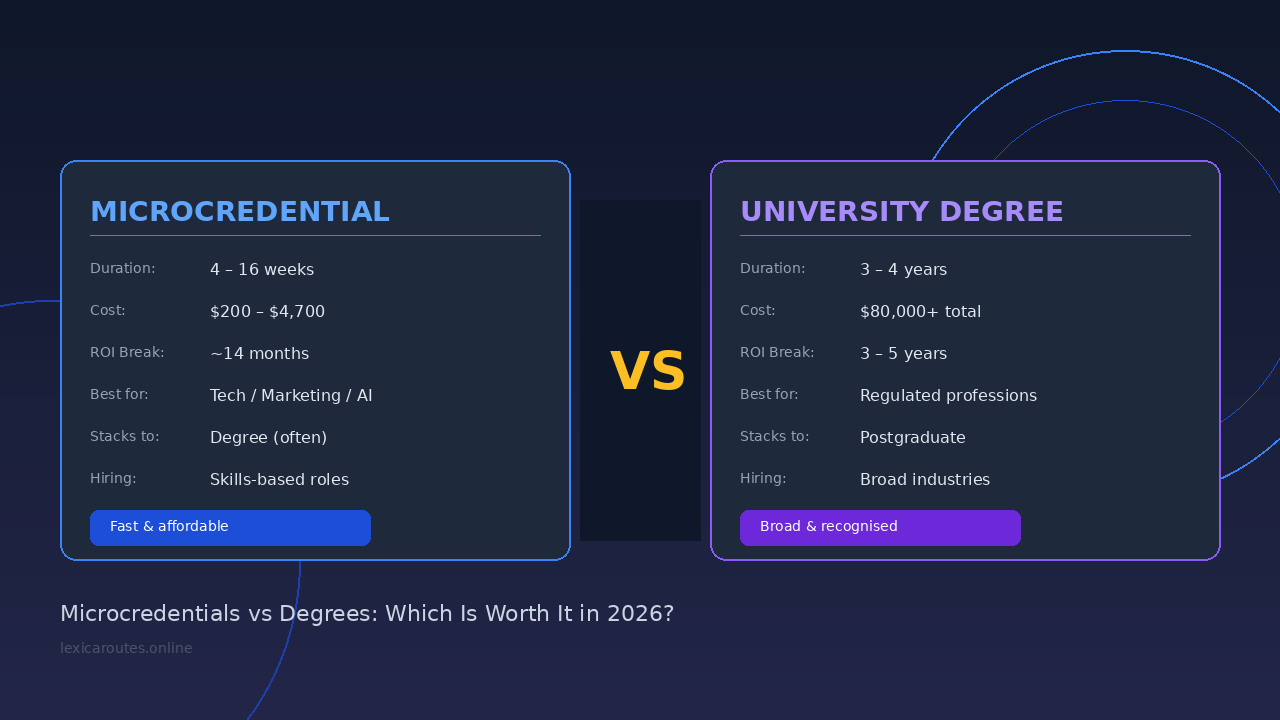
Choosing between a microcredential and a university degree in 2026 is no longer a straightforward decision. Tuition costs are at record highs, the half-life of a technical skill has shrunk to roughly 2.5 years, and employers across the tech, marketing, and data sectors are actively dropping degree requirements from job listings. If you are a student, a career changer, or a working professional weighing your next move, this comparison breaks down exactly what each path offers, where each one falls short, and who should choose which.
What Are Microcredentials, and How Do They Differ from Degrees?
A microcredential is a short, focused program designed to certify competency in a specific skill. Programs range from a few weeks to a few months and typically cost between $200 and $4,700, with an average closer to $1,500 according to recent EdResearcher data. They are delivered online by universities, platforms such as Coursera and edX, and directly by employers like Google, IBM, and Microsoft.
A traditional university degree, by contrast, is a long-form, comprehensive qualification. A bachelor’s degree typically takes three to four years and costs significantly more, with average annual tuition at U.S. public in-state colleges running around $20,800 after financial aid. Degrees cover foundational theory alongside practical knowledge and remain the required qualification for regulated professions such as medicine, law, nursing, and engineering.
The key difference is scope. Degrees signal broad, verified knowledge in a field. Microcredentials signal mastery of a specific, job-ready skill.
Why Microcredentials Are Gaining Ground in 2026
The shift is driven by two forces: employer behaviour and economic pressure.
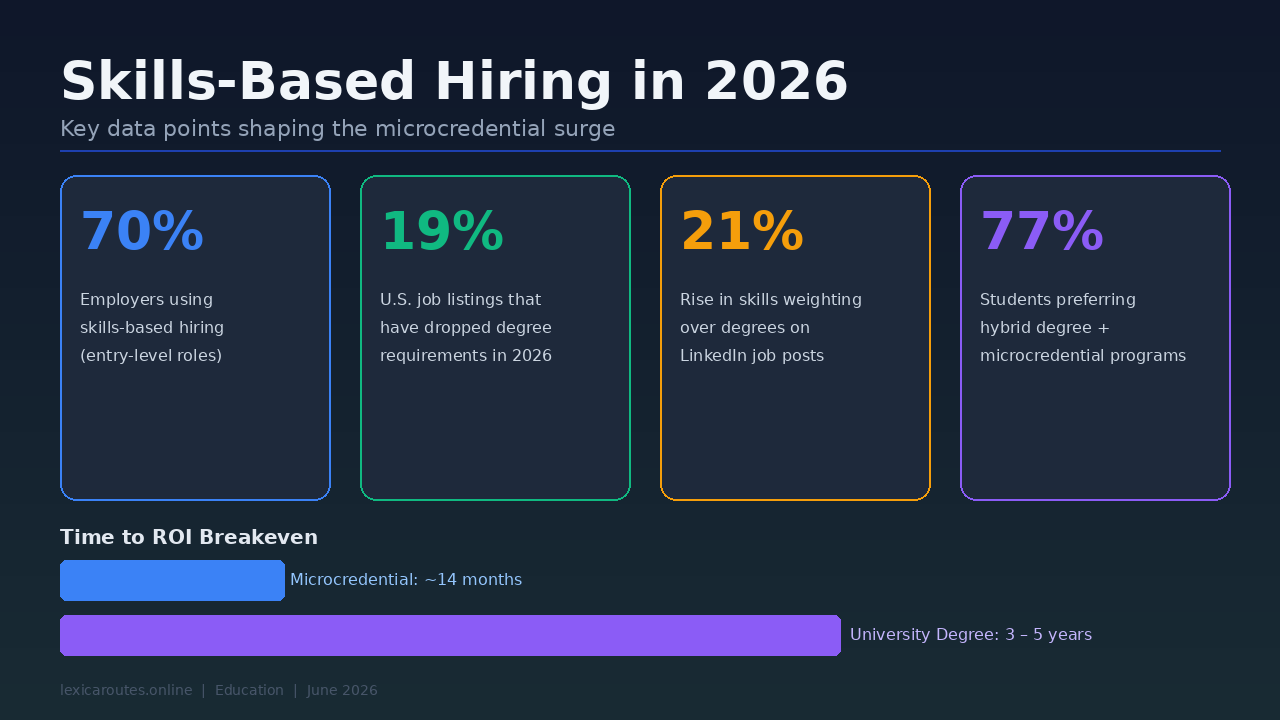
On the employer side, skills-based hiring has accelerated sharply. Around 19% of U.S. job listings have dropped degree requirements, with major tech and retail companies leading that change. A survey by the National Association of Colleges and Employers found that 70% of employers now use skill-based hiring practices for entry-level positions. Coursera CEO Greg Hart, speaking to Fortune in late 2025, confirmed a clear spike in microcredential enrollments as candidates look to stand out in a tightening job market where youth unemployment sits around 9% for the 19 to 24 age bracket.
On the cost side, the return on investment argument has shifted. The breakeven point for a microcredential holder is estimated at around 14 months, compared to three to five years for a traditional graduate. When student loan interest is factored in, the microcredential path can yield a higher net financial position by age 30 in tech-adjacent roles.
LinkedIn data supports this: there has been a 21% rise in the relative weight of skills over degrees in job postings over recent years.
Where Degrees Still Have the Clear Advantage
Microcredentials are not a universal replacement, and the data is clear on this.
Regulated professions require degrees. Fields such as nursing, medicine, law, counselling, and civil engineering are governed by licensing bodies that mandate specific degree qualifications. No microcredential substitutes for a medical degree or a bar admission. If your career path leads into any licensed profession, the degree is non-negotiable.
Degrees still command a salary premium in many sectors. While the gap has narrowed in tech, degree holders across industries still see a marginally lower unemployment rate, and many mid-to-senior management roles list degree attainment as a baseline requirement. For long-term career mobility across sectors, a degree remains the more portable credential.
Employer recognition systems lag behind. Around 32% of HR professionals report that their applicant tracking systems can screen for alternative credentials, according to SHRM research. This means a microcredential may not register in the initial automated filtering stage of a job application, even at companies that claim to value skills over degrees. Candidates need to actively surface their credentials in cover letters and interviews.
Which Is Better for Career Changers and Lifelong Learners?
For professionals already in the workforce, microcredentials offer a clear practical advantage. They allow targeted upskilling without stepping away from employment. Many are available with employer sponsorship, which reduces the out-of-pocket cost to near zero. Fields such as data analysis, digital marketing, project management, cloud computing, and generative AI are particularly well served by the current microcredential market.
The “stackable” credential model also adds flexibility. Many programs, including those offered by MIT through Coursera and by IBM, allow credits to be applied toward larger qualifications over time. This means a learner can start small, validate skills, earn income, and build toward a degree incrementally rather than front-loading all the time and cost.
According to UPCEA research, there are roughly 40 million adults in the U.S. who left college without completing a degree. Stackable microcredentials represent a practical re-entry point for this group, allowing them to build verifiable credentials without repeating an entire degree pathway.
Microcredentials vs Degrees: Summary Comparison
| Factor | Microcredential | University Degree |
|---|---|---|
| Duration | Weeks to months | 3 to 4 years |
| Average cost | $200 to $4,700 | $80,000+ total |
| Employer recognition | Growing, but inconsistent | Widely accepted |
| Best for | Specific skill, career upskilling | Regulated fields, broad foundations |
| ROI breakeven | Around 14 months | 3 to 5 years |
| Stackable | Often, toward degrees | N/A |
| Required for licensed roles | No | Yes |
Bottom line
Neither option wins outright. Microcredentials in 2026 offer a faster, cheaper, and often more immediately relevant path into skills-intensive roles, and the employer landscape is shifting to accommodate them. But they do not replace the degree for regulated professions, long-term career mobility across sectors, or roles where comprehensive theoretical grounding matters.
The most competitive candidates in 2026 are not choosing one over the other. They are doing both: earning a degree for the foundation and layering microcredentials for relevance. Universities that have embedded industry credentials like Google Career Certificates and Salesforce badges into their degree programs report that 77% of students now prefer this hybrid model.
If you are starting out and targeting tech, marketing, or data roles, a targeted microcredential from a recognised provider can get you hired faster than a degree that takes four years to complete. If you are targeting medicine, law, education, or engineering, the degree is the only valid path. For everyone else, the answer is likely both, in the right sequence.
Frequently asked questions
Are microcredentials recognised by employers in 2026?
Yes, increasingly so, but not universally. Around 70% of employers use skills-based hiring for entry-level positions, and major companies including Google, IBM, and Microsoft have built their own microcredential programs. However, many applicant tracking systems still do not screen for alternative credentials, so candidates need to actively explain their qualifications during the hiring process.
How much do microcredentials cost compared to a degree?
Microcredentials typically cost between $200 and $4,700, with an average of around $1,500. A bachelor’s degree at a U.S. public college costs approximately $20,800 per year after financial aid, making the total cost of a degree many times higher. Some microcredentials are free to audit, with a fee only for the verified certificate.
Can microcredentials replace a university degree completely?
For most regulated professions, no. Fields such as nursing, medicine, law, and engineering require licensed degrees that microcredentials cannot substitute. For tech, marketing, data, and business roles, microcredentials are increasingly sufficient for entry-level and mid-level positions, though a degree remains an advantage for senior roles.
What are stackable credentials and how do they work?
Stackable credentials are a series of microcredentials designed to build on each other progressively. Some programs, including those at MIT and through platforms like Coursera, allow completed microcredential credits to count toward a larger certificate or even a degree. This lets learners validate skills and earn income at each stage rather than committing to a multi-year program upfront.
Which microcredentials have the best return on investment in 2026?
Microcredentials in cloud computing, data analysis, generative AI, digital marketing, and project management currently offer the strongest ROI, given high employer demand and relatively low course costs. Credentials issued or endorsed by major companies, such as Google Career Certificates, IBM certifications, and Meta’s social media marketing certificate, carry the strongest employer recognition.