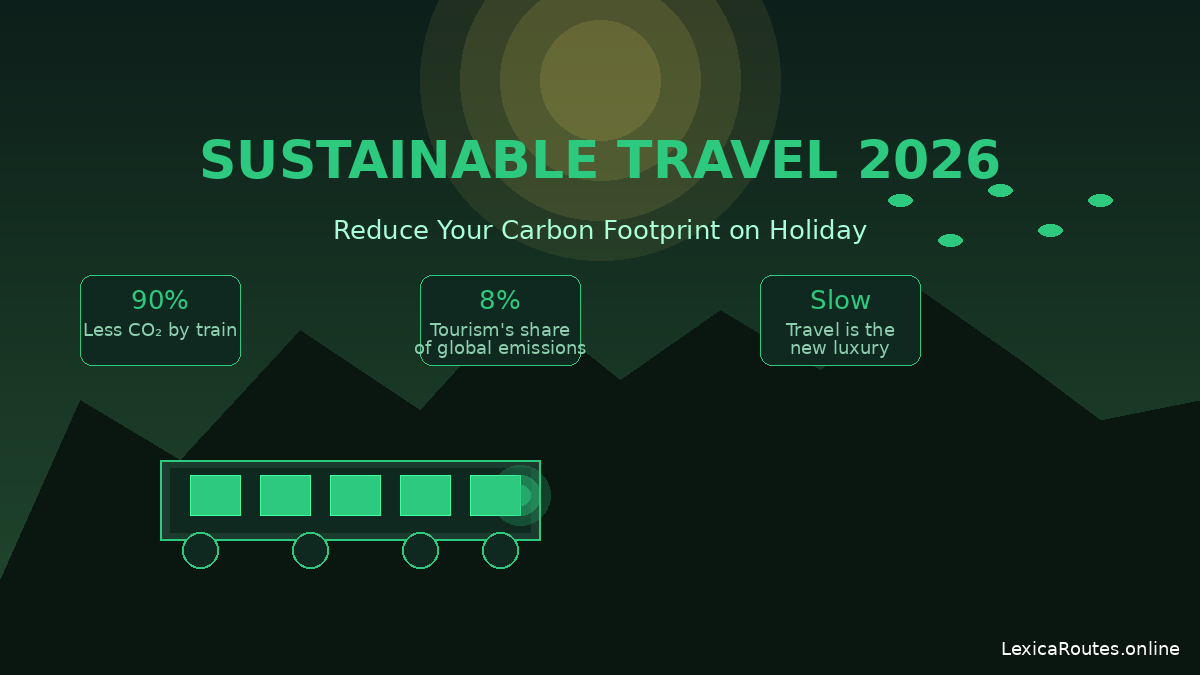
Planning a holiday in 2026? The good news is that sustainable travel carbon footprint reduction is no longer complicated or expensive. Tourism currently accounts for around 8% of the world’s total carbon emissions, and with global travel numbers at record highs, every choice you make now genuinely adds up. This guide walks you through the most impactful steps, starting with how you get there, where you sleep, what you eat, and how to offset what you cannot yet avoid. Whether you are hopping between cities in Europe or flying long-haul to Southeast Asia, there is a version of this that works for your trip.
What You Need to Know Before You Travel
The biggest myth about sustainable travel is that it demands serious sacrifice. It does not. Most of the changes with the highest environmental impact also tend to cost the same or less than the default option. The key is knowing which decisions actually move the needle and which are mostly marketing.
Tourism’s carbon output is driven by three things in roughly this order: how you get there, where you stay, and how long you stay. Swap just one of these smartly, and you make a meaningful difference. Change all three, and your trip goes from average to genuinely low-impact.
Step 1: Choose Your Transport Wisely
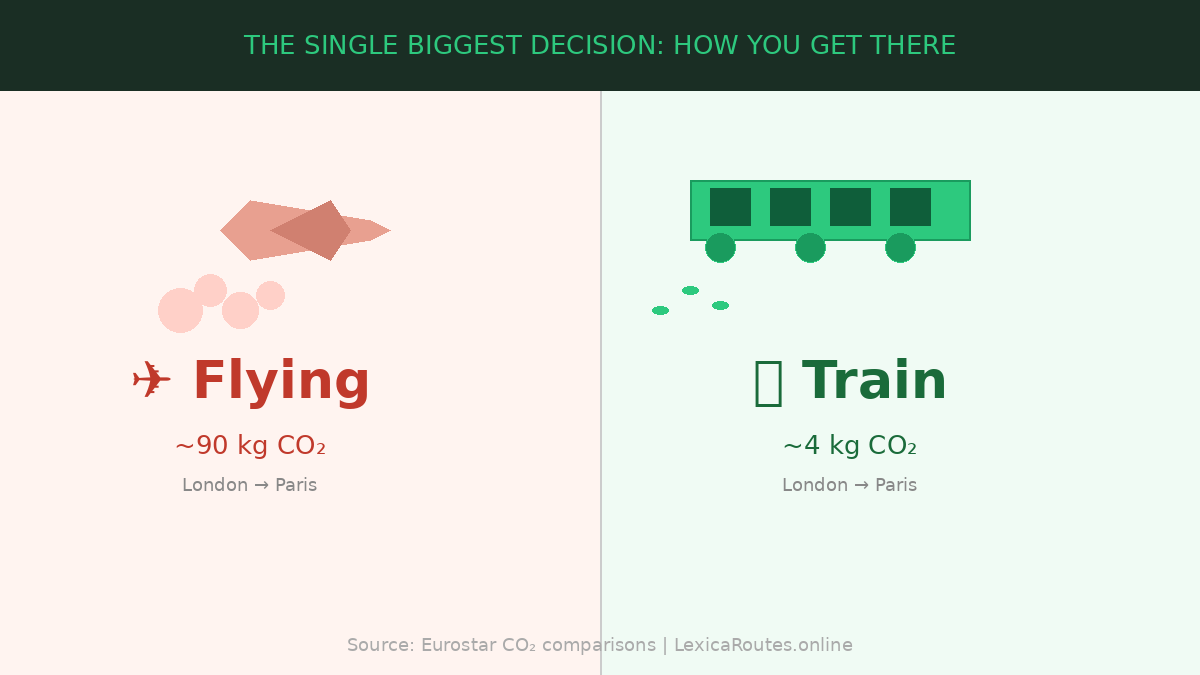
This is the single biggest decision you will make. Train travel produces around 80 to 90% less CO₂ per passenger than flying the equivalent route. The Eurostar from London to Paris, for example, produces roughly 4 kg of CO₂ per passenger. The same journey by plane generates close to 90 kg. That is not a rounding error; it is a 95% difference.
Where train travel is not an option, a few flying rules still apply. Direct flights are meaningfully greener than connecting ones because the majority of a flight’s emissions come from takeoff and landing, not cruising altitude. Economy class also distributes the carbon cost across more passengers, making it the greener choice regardless of what the in-flight magazine implies. In 2026, a growing number of major airlines are also offering Sustainable Aviation Fuel (SAF) options on key routes, and these are worth selecting where available.
Step 2: Stay Somewhere That Actually Earns Its Green Label
The accommodation industry has a greenwashing problem. Plenty of hotels put a card in the bathroom asking you to reuse your towel and call themselves eco-friendly. Genuinely sustainable properties go further: they can tell you their energy source, water consumption data, and waste management approach.
In 2026, look for certifications from the Global Sustainable Tourism Council (GSTC) or EarthCheck when booking. Independent and locally owned hotels and guesthouses typically have 40 to 50% lower carbon footprints than large chain properties, according to green travel platform IMPT, and they keep spending inside the local economy at the same time.
Two simple habits also make a difference once you arrive. Declining daily room cleaning during multi-night stays saves significant water and electricity. And opting for accommodation near a city centre or public transport hub often eliminates the need for hire cars and airport taxis, which are regularly the dirtiest legs of any trip.
Step 3: Slow Down and Stay Longer
Frequent short trips generate far more emissions than fewer longer ones. Five separate weekend trips to five cities produce more carbon than one two-week stay in a single destination, even if the total distance is similar, because each trip has its own travel-day emissions baked in.
The slow travel movement has grown significantly in 2026 as a result. Travellers are spending weeks in secondary cities and lesser-known regions rather than ticking off iconic spots on a rapid circuit. The Algarve in Portugal, the Laem Sak community in Thailand, and the hilltowns of inland Sicily are all seeing longer average stays precisely because people are learning to travel with more intention. The bonus is that you actually get to know a place rather than just photographing the front of it.
Step 4: Eat and Shop Like a Local
Food miles are a real but underestimated part of travel’s environmental cost. Dining at independent, farm-to-table restaurants uses ingredients that have not been flown across continents to reach your plate. Avoiding hotel buffets and chain restaurants in favour of family-run spots also keeps more money inside the community you are visiting.
The same logic applies to shopping. Buying directly from local artisans rather than airport gift shops supports real livelihoods and avoids the supply chain behind mass-produced souvenirs. By 2026, most popular travel destinations will have also introduced restrictions on single-use plastics, so bringing a reusable water bottle and tote bag is not just a good idea; in many places, it is practically required.
Step 5: Offset What You Cannot Yet Avoid
Reduction always beats offsetting, but carbon credits remain a useful tool for the emissions you cannot eliminate on a given trip. In 2026, the most credible offset projects carry a Core Carbon Principles (CCP) label, which guarantees independent verification of the claimed removal or reduction. Projects focused on actual carbon removal, such as reforestation schemes or Direct Air Capture technology, are preferable to those that only prevent future emissions.
You can calculate your trip’s estimated emissions and find verified offset projects through Sustainable Travel International. The cost is usually modest relative to the overall trip budget, and it funds work that would not otherwise happen.
Comparison Table
Quick-Reference: Sustainable Travel Steps at a Glance
| Step | Action | Impact Level | Estimated Time to Implement |
|---|---|---|---|
| 1. Transport | Choose the train over the plane where possible | Very High | At booking |
| 2. Accommodation | Book GSTC or EarthCheck-certified stays | High | At booking |
| 3. Length of stay | Fewer trips, longer stays | High | Trip planning stage |
| 4. Food and shopping | Eat local, buy from artisans | Medium | Daily habit on a trip |
| 5. Carbon offsetting | Use CCP-verified offset projects | Supplementary | After booking |
Final Verdict
Our take
Sustainable travel in 2026 does not ask you to stop exploring. It asks you to think one step earlier in the planning process. Choosing a train over a short-haul flight, booking a locally certified guesthouse, and staying long enough to genuinely see a place are decisions that each take minutes to make and carry a real environmental benefit. You do not need to nail all five steps at once. Start with transport, since that is where most of the impact lives, and build from there.
If you are ready to plan your next eco-conscious trip, read our guide to the best off-peak destinations in Europe for summer 2026, where slow travel and lighter footprints come as standard.
FAQ Section
Frequently asked questions
How much does sustainable travel actually reduce my carbon footprint?
The biggest single action is choosing a train over a short-haul flight, which cuts transport emissions by up to 90% on routes where both options exist. Combining low-carbon transport, certified accommodation, and longer stays can reduce a typical European trip’s footprint by more than half compared to a conventional itinerary.
Is sustainable travel more expensive in 2026?
Not usually. Train fares on many European routes are competitive with or cheaper than equivalent flights once baggage fees are included. Locally owned accommodation is often priced below chain hotels, and eating at independent restaurants typically costs less than tourist-facing chains. The eco-friendly option is frequently the budget-friendly one too.
What certifications should I look for when booking a green hotel?
The most credible labels in 2026 are the Global Sustainable Tourism Council (GSTC) certification and EarthCheck accreditation. Both require properties to provide verifiable data on energy use, water management, and waste practices rather than simply making general environmental claims.
Does flying economy really make a difference compared to business class?
Yes, meaningfully so. Economy class spreads the flight’s total carbon output across more passengers. A business or first-class seat uses roughly two to three times more floor space and allocated fuel per person than an economy seat on the same aircraft, making economy the lower-emission choice even on long-haul routes.
How do I find legitimate carbon offset projects in 2026?
Look for projects that carry a Core Carbon Principles (CCP) label, issued by the Integrity Council for the Voluntary Carbon Market. This certification confirms that the claimed carbon removal or reduction has been independently verified. Sustainable Travel International offers a free flight calculator and a curated list of CCP-certified projects.