Study Abroad Is Booming: 8 Million Students Go Global in 2026
If you have been thinking about studying abroad, you are joining the largest wave of globally mobile students in recorded history. According to UNESCO’s 2026 higher education report, released May 12, 2026, nearly 7.3 million students are currently studying outside their home country. That figure is set to climb to 9 million by 2030.
Just two decades ago, around 2.5 million students were crossing borders for education. Today, that number has nearly tripled, driven by a post-pandemic surge, rising middle classes in Asia, and countries competing harder than ever to attract international talent.
Key Facts
| What | Detail |
|---|---|
| What happened | UNESCO released its 2026 Global Higher Education Report, showing 7.3 million students are currently studying abroad worldwide |
| Who is affected | Students considering international education, universities, governments, and education agents globally |
| When it takes effect | Data covers the 2024 academic year; projections run to 2030 (9 million students) |
| Where to get more info | UNESCO’s international education dataset via UNESCO Institute for Statistics and Our World in Data |
| What it means | A record number of slots, scholarships, and post-study work pathways are opening up for international students right now |
Why Numbers Are Surging Right Now
The post-COVID rebound has been faster than most analysts predicted. The study abroad sector saw a 49% jump in U.S. student participation since the pandemic, surpassing pre-pandemic highs. And the U.S. is just one piece of a much larger picture.
Asia continues to be the biggest engine of growth. Approximately 1.8 million Indian students were studying overseas as of 2025, making India one of the world’s largest sources of outbound students. China, Bangladesh, and Vietnam have all posted steep increases in recent years, fuelled by rapidly expanding middle classes and the recognition that a degree from an internationally recognised institution still carries a strong career premium.
What has changed in 2026 compared to earlier years is that students are far more strategic. They are not just chasing prestige. They are chasing post-study work rights, affordable tuition, and quality of life.
The Destinations Winning the Race
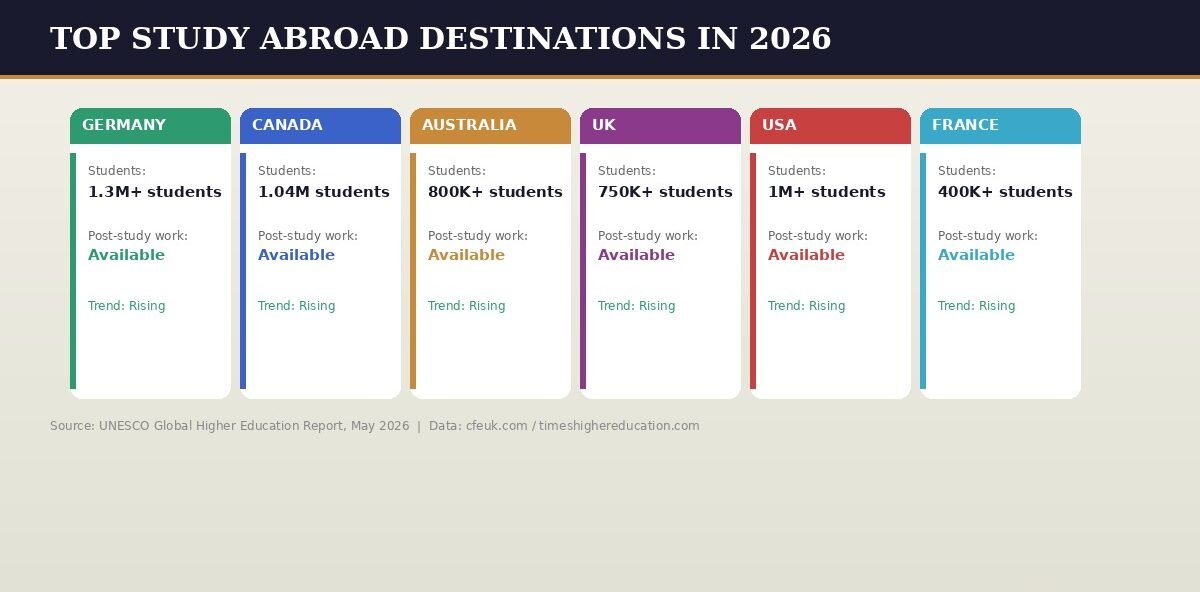
Countries offering clear post-study work pathways are seeing the biggest enrollment gains. Germany, Canada, Australia, the Netherlands, and Ireland have all emerged as front-runners because they combine manageable visa processes with realistic long-term residency routes.
Meanwhile, the US and UK remain dominant by sheer volume. The US hosted over 1 million international students in the most recent academic year. But both countries are feeling competitive pressure as students increasingly weigh political climate and visa unpredictability alongside academic reputation.
Emerging destinations are also gaining ground. Japan has invested heavily in attracting foreign students, targeting 300,000 international enrollments. Malaysia has built a reputation as an affordable English-medium hub for students from across Southeast Asia and beyond.
What Still Needs to Change
UNESCO’s report is not all good news. It specifically calls out that fewer than 3% of the world’s higher education students study abroad, meaning that access remains deeply unequal. Financial barriers, visa complexity, and the difficulty of getting qualifications recognised across borders continue to lock out millions of students who would otherwise go global.
Refugee students face particularly steep obstacles. While enrollment of refugee students in higher education rose from 1% in 2019 to 9% in 2025, UNESCO notes that structural barriers remain significant. This is a gain worth acknowledging while being clear-eyed about how much ground is still to cover.
Cost is also a live issue. A 2025 survey found that only 12% of students reported their study abroad experience was covered within regular tuition fees, underscoring how out-of-pocket costs continue to limit participation among lower-income families.
What This Means for Students in 2026
If you are weighing a study abroad decision right now, the market has never offered more options. Universities are actively competing for international students with scholarships, pathway programs, and English-taught degrees across an increasingly wide range of countries and disciplines. Short-term and hybrid programs are also growing, giving students who cannot commit to a full semester a way to still build international experience.
The competition for spots at the top destinations is also real. Application volumes are rising alongside enrollment, so waiting is not a strategy. If you have been thinking about it, 2026 is a reasonable year to act.
Final Verdict
The study abroad boom is real, it is accelerating, and it is reshaping who gets to compete in the global job market. The UNESCO data points toward 9 million internationally mobile students by 2030, and the countries, universities, and students positioning themselves now will be best placed to benefit. Access remains unequal, costs remain a genuine barrier, and visa policy continues to shift in ways that reward those who stay informed.
Frequently Asked Questions
How many students are studying abroad in 2026?
Nearly 7.3 million students are currently studying outside their home country, according to UNESCO’s May 2026 Global Higher Education Report. This figure is expected to reach 9 million by 2030, continuing a trend that has seen international student numbers triple over the past two decades.
Which countries are the most popular study abroad destinations in 2026?
The US, UK, France, Germany, Canada, and Australia remain the largest destinations by volume. Germany, Canada, and Ireland have seen the fastest growth recently, largely because they offer accessible visa processes and clear post-study work rights, which are now a top priority for students choosing where to go.
Is studying abroad in Germany free for international students in 2026?
Public universities in Germany charge little to no tuition fees for undergraduate programs at most state institutions, even for international students. Living costs and administrative fees still apply, but Germany remains one of the most affordable high-quality study destinations in the world for students who qualify for admission.
What is driving the surge in international student numbers?
The growth is driven by a combination of factors: post-pandemic rebound, a rising middle class in Asia (particularly India and China), expanding post-study work rights in competitive destination countries, and universities actively marketing English-taught programs to global audiences. Short-term and hybrid formats are also bringing in students who cannot commit to full-year programs.
What are the biggest barriers to studying abroad in 2026?
Cost remains the single biggest barrier, with only 12% of students reporting that study abroad was covered within their regular tuition. Visa complexity, lack of qualification recognition across borders, and limited support for students from low-income or conflict-affected backgrounds are also significant obstacles that UNESCO explicitly flags in its 2026 report.