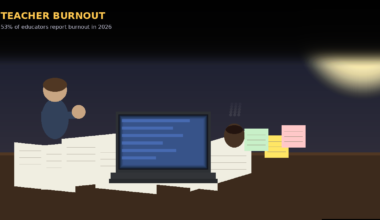
Teachers today face a near-impossible workload. According to the OECD TALIS survey, educators work an average of 54 hours per week, and less than half of that time is spent actually teaching. The rest disappears into grading, lesson planning, parent emails, and admin. AI in education 2026 is changing that equation in concrete, measurable ways. This article breaks down exactly how teachers at every level are using artificial intelligence right now, which tools are doing the real work, and what the numbers actually say.
1. Lesson Planning in Minutes, Not Hours
Creating a single lesson used to take anywhere from 45 minutes to two hours. Teachers had to research the topic, align it to standards, write objectives, design activities, and differentiate for multiple learning levels. AI tools have collapsed that process dramatically.
Platforms like MagicSchool AI, trusted by more than 1.5 million educators worldwide, allow teachers to generate a full, standards-aligned lesson plan in under five minutes. A teacher inputs the grade level, subject, learning objective, time available, and student needs. The tool returns a complete sequence including direct instruction, guided practice, independent tasks, checks for understanding, and an exit ticket. Tools like Nearpod go a step further by turning uploaded content into interactive slide-based lessons with formative assessments built in.
The practical effect is real: teachers report saving between five and ten hours per week when using AI for planning and prep. That time goes back into the classroom, where it belongs.
2. Automated Grading and Feedback
Grading is where AI is making the biggest dent in teacher workload. A 2025 Gallup study commissioned by the Walton Family Foundation, which surveyed more than 2,200 US public school teachers, found that three in ten teachers now use AI grading tools at least weekly, saving an estimated 5.9 hours per week. Across a 28-week school year, that adds up to roughly six full working weeks reclaimed.
Specialist tools like CoGrader connect directly to Google Classroom and Canvas. Teachers select a class and assignment, and CoGrader imports all submissions automatically, evaluates each one against the selected rubric, and returns a suggested grade with detailed inline feedback. CoGrader reports up to 80 percent reduction in grading time. Gradescope handles a wider range of assignment types, including handwritten work, coding submissions, and bubble-sheet exams, making it popular in higher education and large K-12 classes.
Crucially, the teacher reviews everything before it reaches students. AI handles the mechanical first pass; the professional judgment stays with the educator.
3. Personalised Learning at Scale
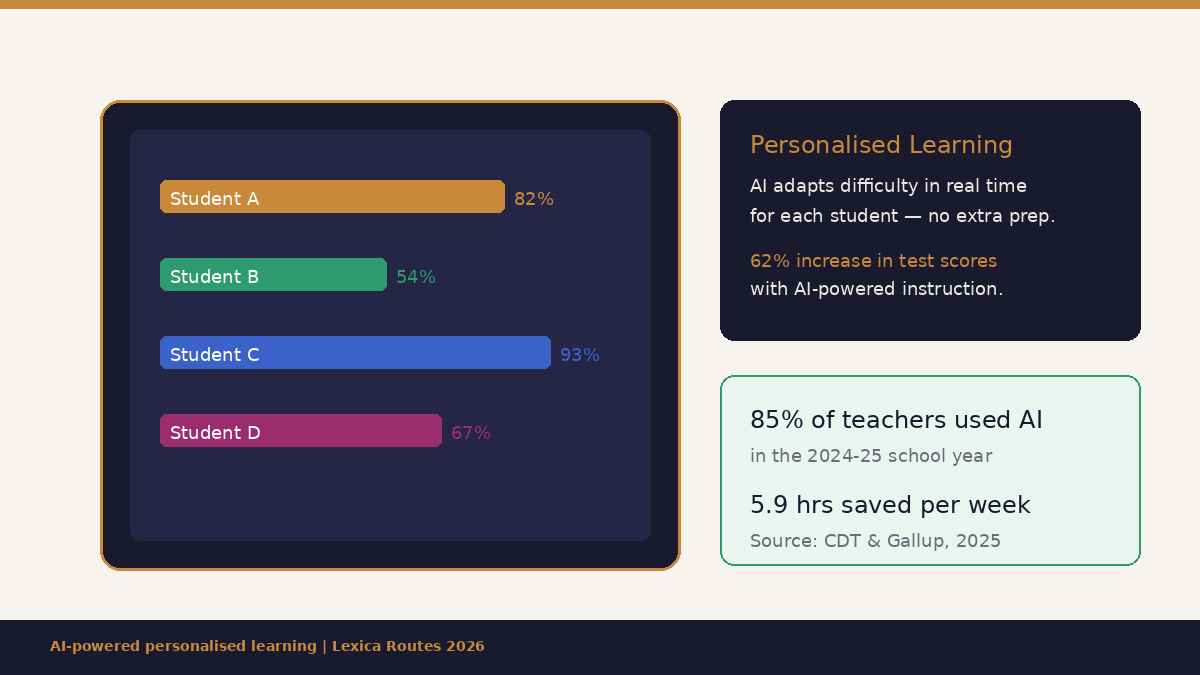
One of AI’s clearest advantages is its ability to adapt content to individual students in real time. By 2026, AI systems can analyse student responses continuously, identify specific learning gaps, and adjust content difficulty on the fly, without requiring teachers to create separate lesson versions for each learner.
A student who is ahead in geometry gets logic-based extension problems. A student still working on angle basics gets targeted practice on that exact skill. Both students are in the same class, receiving differentiated instruction simultaneously. An AIPRM report on US students found a 62 percent increase in test scores among those using AI-powered instruction systems, attributed primarily to this kind of personalised delivery. For teachers in large or under-resourced classrooms, this scalability is significant. A single well-equipped educator can now support a much wider range of learning needs than was previously manageable.
4. AI Tutoring Outside Class Hours
Students who need additional help have historically had limited options once school ends. AI tutoring tools are filling that gap. Third Space Learning’s Skye, for example, is a conversational AI math tutor built for elementary and high school students that allows learners to ask questions, request explanations, and work through problems at their own pace, after hours and at no extra cost to families.
Broader tools like ChatGPT and Google Gemini are also being used directly by students for revision, concept clarification, and writing support. Research from the Center for Democracy and Technology, published in October 2025, found that 86 percent of students used AI tools during the preceding school year. The challenge schools are actively navigating is the distinction between AI that supports thinking and AI that replaces it. That line is now central to education policy in 2026.
5. Professional Development for Teachers
AI is not only changing what happens in the classroom. It is reshaping how teachers grow professionally. School leaders are increasingly using AI platforms to personalise professional development based on each teacher’s needs, goals, and teaching style.
IRIS Connect, an instructional coaching platform, now includes AI features that analyse recorded lessons and suggest targeted areas for development. Newly qualified teachers are using AI to reflect on lessons and receive structured improvement suggestions. The American Federation of Teachers has launched the National Academy for AI Instruction, providing educators with vetted, safe AI curricula. Google and ISTE+ASCD have jointly released free Gemini AI training to help teachers build rubrics and differentiate materials. The shift is from one-size-fits-all professional development toward coaching that adapts to the individual teacher, the same principle being applied to students.
6. Differentiated Materials Without Extra Prep Time
Differentiation has always been one of teaching’s most demanding requirements. Producing three versions of the same reading passage, or creating extension tasks for advanced learners while preparing support materials for others, can double a teacher’s planning time. AI handles this in seconds.
Teachers can prompt tools like ChatGPT or Claude to rewrite a passage at three reading levels, generate additional practice questions for students who need reinforcement, or add enrichment challenges for those who finish early. The key is specificity in the prompt: a request that includes grade level, standard, student needs, time available, and desired format produces genuinely usable output. Vague prompts produce generic results. Teachers who have refined their prompting approach report that differentiation, once one of the most time-consuming parts of their week, now takes minutes rather than hours.
7. Academic Integrity and AI Detection
As student use of generative AI has grown, so has the importance of tools that help teachers understand how assignments were produced. Turnitin’s Feedback Studio remains the most widely used platform for academic integrity at the secondary and higher education level, adding AI content detection alongside its established plagiarism-checking capabilities. GPTZero, originally built as an AI detection tool, has expanded to include grading functionality, giving teachers both detection and assessment in one workflow.
Schools are also taking a structural approach, redesigning assignments so that AI assistance becomes less relevant to the core assessment. Faculty are being trained not just to detect AI use but to build assessments that require genuine thinking that AI cannot substitute for. The central question for education policy in 2026 is not whether students use AI. It is how schools verify that real learning happened.
AI in Education 2026: How the Tools Compare
| Tool | Primary Use | Best For | Free Tier |
|---|---|---|---|
| MagicSchool AI | Lesson planning, admin | All-subject teachers | Yes |
| CoGrader | Essay grading, feedback | English and humanities | Yes (limited) |
| Gradescope | Mixed-format grading | Large classes, higher ed | Yes (limited) |
| Nearpod | Interactive lessons | Hybrid and blended learning | Yes |
| Turnitin | Academic integrity | Secondary and university | No (institutional) |
| Third Space Learning Skye | AI math tutoring | Elementary and high school | School-licensed |
| ChatGPT / Claude | General planning, drafting | All use cases | Yes |
Final verdict
AI in education in 2026 is no longer experimental. It is in classrooms, grading queues, professional development sessions, and after-school tutoring. The data is clear: teachers who adopt the right tools are saving close to six hours per week, and students using AI-supported instruction are showing measurable gains. The tools work best when teachers stay in control, use AI for the mechanical and repetitive tasks, and reserve their judgment for the decisions that require human insight.
The risk is not AI replacing teachers. The risk is deploying it without a clear framework for where human judgment must remain central. Schools that have answered that question are already seeing the benefits.
Frequently asked questions
How is AI being used in education in 2026?
Teachers are using AI for lesson planning, automated grading, personalised learning, student tutoring, differentiated materials, professional development, and academic integrity detection. The most common tools include MagicSchool AI, CoGrader, Gradescope, and Nearpod.
How much time does AI save teachers each week?
A 2025 Gallup study found that teachers who use AI tools at least weekly save an estimated 5.9 hours per week. Over a 28-week school year, that equates to roughly six full working weeks reclaimed for instruction and student support.
Is AI replacing teachers in 2026?
No. AI handles repetitive and administrative tasks such as grading, drafting feedback, and generating lesson materials. Teachers continue to provide professional judgment, human connection, emotional support, and instructional decision-making that AI cannot replicate.
What is the best AI tool for teachers in 2026?
The best choice depends on your primary need. MagicSchool AI is the most versatile option for lesson planning and admin. CoGrader is the strongest for essay grading. Gradescope suits large classes with mixed assignment formats. ChatGPT works well as a general drafting and planning tool.
How many teachers are using AI in 2026?
According to an October 2025 report by the Center for Democracy and Technology, 85 percent of teachers used AI tools during the 2024-2025 school year. Three in ten US public school teachers now use AI at least weekly, according to a separate Gallup survey.